Welcome to Our Travel Agency!



On May 17, 2026, the International Mountain Tourism Alliance (IMTA) announced, as a supporting organization of the 2026 China International Camping Conference, the official launch of the ‘China Camping Equipment UIAA Adaptation Program’. This marks the first systematic alignment in China’s outdoor cultural and tourism equipment manufacturing sector with the world’s most authoritative safety certification system for mountaineering and outdoor equipment—the standards of the International Climbing and Mountaineering Federation (UIAA), and will have a structural impact on the export-oriented outdoor industry chain.
Event Overview
As a supporting organization of the 2026 China International Camping Conference, the International Mountain Tourism Alliance (IMTA) announced the launch of the ‘China Camping Equipment UIAA Adaptation Program’, with the first batch of 17 Chinese manufacturers selected to participate in testing and certification. UIAA certification is a rigid market-entry threshold for the high-end outdoor markets in Europe and North America, and this move will accelerate the leap of China’s cultural and tourism equipment manufacturing exports toward higher value-added segments.
Which Sub-sectors Will Be Affected
Direct Trading Enterprises
Exporters of outdoor products serving high-end channels in the EU, Switzerland, the UK, and North America will directly benefit from the certification synergy effect. UIAA certification is currently the mandatory technical endorsement required by buyers such as Germany’s Deuter, France’s Quechua high-end line, and the private-label brand of the United States’ REI; uncertified products face restrictions when being listed in mainstream outdoor retail chain channels. Certification adaptation will shorten their compliance market-entry cycle and reduce the costs of third-party inspection and repeated testing.
Raw Material Procurement Enterprises
Suppliers of key materials such as high-performance nylon 66, high-strength textured DTY yarn, flame-retardant coated base fabric, and lightweight aluminum alloy tubing will face stricter requirements for batch consistency and traceability. UIAA testing items cover low-temperature tear resistance of materials, strength retention after UV aging, and static load at welded/stitched joints, among others, forcing upstream suppliers to provide material certification documents compliant with composite standards such as EN ISO 13934-1 and UIAA 123, while some small and medium-sized raw material suppliers will need to restructure their quality inspection processes.
Processing and Manufacturing Enterprises
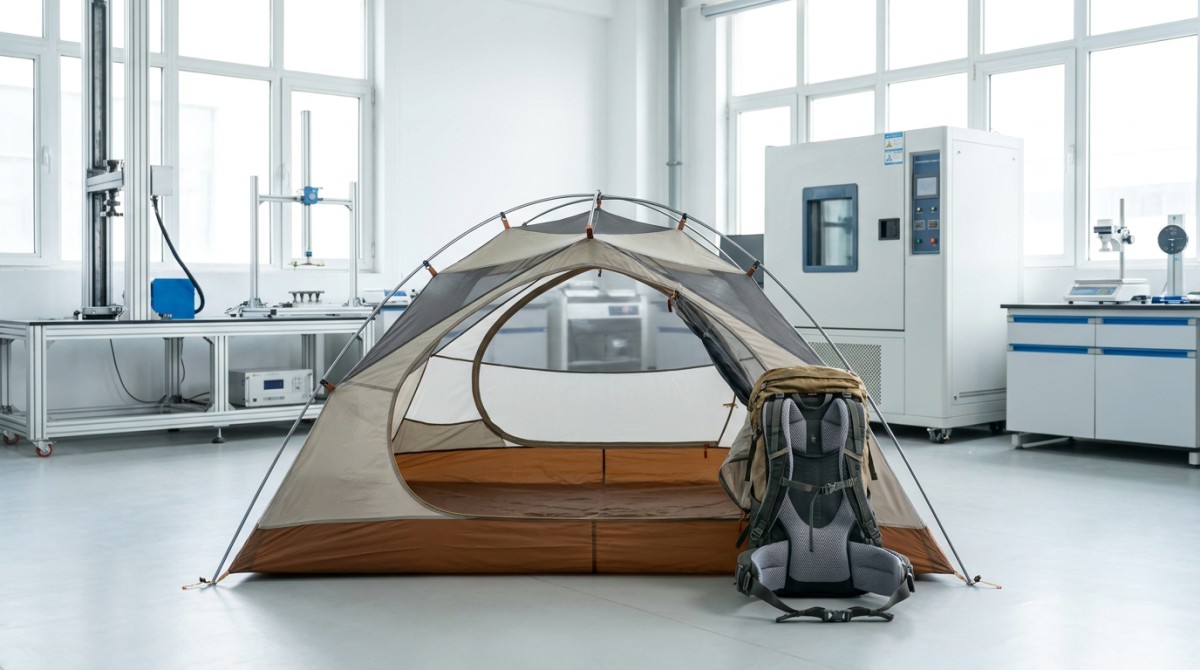
The 17 manufacturers selected in the first batch will enter a 12–18 month stage of UIAA laboratory submission testing and factory audit, involving structural design verification (such as tent wind-pressure simulation), repeated ergonomic testing (such as dynamic load-bearing of backpack suspension systems), and multilingual compliance for labels and manuals. Although unselected enterprises are not yet under mandatory obligation, leading contract manufacturers have already seen a trend of customers requesting ‘pre-inspection according to UIAA draft standards’ in advance, and quality control granularity on the manufacturing side is being upgraded from ‘meeting national standards’ to ‘being verifiable under UIAA’.
Supply Chain Service Enterprises
Business demand is rising significantly for third-party testing institutions focused on the outdoor sector (such as SGS outdoor programs and CTI outdoor laboratories), certification consulting service providers, multilingual technical document translation companies, and localization audit coordinators with UIAA authorization qualifications. In particular, UIAA does not accept purely remote audits and requires on-site observation of production beats and process records at factories, creating new scenarios for cross-time-zone coordinated audit services.
Key Focus Areas and Response Measures for Relevant Enterprises or Practitioners
Prioritize Identifying Product Categories Covered by the Core UIAA Certification Catalog
At present, mandatory UIAA certification covers 12 categories of products including tents, backpacks, sleeping bags, climbing ropes, carabiners, quickdraws, and headlamps; among them, the first 5 categories are frequently involved in camping scenarios. Enterprises should compare whether their main products fall within the scope of current standards such as UIAA 105 (tents), UIAA 109 (backpacks), and UIAA 112 (sleeping bags), so as to avoid investing resources in non-mandatory categories.
Simultaneously Launch Bilingual Standardization of Technical Documentation
UIAA certification requires that manuals, warning labels, and material lists all be provided in German and English bilingual versions, and terminology must be consistent with the UIAA Glossary (for example, ‘pole sleeve’ cannot be translated as ‘杆套’ but must use ‘pole pocket’). Enterprises should immediately sort through existing technical documents and entrust translation teams with EN/DE bilingual outdoor engineering backgrounds to jointly build a terminology database.
Reserve at Least 15% of Production Capacity for Iteration of Certification Samples
UIAA test failures commonly occur in details such as insufficient stitch density, inadequate coating adhesion, and metal parts exceeding salt spray test limits. Historical data show that the first-inspection pass rate is only 41% (2023 UIAA Asia submission testing annual report), with an average of 2.3 rounds of sample correction required. Manufacturing enterprises need to separately allocate ‘dedicated certification capacity’ in production scheduling plans to avoid delivery conflicts caused by mixing such work with regular orders.
Editor’s Viewpoint / Industry Observation
Observably, this is not merely a certification alignment initiative but a strategic infrastructure upgrade for China’s outdoor manufacturing value chain. Unlike past CE or ISO certifications that focus on factory systems or basic safety, UIAA standards are performance-based and scenario-driven — e.g., testing tent stability under 60km/h crosswinds, or backpack frame fatigue after 10,000 cycles of 25kg dynamic load. Analysis shows the real bottleneck lies not in R&D capability, but in traceability maturity: 68% of initial failures in 2024 pilot tests were linked to unlogged material lot numbers or undocumented process parameter deviations. Therefore, the ‘UIAA adaptation’ is better understood as a catalyst for digital quality management adoption among mid-tier manufacturers.
Conclusion
This adaptation program is not simply about obtaining a certificate, but a key institutional interface driving Chinese outdoor equipment to leap from ‘usable’ to ‘trustworthy’. Its long-term value lies not in short-term export growth, but in forcing the entire chain to establish a technical response mechanism anchored in real usage scenarios. Rationally speaking, this marks that China’s outdoor industry is shifting from a phase driven by cost and scale to a new stage driven by standards coordination and trust co-building.
Statement on Information Sources
Announcement on the official website of the International Mountain Tourism Alliance (IMTA) (released on May 17, 2026); UIAA official website, “Certification Rules v.4.2” (revised edition of March 2025); China National Textile and Apparel Council, “Technical Guide for Outdoor Products Export (2025)”. Note: Details such as the UIAA certification fee structure, the expansion progress of designated domestic laboratories, and the timetable for selecting the second batch of manufacturers are pending subsequent disclosure by IMTA, and will continue to be tracked.
Your 1:1 travel consultant will respond within 1 business day
How to plan your trip
- Hebei Launches Five “Trendy Hebei” Premium Tourism Routes for Inbound Travelers, Moving Toward Standardized Offerings
- The 12th Qionghai Tanmen Coastal Foraging Festival Opens on August 16
- Guangxi’s Digital Silk Road Accelerates: Orah Mandarin Juice Secures an Italian Order, Drawing Attention to Export Standards for Souvenirs
- New Inquiry Triggered by Coastal Cultural Tourism Space Standards
- Zhuanghe’s agro-cultural tourism model draws ASEAN attention, highlighting the compliance requirements for the internationalization of camping and intangible cultural heritage handicrafts
Monthly travel guide
- Typhoon “White Dolphin” Forces Henan Scenic Areas to Close, Putting Summer Ground-Handling Services Under Pressure
- RCEP Implementing Rules for Indonesia Take Effect: Zero Tariffs for Cultural and Tourism Services Alongside Strict Customer Service Requirements
- Saudi Arabia’s New SASO Regulations Take Effect: Taqat Certification Required Before Chinese-Language Cultural Tourism Services Can Access Visit Saudi
- Zhengzhou Launches a Dedicated LCL Shipping Route for Cultural and Tourism Materials, Cutting Freight Costs by 18%
- Luoyang Cold Chain Intensification: Cultural and Creative Exports Delivered in 9 Days
- Expedited Pre-Approval for Group Visas to Three Southeast Asian Countries
- Tightening air freight capacity at Zhengzhou Airport delays the delivery of cultural and tourism materials
- Vietnam's New Regulations on Bus Monitoring Requirements for Group Tours
- Saudi SAMA New Regulations on Travel Liability Insurance Compliance Preparation
- Japanese tourists' new regulations for entering Henan local transport vehicles
- Wai Gao Qiao Wen Travel customs bonded warehouse summer group equipment fast lane
- JTB Warning: Risks in Henan’s September Red Leaf Family Tour Purchases
Popular destinations
- The China-Europe Railway Express (Zhengzhou) Launches a Dedicated Train for Culture and Tourism Equipment, Cutting Customs Clearance Time to 48 Hours
- RCEP Cultural and Tourism Services Commitment Upgrade: Faster Market Access for Chinese Outbound Tourism Service Providers in Vietnam and Malaysia
- Tourism Authority of Thailand Launches “China Ready” Certification Program, with Henan Inbound Travel Service Providers Included in the First Batch of Recommended Providers
- Thailand Tourism Authority Promotes “China Ready” Certification, with a Henan Local Tour Operator Included in the First Recommended List
- Overseas Chinese Fair Opens in Shenzhen: Smart Culture and Tourism Equipment and Culinary Tourism Services Go Global on Two Fronts
Why choose us

High cost-performance and transparent experience
Offer astonishing low prices without hidden tourism traps, enabling travelers to explore at lower costs while avoiding unnecessary spending loopholes, ensuring transparent consumption.

Personalization and dedicated service
Support 100% free customization, paired with one-on-one expert service, crafting exclusive itineraries based on travelers' specific needs, while providing professional guidance to enhance the personalization and professionalism of the journey.

Premium itinerary planning
Compact yet rich itineraries allow travelers to experience more within limited time; simultaneously, carefully selected hotels in prime locations provide convenient lodging conditions, overall enhancing travel comfort and experience.