Welcome to Our Travel Agency!




Travel Guide
How Do You Verify a Coach Operator’s Credentials for a Henan Business Group?
How do we verify a coach operator's credentials for a Henan business group? A competitive quote is only the starting point. Confirming operator licensing, vehicle documentation, driver qualifications, and insurance helps reduce safety risks and avoid disruption. Whether your itinerary connects meetings in Zhengzhou with cultural visits to Luoyang or Kaifeng, reliable transport requires checks beyond a polished brochure.
The practical answer is to verify the business, the assigned coach, and the assigned driver as connected parts of one booking. A legitimate company can still propose an unsuitable vehicle. A well-maintained coach can still arrive with an unverified substitute driver. Your approval should therefore cover the actual transport arrangement, not simply the supplier’s name.
Establish who will actually operate the coach
Start with a direct question: “Are you the licensed passenger transport operator, or are you arranging transport through another company?” Both arrangements can be workable, but the responsibilities must be clear. A travel agency’s credentials do not replace those of the carrier operating the vehicle.
Request the carrier’s registered legal name, unified social credit code, business license, and road transport operating permit. Check that the permitted business scope covers the proposed passenger transport service. A business license alone establishes neither the suitability of a coach nor authorization for every type of commercial transport.
Use China’s National Enterprise Credit Information Publicity System to cross-check the legal entity and registration status. Transport permissions require a separate check through the relevant transport authority or an available official verification service. If an online record is unavailable, seek confirmation from the issuing authority using independently obtained contact details.
For an overseas procurement team, request a short English summary alongside the original documents. Verify the original legal name and registration identifiers rather than relying on an English trading name, which may vary between quotations, websites, and invoices.
Build a document trail that matches the assigned vehicle
A supplier may initially quote a vehicle category before allocating a specific coach. That is different from refusing to identify the vehicle. Agree on a deadline for receiving the registration plate and vehicle documents, with time to resolve discrepancies before departure.
The core file should include the vehicle registration document, road transport certificate, current inspection evidence, and relevant insurance documentation. Ask whether any charter-specific documentation is required for the itinerary and how it will be provided. Requirements can depend on the service and route; confirm current applicability with the responsible transport authority rather than assuming one document covers every journey.
- Match identifiers: the plate number should agree across vehicle, transport, and insurance records. Check the vehicle identification number where necessary.
- Check dates: documents must remain valid throughout the service period, not merely on the quotation date.
- Reconcile ownership: if the registered owner differs from the carrier, request an explanation and evidence of the lawful operating arrangement.
- Confirm capacity: establish passenger seats available after accounting for the driver, guide, and any accompanying staff.
Document discrepancies are reasons to investigate, not automatic proof of misconduct. An unexplained plate mismatch, however, should prevent approval until resolved.
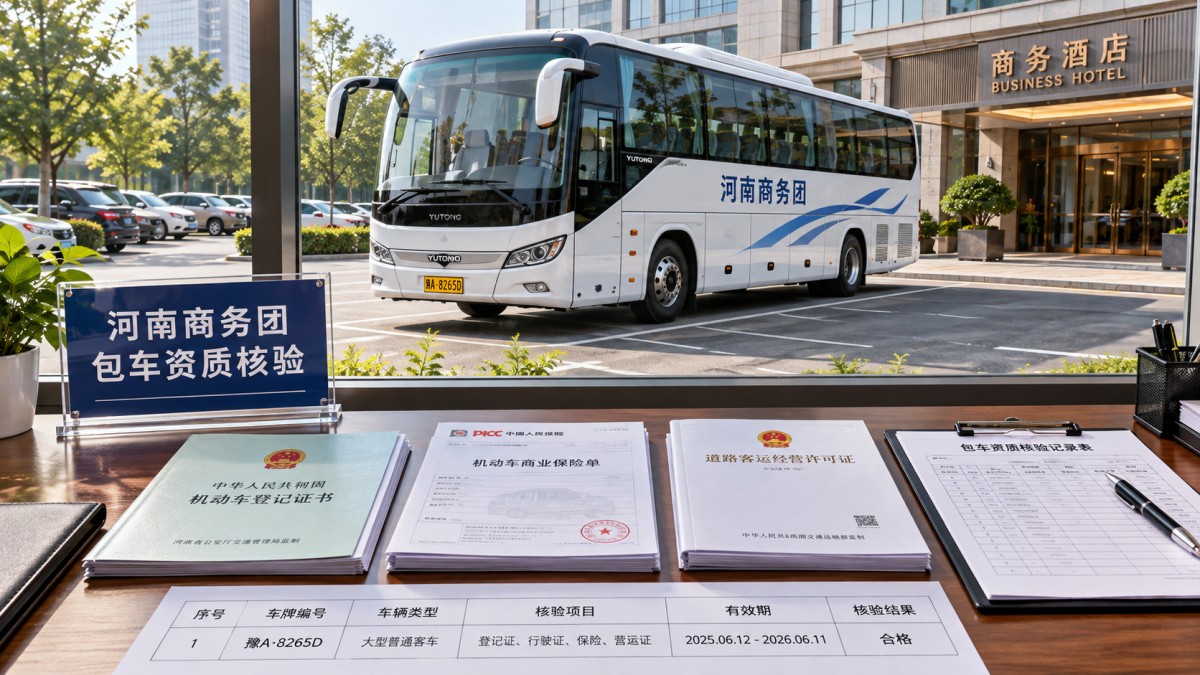
Keep a simple verification record showing each document, its identifier, validity period, checking method, and reviewer. Store personal documents securely and limit access. The purpose is to retain enough evidence for an accountable decision, not to circulate drivers’ personal information across a large email group.
Verify the driver—and the proposed working day
Request confirmation of the assigned driver’s identity, driving license with the appropriate vehicle entitlement, and the applicable commercial passenger transport qualification. Check validity and consistency with the proposed coach. Where available, use official qualification verification channels; otherwise ask the carrier how the records can be independently confirmed.
Qualifications establish eligibility, but they do not answer whether the duty schedule is safe. A morning airport pickup, meetings in Zhengzhou, a Shaolin Temple visit, and an evening transfer to Luoyang can create a demanding day once waiting, repositioning, and traffic are included.
Ask the operator to explain the full duty plan, including work before your pickup, planned breaks, overnight arrangements, and whether relief staffing is needed. Applicable driving and rest requirements should be checked against current rules for the service. Do not accept an itinerary built on the assumption that a driver’s waiting time always equals adequate rest.
For international groups, also establish the communication arrangement. A professional driver need not be an English-speaking guide. A bilingual coordinator can manage pickup instructions and itinerary changes while allowing the driver to concentrate on driving.
Read insurance as coverage, not as a certificate
“Fully insured” is too vague for corporate approval. Request the policy schedule or other verifiable evidence showing the insurer, insured party, covered vehicle or fleet, policy period, coverage limits, and relevant exclusions.
Distinguish compulsory motor liability cover from carrier liability cover and any additional commercial insurance. These serve different purposes. Passenger travel accident insurance is another separate layer and should not be treated as a substitute for the carrier’s required protection.
Check whether the stated use matches commercial passenger carriage and whether the proposed journey falls within the policy’s scope. Ask how limits apply: per person, per incident, or across a policy period. For a corporate group, the adequacy of those limits should also be assessed against your organization’s travel risk requirements.
If wording is unclear, obtain clarification from the insurer through independently verified contact channels. A supplier’s verbal explanation cannot broaden a policy’s actual coverage. Record the claims contact and reporting procedure before departure, when there is still time to clarify them.
Check operational readiness for the Henan itinerary
Paperwork cannot tell you whether luggage will block an aisle or whether the planned drop-off is accessible to a full-size coach. Review the route with the operator, including hotel entrances, meeting venues, attraction parking, transfer points, and seasonal access restrictions.
A Zhengzhou–Shaolin Temple–Longmen Grottoes itinerary needs realistic boarding and parking allowances. A mountain excursion requires a separate discussion of road suitability and local shuttle arrangements. The itinerary designer and transport dispatcher should agree on what the booked coach can actually deliver.
Request recent maintenance information and confirmation of pre-departure checks. At boarding, verify that the vehicle matches the approved plate and that seat belts, exits, luggage storage, and required emergency equipment appear accessible and serviceable. This visual check complements professional inspection; it does not replace it.
Seat count is not the same as usable capacity. Airport groups carrying large suitcases, exhibition materials, or mobility aids may need more luggage space than the quoted coach provides. Resolve that during planning, not beside the terminal.
Put substitutions and accountability into the contract
Credential checks lose much of their value if the supplier can replace the coach or driver without notice. The contract should identify the service requirements and set out how substitutions are proposed, documented, and approved.
Include a requirement that replacement vehicles and drivers meet the same verification standard. Where allocation is not final at signing, define the confirmation deadline and the minimum acceptable specification. “Equivalent coach” should address capacity, luggage space, operating eligibility, and agreed facilities—not simply appearance.
Also clarify breakdown support, emergency contacts, responsibility for replacement transport costs, cancellation terms, and handling of service failures. Ask where backup support would come from along the actual route. A general promise of assistance is less useful than a named dispatcher with a workable escalation process.
Keep the commercial terms equally clear: parking, tolls, driver accommodation, overtime, and additional transfers should be addressed. Ambiguous pricing can encourage rushed decisions or disputes when meetings run late.
Know when to pause approval
An unusually low price deserves questions, but price alone does not establish risk. More serious warning signs include refusal to name the actual carrier, expired documents, insurance evidence that cannot be linked to the proposed service, and pressure to accept unexplained last-minute substitutions.
Use a practical decision rule: approve when the evidence is complete and consistent; hold when a discrepancy can reasonably be resolved; decline when a material requirement remains unverified. A reference from another organizer can support a service-quality assessment, but it cannot replace licensing or insurance checks.
A local travel partner can coordinate this process alongside hotels, guides, tickets, and venue access. Henan Le Journey Travel Agency Co., Ltd., based in Luoyang, provides inbound travel services throughout Henan and customized domestic group arrangements. Its local transport relationships and itinerary coordination are relevant when a business visit combines meetings with cultural travel. The useful expectation is clear: request the actual carrier details, a documented verification process, and one accountable contact for changes.
Before authorizing departure, confirm the final plate number, driver, dispatch contact, and unresolved exceptions. If the arriving coach differs from the approved booking, pause boarding until the replacement has been checked. That final comparison connects the paperwork to the people and vehicle carrying your group.
Your 1:1 travel consultant will respond within 1 business day
How to plan your trip
- “Discover Hebei in Winter” Tourism Exchange and Matchmaking Event Held in Jinan
- Zhangjiakou 2026–2027 Snow Season Launch and Ice and Snow Tourism Promotion Event Held in Shanghai
- The Palace Museum Explained: From Imperial Residence to Public Museum
- The 2026 autumn break covers over 100 cities, with family trips driving off-season demand for cultural and tourism services
- Family Travel in China: Planning a Relaxed Itinerary with Young Children
Monthly travel guide
- Luoyang launches the “Autumn Charm of the Divine Capital” tourism promotion to build anticipation for winter travel
- Typhoon “White Dolphin” Forces Henan Scenic Areas to Close, Putting Summer Ground-Handling Services Under Pressure
- RCEP Implementing Rules for Indonesia Take Effect: Zero Tariffs for Cultural and Tourism Services Alongside Strict Customer Service Requirements
- Saudi Arabia’s New SASO Regulations Take Effect: Taqat Certification Required Before Chinese-Language Cultural Tourism Services Can Access Visit Saudi
- Zhengzhou Launches a Dedicated LCL Shipping Route for Cultural and Tourism Materials, Cutting Freight Costs by 18%
- Luoyang Cold Chain Intensification: Cultural and Creative Exports Delivered in 9 Days
- Expedited Pre-Approval for Group Visas to Three Southeast Asian Countries
- Tightening air freight capacity at Zhengzhou Airport delays the delivery of cultural and tourism materials
- Vietnam's New Regulations on Bus Monitoring Requirements for Group Tours
- Saudi SAMA New Regulations on Travel Liability Insurance Compliance Preparation
- Japanese tourists' new regulations for entering Henan local transport vehicles
- Wai Gao Qiao Wen Travel customs bonded warehouse summer group equipment fast lane
Popular destinations
- Outdoor Team Building: Planning for Bad Weather and Mixed Fitness Levels
- Guided or Self-Guided Cultural Tour in China: Which Suits Your Interests?
- Is Jinshanling Great Wall Right for Beginners? Routes, Steps, and Fitness
- Business Travel in China: What to Include in a Corporate Travel Budget
- China's Natural Landscapes: Choosing Between Karst, Mountains, and Deserts
Why choose us

High cost-performance and transparent experience
Offer astonishing low prices without hidden tourism traps, enabling travelers to explore at lower costs while avoiding unnecessary spending loopholes, ensuring transparent consumption.

Personalization and dedicated service
Support 100% free customization, paired with one-on-one expert service, crafting exclusive itineraries based on travelers' specific needs, while providing professional guidance to enhance the personalization and professionalism of the journey.

Premium itinerary planning
Compact yet rich itineraries allow travelers to experience more within limited time; simultaneously, carefully selected hotels in prime locations provide convenient lodging conditions, overall enhancing travel comfort and experience.