Welcome to Our Travel Agency!




Travel Guide
The Palace Museum Explained: From Imperial Residence to Public Museum
How did an imperial palace become one of China’s most important public museums? The Palace Museum in Beijing occupies the Forbidden City, the former residence of Ming and Qing emperors, and opened to the public in 1925. Its transformation offers a revealing window into China’s changing relationship with its imperial past. Understanding that change also makes a visit more rewarding: the buildings become more than impressive scenery, and the objects inside them become evidence of how a court governed, worshipped, collected, and lived.
For a first-time visitor, the challenge is not finding something worth seeing. It is deciding how to read an enormous site without reducing it to a procession of gates and throne rooms. Start with a distinction that travel descriptions sometimes blur.
The Forbidden City and the museum are not quite the same thing
The Forbidden City is the historic palace complex: its walls, courtyards, halls, residences, gardens, and supporting buildings. The Palace Museum is the institution established to preserve, research, and exhibit the palace and its collections. In everyday travel conversation, the names often refer to the same destination, but they describe different aspects of it.
That difference matters on the ground. A ceremonial hall may be presented as a historic interior, while another palace building houses a curated exhibition of ceramics or paintings. Some spaces are protected rather than accessible. A ticket therefore does not mean that every room is open, or that every celebrated object is on display.
There is another naming distinction to keep straight: Beijing’s Palace Museum and Taipei’s National Palace Museum are separate institutions. Their histories intersect through the movement of former imperial collections, but they are not interchangeable destinations.
Before 1925: a palace built around imperial authority
Construction of the Beijing palace began in 1406 under the Ming Yongle emperor and was substantially completed in 1420. It became the principal imperial residence and political center for successive Ming and Qing rulers. Much of what visitors see today reflects later rebuilding and alteration, not an untouched survival from a single construction campaign. Fire, maintenance, changing tastes, and political needs all left their marks.
The name “Forbidden City” points to controlled access, not complete isolation. Officials, guards, servants, craftspeople, and others entered according to their duties and status. What mattered was who could pass through which gate, approach which hall, or occupy which space. Architecture made those distinctions visible.
The broad division between the Outer Court and Inner Court helps explain the layout. The southern ceremonial spaces supported state rituals and public expressions of imperial authority. Farther north, the inner palaces served residential and court functions. This was not a simple modern division between “office” and “home”: family hierarchy, ritual obligations, and government remained closely connected.
Nor should every grand hall be imagined as a room where the emperor sat conducting ordinary business all day. The Hall of Supreme Harmony, for example, was associated with major ceremonies. Asking what happened in a building is more useful than assuming that its size tells you how frequently it was used.
How the imperial residence became public heritage
The transition did not happen immediately after the Qing dynasty ended. Following his abdication in 1912, the last emperor, Puyi, was permitted to continue living in the inner palace under arrangements made with the new republic. For a time, an imperial household remained inside a country that no longer had an emperor.
Puyi was expelled from the palace in 1924. The following year, on October 10, 1925, the Palace Museum formally opened. This changed the status of both the site and its contents. Spaces once governed by court privilege became accessible to a public audience, while imperial possessions became objects to inventory, study, conserve, and interpret.
Opening the gates was only part of that work. A palace collection is not automatically a museum collection: objects need identification, records, suitable storage, and a clear account of their historical context. The institution also inherited a difficult balance that continues today—protecting fragile buildings while allowing people to experience them.
War complicated the museum’s early development. Beginning in 1933, selected collections were evacuated from Beijing for protection and moved through several locations. Part of the evacuated material was later taken to Taiwan, while other holdings remained on the mainland or returned to Beijing. This history helps explain why related imperial collections now exist in different institutions. It should not be simplified into a claim that all the palace treasures followed one route.
Reading the architecture while you walk
The central axis provides the clearest introduction. Moving north from the Meridian Gate, visitors encounter successive gateways, open courts, and elevated ceremonial halls. The sequence creates distance and anticipation. Someone approaching the throne did not simply enter a building; they passed through a carefully arranged hierarchy of spaces.
Pause before climbing toward the principal halls. From the courtyard, the raised terraces and broad stairways explain imperial rank more clearly than a close-up photograph of a throne can. Then look at the rooflines, painted timber brackets, and changes in scale between the ceremonial center and the more enclosed residential compounds.
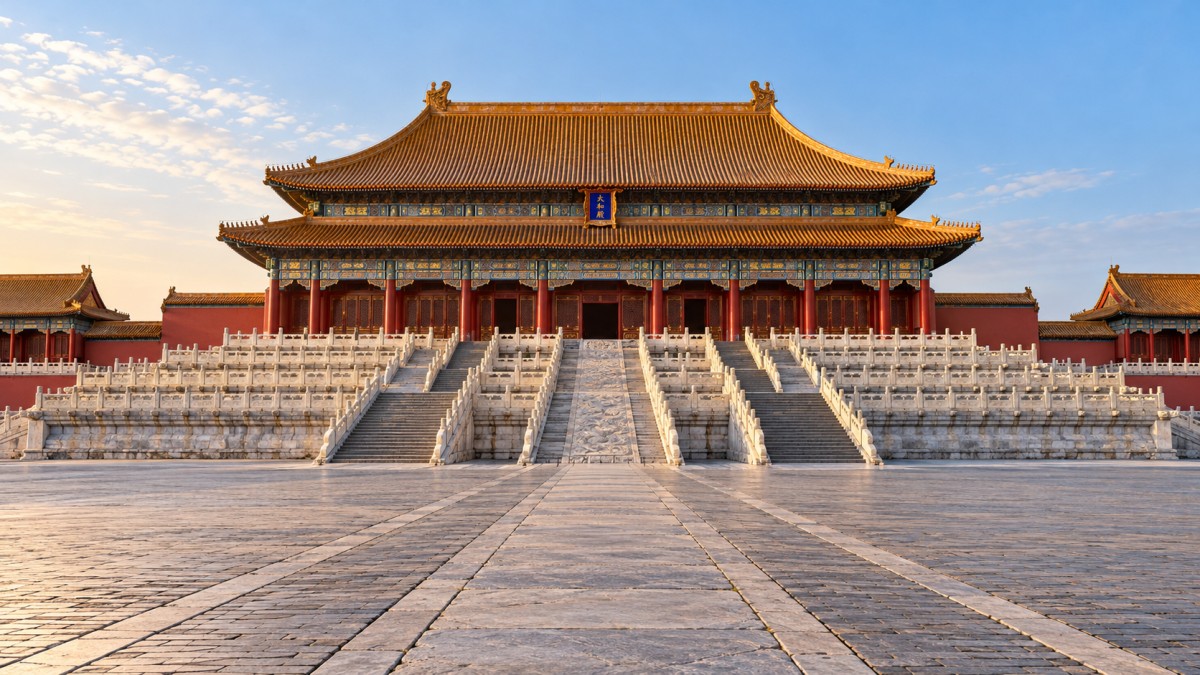
Yellow glazed roofs and red walls contribute to the palace’s recognizable appearance, but avoid treating every color or decorative figure as a universal code with one fixed meaning. A building’s function, period, and later modifications all affect interpretation. The same caution applies to the familiar claim that the palace contains exactly 9,999 rooms: counting bays and counting rooms are not necessarily the same exercise.
The main axis delivers grandeur, but the side compounds provide contrast. Smaller courtyards reveal a less theatrical scale and help visitors imagine the palace as a working environment. Leaving time for one lateral route is usually more revealing than racing north solely to complete the central sequence.
What the collections reveal beyond court splendor
The museum’s holdings include paintings, calligraphy, ceramics, bronzes, jade, lacquerware, textiles, clocks, and court objects. Their interest is not limited to luxury. Together they reveal systems of workshop production, connoisseurship, religious practice, diplomacy, and exchange.
A porcelain vessel might tell a story about imperial commissions and kiln production. A mechanical clock can open a discussion about overseas trade, gifts, and technical curiosity. An emperor’s seal or inscription on a painting may show how collecting became a declaration of cultural authority. Useful questions are: who made this, who used it, and why was it kept?
There is also a difference between viewing a furnished palace interior and visiting an object exhibition. The former emphasizes setting and historical relationships; the latter allows closer attention to individual works. Neither replaces the other. A balanced first visit includes some of each, rather than treating galleries as optional rooms between the famous halls.
Do not build an itinerary around a single artwork without checking its exhibition status. Light-sensitive paintings and textiles may rotate, and conservation or loans can affect availability. The museum’s official exhibition notices are a better guide than an old travel article promising that a particular masterpiece is always visible.
Planning a visit without turning it into an endurance test
For many first-time visitors, a half-day allows an introduction rather than exhaustive coverage. Choose the main ceremonial route and one collection or residential area that genuinely interests you. A longer visit makes sense for people who enjoy reading labels and exploring galleries, but more hours do not automatically produce a better experience.
Before fixing transport and guide arrangements, check the official Palace Museum booking information for current reservation procedures, accepted identity documents, opening days, entry times, and exhibition access. Rules can change, and some galleries or special exhibitions may have separate requirements. Booking assistance from an agency should never be confused with guaranteed admission.
- Plan around the published entrance and exit arrangements rather than assuming you can leave through the gate where you arrived.
- Allow for security checks and the walk to the entrance; a map pin does not represent the full arrival process.
- Expect substantial walking, exposed courtyards, and uneven historic surfaces. Families and travelers with mobility needs should confirm accessible routes in advance.
- Discuss the guide’s emphasis before the visit: architecture, court history, and decorative arts require different pacing.
Weather also changes the experience. Summer courtyards can be demanding in the heat, while winter wind makes long outdoor explanations uncomfortable. A sensible route alternates looking, walking, and resting rather than saving every break until everyone is tired.
Putting Beijing’s palace into a wider China itinerary
The palace offers a concentrated view of Ming and Qing court culture, not a complete account of Chinese civilization. Travelers interested in earlier periods can gain useful perspective by continuing to Henan. Luoyang’s Longmen Grottoes introduces Buddhist patronage and stone sculpture, while Anyang provides a route into Shang history and oracle bone inscriptions. These destinations answer different historical questions rather than repeating the palace experience.
Henan Le Journey Travel Agency Co., Ltd., based in Luoyang, provides inbound travel services within Henan and customized domestic itineraries. For a Beijing–Henan journey, its relevant role is coordinating the Henan portion—transport, accommodation, guiding, and reservations—around the traveler’s interests and pace. In spring, the Luoyang Leisure Two-Day Tour (Customizable Tour in April to View Peonies) offers a possible slower-paced addition; flowering conditions should be checked rather than assumed from the calendar alone.
For the Palace Museum itself, keep the plan selective. Follow the ceremonial axis to understand authority, step into a side compound to appreciate the lived environment, and examine a collection to discover what the court valued. That combination makes the transformation from imperial residence to public museum tangible—without requiring you to see every open room.
Your 1:1 travel consultant will respond within 1 business day
How to plan your trip
- “Discover Hebei in Winter” Tourism Exchange and Matchmaking Event Held in Jinan
- Zhangjiakou 2026–2027 Snow Season Launch and Ice and Snow Tourism Promotion Event Held in Shanghai
- The Palace Museum Explained: From Imperial Residence to Public Museum
- The 2026 autumn break covers over 100 cities, with family trips driving off-season demand for cultural and tourism services
- Family Travel in China: Planning a Relaxed Itinerary with Young Children
Monthly travel guide
- Luoyang launches the “Autumn Charm of the Divine Capital” tourism promotion to build anticipation for winter travel
- Typhoon “White Dolphin” Forces Henan Scenic Areas to Close, Putting Summer Ground-Handling Services Under Pressure
- RCEP Implementing Rules for Indonesia Take Effect: Zero Tariffs for Cultural and Tourism Services Alongside Strict Customer Service Requirements
- Saudi Arabia’s New SASO Regulations Take Effect: Taqat Certification Required Before Chinese-Language Cultural Tourism Services Can Access Visit Saudi
- Zhengzhou Launches a Dedicated LCL Shipping Route for Cultural and Tourism Materials, Cutting Freight Costs by 18%
- Luoyang Cold Chain Intensification: Cultural and Creative Exports Delivered in 9 Days
- Expedited Pre-Approval for Group Visas to Three Southeast Asian Countries
- Tightening air freight capacity at Zhengzhou Airport delays the delivery of cultural and tourism materials
- Vietnam's New Regulations on Bus Monitoring Requirements for Group Tours
- Saudi SAMA New Regulations on Travel Liability Insurance Compliance Preparation
- Japanese tourists' new regulations for entering Henan local transport vehicles
- Wai Gao Qiao Wen Travel customs bonded warehouse summer group equipment fast lane
Popular destinations
- The Palace Museum Explained: From Imperial Residence to Public Museum
- Shanghai Skyline Views: The Bund vs. Lujiazui for First-Time Visitors
- Is a 15-day panoramic tour of China covering multiple cities too rushed?
- Visiting China for the First Time: How Many Cities Should You Include in a 15-Day Grand Tour?
- Is it worth hiring a guide for a visit to the Terracotta Army?
Why choose us

High cost-performance and transparent experience
Offer astonishing low prices without hidden tourism traps, enabling travelers to explore at lower costs while avoiding unnecessary spending loopholes, ensuring transparent consumption.

Personalization and dedicated service
Support 100% free customization, paired with one-on-one expert service, crafting exclusive itineraries based on travelers' specific needs, while providing professional guidance to enhance the personalization and professionalism of the journey.

Premium itinerary planning
Compact yet rich itineraries allow travelers to experience more within limited time; simultaneously, carefully selected hotels in prime locations provide convenient lodging conditions, overall enhancing travel comfort and experience.