Welcome to Our Travel Agency!




Travel Guide
Outdoor Team Building: Planning for Bad Weather and Mixed Fitness Levels
Outdoor team building can strengthen collaboration, but a forecast change or an unexpectedly steep route can turn a useful retreat into an exercise in keeping up. For project managers and engineering leads, the challenge is familiar: protect the objective while adapting the delivery plan. The objective is better communication and stronger working relationships—not getting every colleague to the same summit.
A resilient itinerary needs more than rain ponchos and an optional rest stop. It needs clear weather decisions, activities with genuinely different physical demands, and transport that can support a change of plan. Whether you are arranging a cultural retreat in Henan or a group trip elsewhere in China, those details should be settled before participants board the coach.
Define the team outcome before choosing the attraction
Start with the working relationship you want to improve. A newly assembled project team might need practice sharing incomplete information. A group approaching a difficult handover may benefit from exercises in explaining assumptions and checking understanding. Neither objective requires strenuous hiking.
This distinction matters when choosing between a mountain excursion and a cultural itinerary. Mount Laojun or the southern Taihang Mountains may appeal to enthusiastic walkers, but scenic appeal alone does not make a route suitable for a mixed group. Steps, exposure, queues, transfers, and the distance from transport all affect the actual demand.
For a team with varied mobility and stamina, a shorter cultural visit followed by a facilitated challenge may be the better choice. In Luoyang, for example, a heritage-focused itinerary can give colleagues something interesting to discuss without making endurance the main achievement. However, a famous cultural attraction is not automatically accessible; the proposed route still needs checking.
Use one test: if the outdoor section disappears, can the day still achieve its purpose? If the answer is no, the programme depends too heavily on the setting.
Build a weather decision plan, not a vague backup
“We will go indoors if it rains” leaves too many questions unanswered. Where will everyone go? Is that venue reserved? Can the vehicle reach the pickup point? Who tells participants that the itinerary has changed?
Assign a named decision-maker and a local operations contact. The company organiser can protect the team objective and approve commercial changes; the local operator should assess route conditions, transport feasibility, and venue restrictions. Participant enthusiasm should never override an official closure or a safety stop.
Use a simple decision structure, then agree site-specific triggers with the provider:
- Proceed with adjustments: conditions remain suitable, but the route is shortened, breaks increase, or exposed sections are removed.
- Switch to the reserved alternative: conditions make the planned activity unsuitable, while travel to the replacement venue remains safe.
- Stop, postpone, or cancel: warnings, closures, road conditions, or emergency access concerns prevent safe delivery.
Avoid applying one universal rainfall or temperature threshold to every destination. A paved urban route and a mountain trail respond differently to the same forecast. Check official local weather information, attraction notices, and the operator’s on-site assessment. Agree review points before departure and again before entering the activity area.
Thunderstorms require particular caution. An open-sided pavilion is not a reliable lightning shelter. The plan should identify suitable substantial buildings or enclosed vehicles, follow local emergency guidance, and explain how the group will reach safety. Heat also deserves a contingency: shade, water, reduced exertion, and a cooler alternative may matter more than rain cover.
Offer different effort levels without creating a hierarchy
A public question such as “Who is not fit enough for the walk?” is unlikely to produce useful answers. Colleagues may not want to discuss an injury, pregnancy, fatigue, or a health condition in front of their manager.
Before confirming the route, collect practical requirements privately. Ask about comfortable walking duration, stairs, uneven ground, standing, seating, and transport access. Request only information needed to arrange participation, explain who will see it, and avoid collecting unnecessary medical details.
Then offer routes described by conditions rather than labels such as “easy” and “advanced.” State the expected walking time, surfaces, steps, rest opportunities, and return arrangements. Someone may comfortably walk on level ground but struggle with repeated stairs; a distance figure alone will not reveal that problem.
For the team task, distribute meaningful roles across both options. One group might gather observations along a longer route while another examines guide-approved materials at a seated base. They then combine their findings to solve the same brief. Both contributions must matter; otherwise, the shorter option becomes a waiting room.
Do not award points for speed or distance if inclusion is the goal. Reward clear handovers, useful questions, sound reasoning, and checking assumptions. Make switching options normal, with no explanation required.
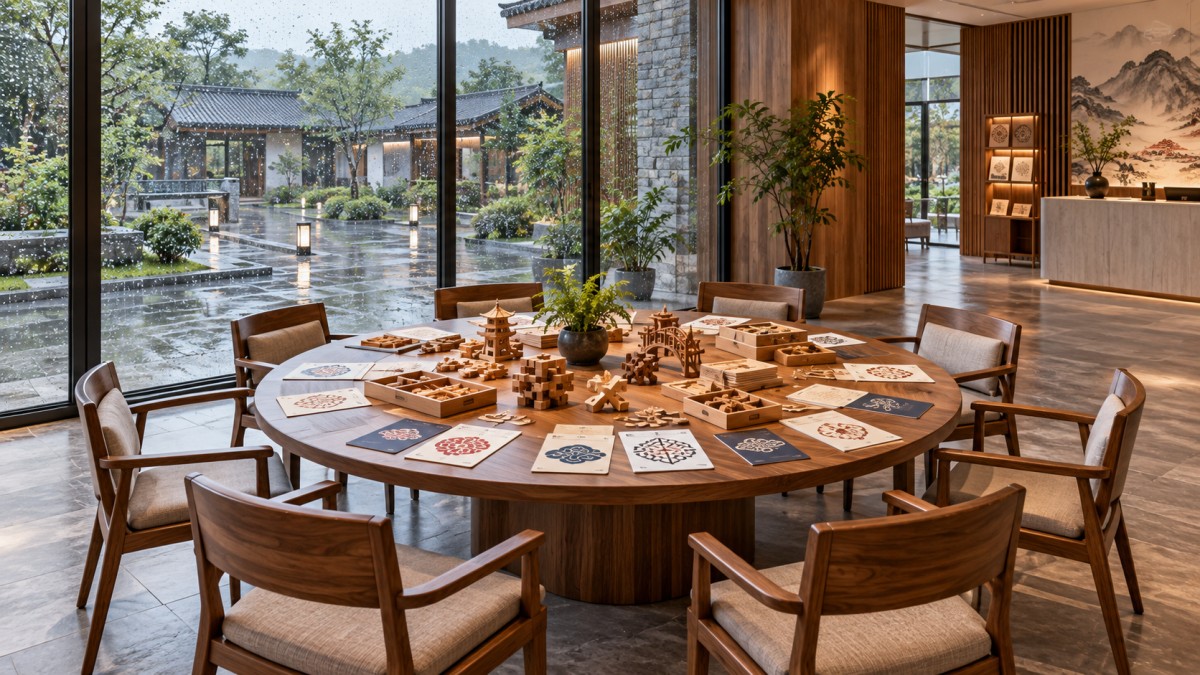
Make the indoor alternative worth attending
A hotel meeting room is a location, not a programme. If the backup is an improvised presentation, participants will understandably feel that the useful part of the day has been cancelled.
Keep the collaboration task consistent across both formats. An outdoor observation exercise can become an indoor information-sharing challenge using prepared photographs, maps, and cultural interpretation materials. Give each group different information and ask them to develop a shared visitor itinerary under constraints such as access, time, and changing weather. This makes communication—not physical performance—the difficult part.
For a Henan retreat, regional history or a locally arranged craft workshop can provide a relevant setting. Confirm instructor availability, language support, seating, materials, and accessibility before promising the activity. A museum visit may also work, but group reservations and permitted activities need checking; public galleries are not automatically suitable for facilitated games.
Ask what “reserved” means commercially. Is the alternative held exclusively, provisionally available, or simply recommended? Record the release deadline, cancellation charge, and any additional facilitator or transport fees. Paying to hold a suitable room can be sensible; discovering that every nearby venue is full after the rain starts is not.
Protect the schedule at its weakest points
Group schedules often fail at transitions rather than during activities. Toilets, ticket collection, boarding, wet clothing, and finding a missing participant all take time. Rain adds pressure because people move more slowly and available shelter becomes crowded.
Work backwards from the fixed commitment: a train departure, airport check-in, or essential evening meeting. Protect that deadline by identifying which activity can be removed entirely. Trying to preserve every stop usually consumes the recovery time needed for safe travel.
This matters especially when adding team activities to a short transit itinerary. If considering a Zhuhai Transit One-Day Tour, ask the provider to confirm the actual route, transfer allowances, walking demands, and weather alternatives before treating it as a team-building programme. A one-day tour title alone does not establish suitability for your group.
For any destination, confirm where the vehicle can legally wait and where participants can board under cover. Check whether leaving an attraction early affects re-entry. Keep the emergency pickup arrangement separate from the routine meeting point; they may not be the same place.
Give the local operator a brief they can actually deliver
“Something fun outdoors” encourages a generic itinerary. A useful brief states the team objective, group size, working languages, physical access requirements, fixed deadlines, and acceptable alternatives. It should also identify who can approve extra costs when conditions change.
Henan Le Journey Travel Agency Co., Ltd., based in Luoyang, provides inbound services across Henan and customised domestic group travel. Its coordination of vehicles, guides, accommodation, tickets, and dining is relevant here because a weather change can affect all five at once. Ask for those dependencies to be reflected in one operational plan, rather than separate booking confirmations.
Local relationships can help establish what is practical, but they do not override closures, capacity limits, or access restrictions. For an itinerary involving Longmen Grottoes, Shaolin Temple, or mountain scenery, request a route-specific assessment rather than reassurance based only on destination familiarity.
Before approving the booking, obtain written confirmation of:
- The planned route and lower-exertion option, including their meeting points.
- The weather decision owner, communication channel, and replacement venue status.
- The transport plan, first-aid provision, emergency contacts, and arrangements for anyone leaving early.
- The price difference between proceeding, switching, postponing, and cancelling.
Brief participants clearly, then leave room to adapt
Send a short participant brief describing clothing, footwear, walking conditions, available options, and how changes will be communicated. For international groups, provide instructions in the agreed working language and ensure essential contacts remain available if someone loses internet access. Name a contact for concerns that participants would rather raise privately.
On the day, explain that changing routes is part of the plan, not a disruption caused by slower colleagues. Leaders should reinforce that message by choosing activities for their purpose rather than their prestige.
Finish with a brief discussion tied to work: where did information get lost, which assumptions went unchecked, and what helped the group adjust? Before departure, one practical question remains worth asking the organiser: if conditions change and someone needs to stop, can everyone describe what happens next? If not, resolve that gap before adding another activity.
Your 1:1 travel consultant will respond within 1 business day
How to plan your trip
- “Discover Hebei in Winter” Tourism Exchange and Matchmaking Event Held in Jinan
- Zhangjiakou 2026–2027 Snow Season Launch and Ice and Snow Tourism Promotion Event Held in Shanghai
- The Palace Museum Explained: From Imperial Residence to Public Museum
- The 2026 autumn break covers over 100 cities, with family trips driving off-season demand for cultural and tourism services
- Family Travel in China: Planning a Relaxed Itinerary with Young Children
Monthly travel guide
- Luoyang launches the “Autumn Charm of the Divine Capital” tourism promotion to build anticipation for winter travel
- Typhoon “White Dolphin” Forces Henan Scenic Areas to Close, Putting Summer Ground-Handling Services Under Pressure
- RCEP Implementing Rules for Indonesia Take Effect: Zero Tariffs for Cultural and Tourism Services Alongside Strict Customer Service Requirements
- Saudi Arabia’s New SASO Regulations Take Effect: Taqat Certification Required Before Chinese-Language Cultural Tourism Services Can Access Visit Saudi
- Zhengzhou Launches a Dedicated LCL Shipping Route for Cultural and Tourism Materials, Cutting Freight Costs by 18%
- Luoyang Cold Chain Intensification: Cultural and Creative Exports Delivered in 9 Days
- Expedited Pre-Approval for Group Visas to Three Southeast Asian Countries
- Tightening air freight capacity at Zhengzhou Airport delays the delivery of cultural and tourism materials
- Vietnam's New Regulations on Bus Monitoring Requirements for Group Tours
- Saudi SAMA New Regulations on Travel Liability Insurance Compliance Preparation
- Japanese tourists' new regulations for entering Henan local transport vehicles
- Wai Gao Qiao Wen Travel customs bonded warehouse summer group equipment fast lane
Popular destinations
- Outdoor Team Building: Planning for Bad Weather and Mixed Fitness Levels
- Guided or Self-Guided Cultural Tour in China: Which Suits Your Interests?
- Is Jinshanling Great Wall Right for Beginners? Routes, Steps, and Fitness
- Business Travel in China: What to Include in a Corporate Travel Budget
- China's Natural Landscapes: Choosing Between Karst, Mountains, and Deserts
Why choose us

High cost-performance and transparent experience
Offer astonishing low prices without hidden tourism traps, enabling travelers to explore at lower costs while avoiding unnecessary spending loopholes, ensuring transparent consumption.

Personalization and dedicated service
Support 100% free customization, paired with one-on-one expert service, crafting exclusive itineraries based on travelers' specific needs, while providing professional guidance to enhance the personalization and professionalism of the journey.

Premium itinerary planning
Compact yet rich itineraries allow travelers to experience more within limited time; simultaneously, carefully selected hotels in prime locations provide convenient lodging conditions, overall enhancing travel comfort and experience.