Welcome to Our Travel Agency!




Travel Guide
To claim a refund when a guided hiking route closes after booking, contact the company responsible for your reservation, document that the booked route is unavailable, and request a written refund calculation. Do not immediately use a standard “cancel booking” button: it may record the cancellation as your choice and apply charges that do not reflect the closure.
A closure does not automatically guarantee repayment of every travel expense, but a “non-refundable” label does not settle the issue either. The key questions are whether the operator can deliver the essential experience you purchased, whether you accept a replacement, and what deductions are permitted under the contract and applicable law. For hiking trips in Henan or elsewhere in China, distinguish a standalone excursion from a package that also includes hotels, vehicles, and other visits.
Establish exactly what has closed
A closed summit trail is not necessarily the same as a closed scenic area. A destination may keep its entrance, cableway, and lower walking paths open while restricting the ridge route advertised in your booking. Alternatively, the entire site may suspend admission because of severe weather, wildfire risk, maintenance, or an official safety order.
Ask the operator to confirm in writing:
- Which trail, entrance, or activity is unavailable.
- Whether the restriction covers your scheduled hiking date.
- Whether the original itinerary can still operate safely and lawfully.
- Whether the operator is cancelling, proposing a change, or waiting for an official decision.
The distinction matters because the refund claim concerns what was promised, not simply whether some part of the destination remains open. If your booking specifically advertised a guided summit hike, admission to a visitor center may not provide an equivalent experience. If the closed section was a minor optional detour, the case for cancelling the entire trip is less straightforward.
Do not treat an unofficial social media post as conclusive evidence. Look for a dated notice from the scenic-area administration, relevant authority, or operator. If the notice does not specify a reopening date, preserve that uncertainty rather than assuming it will cover your trip.
Preserve the booking before requesting changes
Save the documents that establish both the purchase and the closure. Booking pages can change, and access to messages may become harder after an order is cancelled.
- The confirmation, booking reference, invoice, and payment receipt.
- The advertised itinerary, including named trails, walking duration, guide arrangements, and included transport.
- The cancellation, itinerary-change, weather, and minimum-participation terms provided at purchase.
- The closure notice, with its source, publication date, and affected dates.
- Messages offering alternatives or explaining why the original hike cannot proceed.
Screenshots should show enough context to identify the source and booking. Keep original emails and downloadable documents as well. If a phone call resolves an important point, send a follow-up message recording your understanding and ask the provider to confirm it.
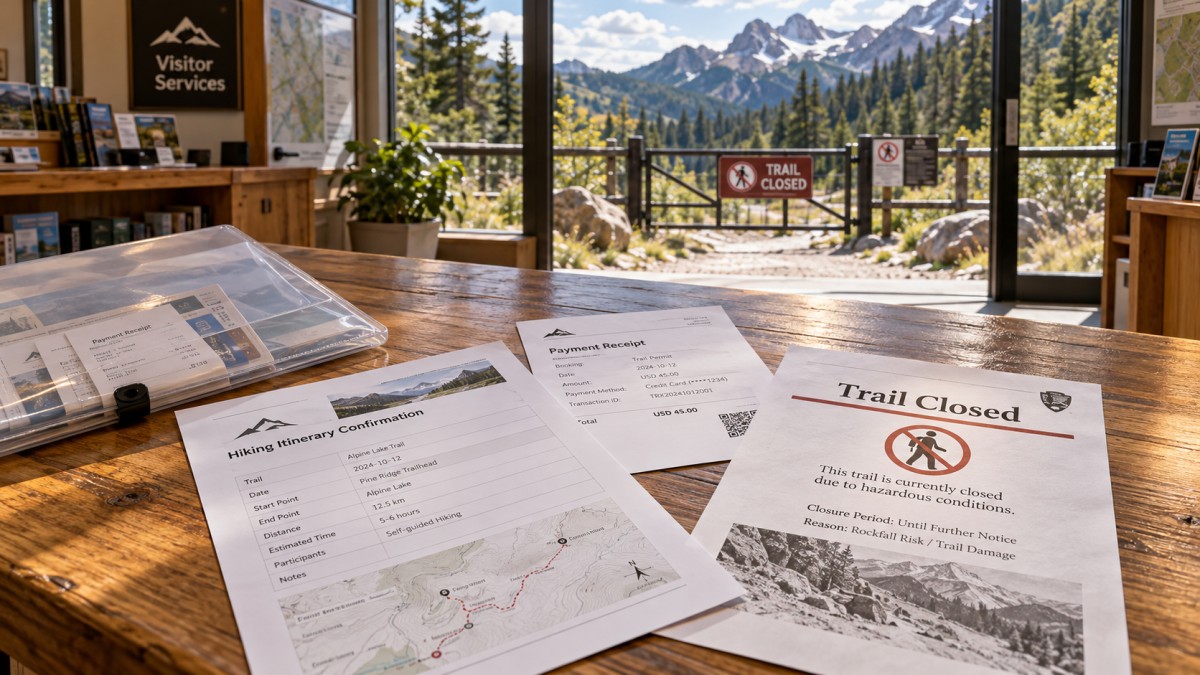
If the departure is imminent, contact the provider promptly through both its operational contact and the booking platform, where applicable. Unless instructed otherwise, do not simply miss the meeting point: an unexplained absence can create a separate dispute about whether you were a no-show.
Send the claim to the party responsible for the booking
The guide, scenic area, payment processor, and travel agency may have different roles. Start with the business named as the contracting provider on your confirmation or travel agreement. If you booked through a marketplace, also open a case within that platform so its support team can see the closure evidence and preserve the dispute record.
Ask the platform to clarify whether it sold the activity itself or acted as an intermediary. A platform’s involvement does not automatically mean it owes the refund, but it may control the payment, cancellation workflow, or dispute process.
For a package arranged through an overseas agency and delivered by a local Chinese operator, notify the agency that sold you the package. Local staff can confirm operational facts, but they may not have authority to settle the financial claim. Avoid accepting a small local payment as a complete settlement unless that is what you intend.
Where several people share one reservation, identify the booking holder and provide any authorization needed to act for the group. State whether the request covers everyone or only named participants; otherwise, a partial request may be mistaken for cancellation of the whole booking.
Decide whether the proposed replacement is acceptable
A replacement route can preserve a trip, but it should be evaluated against the actual booking. Compare hiking duration, elevation gain, terrain, scenery, travel time, accessibility, and included services. A short paved walk is not necessarily a substitute for a full-day mountain trek, even if both take place within the same scenic area.
Ask for the revised itinerary and price adjustment before agreeing. For example, if the replacement no longer requires a cableway ticket or specialist guide, ask how the unused component will be handled. Equally, do not assume every operational change creates a refund entitlement if the contracted experience remains substantially intact.
If you accept a change, record whether you are also accepting it as full settlement. You can ask to accept the replacement while leaving a disputed price adjustment unresolved, but the provider should confirm that arrangement in writing. Avoid clicking an acceptance box whose terms you have not saved.
No refund discussion should depend on entering a closed trail. A suggestion to bypass an official restriction is a reason to reject that arrangement, not a reasonable alternative you must accept to preserve your claim.
Request a calculation, not just a refund percentage
The most useful question is: “Which services will not be delivered, and what is the contractual or legal basis for retaining each amount?” An unexplained percentage tells you little about whether the settlement is reasonable.
For Chinese package-tour contracts, the Tourism Law addresses certain unavoidable events affecting an itinerary. Depending on the circumstances, it provides for changes or termination and, following termination, repayment after deduction of qualifying non-refundable expenses paid to local operators or assisting service providers. It does not establish a universal full-refund rule for every weather-related closure.
Nor does describing an event as “force majeure” automatically justify retaining the entire payment. Ask what prevented performance, when the provider learned of it, and how each claimed expense relates to your reservation. The rules applicable to a standalone activity may differ from those governing a package tour.
Request reasonable supporting detail for deductions, such as the supplier category, cancellation condition, amount paid, and whether recovery has been attempted. Commercial records may contain confidential information, but that does not prevent the provider from explaining its calculation. Ask how any supplier refund received later will be passed on.
Separately booked flights and hotels require separate assessment. Their cost does not automatically become recoverable from the hiking operator because the route closed. Any claim for additional losses depends on the contract, governing law, responsibility for the failure, and the connection between the failure and the expense.
Make a clear written refund request
A concise claim should identify the unavailable service, your preferred remedy, and the information needed to assess any deductions. Avoid describing the situation as a voluntary cancellation if the reason is that the booked hike cannot operate.
Subject: Refund request for unavailable guided hike — booking [reference]
I booked [route/activity] for [date] and paid [amount and currency]. The attached notice and your message dated [date] indicate that [specific route or service] will not be available.
I am requesting [a refund for the cancelled activity / termination of the affected booking and the applicable refund]. I do not accept the proposed replacement because [brief, specific difference from the booked service].
Please confirm the booking’s status, the proposed refund amount, and an itemized explanation of any deductions, including their contractual or legal basis. Please also confirm the payment method and expected processing date.
Please respond by [reasonable date, taking account of departure timing]. This request concerns the unavailability of the booked service, rather than a change in my personal travel plans.
If the booking platform requires you to select a cancellation reason, choose the option that accurately describes the closure or operator cancellation. Where none fits, contact support before proceeding and retain its instructions. Do not allow the search for perfect wording to make you miss a stated claim deadline.
Escalate a stalled claim without losing other deadlines
If the provider refuses the request or offers no explanation, ask for its final written position. Escalate through the booking platform with the confirmation, closure evidence, correspondence, and a clear statement of the amount disputed.
For services supplied in China, complaints may also be directed through the relevant local culture and tourism authority or an applicable public-service complaint channel. The 12345 public-service hotline can help route local matters, while 12315 handles consumer complaints within its remit. Jurisdiction, language support, and handling procedures vary; keep any case reference and submit an organized evidence file.
A card dispute may be available where a paid service was not provided, subject to the issuer’s rules, evidence requirements, and deadlines. Explain the closure accurately rather than reporting an authorized purchase as fraud. Ask the issuer about deadlines while the merchant discussion continues; negotiations do not necessarily pause them.
Travel insurance is another separate route, not a guaranteed substitute for a supplier refund. Check the policy’s covered causes, cancellation or interruption provisions, exclusions, and notification requirements. Disclose refunds already received, and update any claim if another party pays you later.
Confirm the settlement before closing the case
Obtain written confirmation of the amount, currency, payment destination, and processing date. Distinguish the date the provider initiates repayment from the date it is expected to reach your account. Currency conversion can mean the amount received in your home currency differs from the original debit.
A voucher is not the same as cash. Before accepting one, check its expiry, transferability, restrictions, and whether acceptance waives the refund dispute. For a one-time international trip, credit with a local operator may have limited practical value.
Keep the case open until the agreed payment arrives, or follow the platform’s instructions if closure is required to process it. The strongest resolution is a documented agreement showing what was cancelled, what was delivered, which deductions were accepted, and what remains payable—not simply a message saying the refund has been “approved.”
Your 1:1 travel consultant will respond within 1 business day
How to plan your trip
- “Discover Hebei in Winter” Tourism Exchange and Matchmaking Event Held in Jinan
- Zhangjiakou 2026–2027 Snow Season Launch and Ice and Snow Tourism Promotion Event Held in Shanghai
- The Palace Museum Explained: From Imperial Residence to Public Museum
- The 2026 autumn break covers over 100 cities, with family trips driving off-season demand for cultural and tourism services
- Family Travel in China: Planning a Relaxed Itinerary with Young Children
Monthly travel guide
- Luoyang launches the “Autumn Charm of the Divine Capital” tourism promotion to build anticipation for winter travel
- Typhoon “White Dolphin” Forces Henan Scenic Areas to Close, Putting Summer Ground-Handling Services Under Pressure
- RCEP Implementing Rules for Indonesia Take Effect: Zero Tariffs for Cultural and Tourism Services Alongside Strict Customer Service Requirements
- Saudi Arabia’s New SASO Regulations Take Effect: Taqat Certification Required Before Chinese-Language Cultural Tourism Services Can Access Visit Saudi
- Zhengzhou Launches a Dedicated LCL Shipping Route for Cultural and Tourism Materials, Cutting Freight Costs by 18%
- Luoyang Cold Chain Intensification: Cultural and Creative Exports Delivered in 9 Days
- Expedited Pre-Approval for Group Visas to Three Southeast Asian Countries
- Tightening air freight capacity at Zhengzhou Airport delays the delivery of cultural and tourism materials
- Vietnam's New Regulations on Bus Monitoring Requirements for Group Tours
- Saudi SAMA New Regulations on Travel Liability Insurance Compliance Preparation
- Japanese tourists' new regulations for entering Henan local transport vehicles
- Wai Gao Qiao Wen Travel customs bonded warehouse summer group equipment fast lane
Popular destinations
- Outdoor Team Building: Planning for Bad Weather and Mixed Fitness Levels
- Guided or Self-Guided Cultural Tour in China: Which Suits Your Interests?
- Is Jinshanling Great Wall Right for Beginners? Routes, Steps, and Fitness
- Business Travel in China: What to Include in a Corporate Travel Budget
- China's Natural Landscapes: Choosing Between Karst, Mountains, and Deserts
Why choose us

High cost-performance and transparent experience
Offer astonishing low prices without hidden tourism traps, enabling travelers to explore at lower costs while avoiding unnecessary spending loopholes, ensuring transparent consumption.

Personalization and dedicated service
Support 100% free customization, paired with one-on-one expert service, crafting exclusive itineraries based on travelers' specific needs, while providing professional guidance to enhance the personalization and professionalism of the journey.

Premium itinerary planning
Compact yet rich itineraries allow travelers to experience more within limited time; simultaneously, carefully selected hotels in prime locations provide convenient lodging conditions, overall enhancing travel comfort and experience.