Welcome to Our Travel Agency!




Travel Guide
Is a Shaolin kung fu show or a beginner lesson better for a mixed-age group? For most families with widely different energy levels, a show is the easier shared choice. A beginner lesson suits groups that actively want to participate, provided the instructor can adapt movements and make sitting out comfortable. Age matters less than mobility, willingness, and how much walking everyone has already done.
The decision becomes clearer when you picture your actual travelers: a child eager to copy every kick, a grandparent who enjoys watching but dislikes stairs, and adults hoping for something more memorable than another photo stop. Neither experience has to disappoint them. The key is choosing the right format—and checking what the booking really includes.
Which option works best when everyone has different abilities?
Choose a performance when staying together with minimal physical effort is the priority. Choose a beginner lesson when shared participation matters more than spectacle and the activity can accommodate different limits.
“Mixed-age” does not automatically mean “low mobility.” An older traveler may be keen to learn, while a teenager may prefer to watch. Ask each person whether they want to observe, try a few movements, or take part throughout. That simple conversation is often more useful than dividing the group by age.
What should you expect from a Shaolin kung fu show?
A performance presents martial arts for an audience rather than teaching visitors to reproduce what they see. Depending on the program, it may feature forms, coordinated routines, athletic movements, or weapon demonstrations. Content varies, so do not assume that a particular routine seen online will appear during your visit.
For a multigenerational group, the appeal is immediate: everyone shares the same moment without needing the same strength or confidence. A child may focus on movement and speed; an adult may notice precision; another traveler may simply welcome the chance to watch rather than walk.
However, low participation does not necessarily mean easy access. The journey from the vehicle to the venue, waiting arrangements, entrance steps, and seating layout can matter more than the performance itself. Confirm whether seating is available and whether any accessibility requirements can be met at the specific venue.
Also distinguish between a performance associated with a scenic-area visit and a separately arranged theatrical production or martial arts school demonstration. Their locations, ticket arrangements, and atmosphere may differ. Ask for the exact venue rather than booking on the strength of the phrase “Shaolin show” alone.
Is a beginner kung fu lesson suitable for children and older adults?
It can be, but the word “beginner” is not enough to establish suitability. A well-matched introductory session should focus on manageable fundamentals, not on reproducing advanced stage movements. Possible content includes greetings, posture, simple hand movements, and a short sequence adapted to participants.
A child and an older adult might learn the same upper-body movement while using different stance depths. One person may remain standing throughout; another may need regular rests. These adaptations should be agreed with the provider before booking, not negotiated only after the lesson starts.
Ask whether the instructor can offer:
- Shallow stances instead of deep knee bends.
- Movements without jumping, high kicks, or rapid turns.
- A slower pace, demonstrations, and time for questions.
- Rest breaks and an appropriate place to observe.
- Seated participation where feasible and agreed in advance.
These are requests to confirm, not features to assume. Some group sessions follow a set format and may have limited flexibility.
Travelers with recent injuries, balance difficulties, significant joint problems, or medical conditions affecting exercise should seek appropriate medical advice before participating. Tell the organizer about relevant functional needs. The instructor needs to know what movements should be avoided, without expecting anyone to disclose unnecessary private medical details.
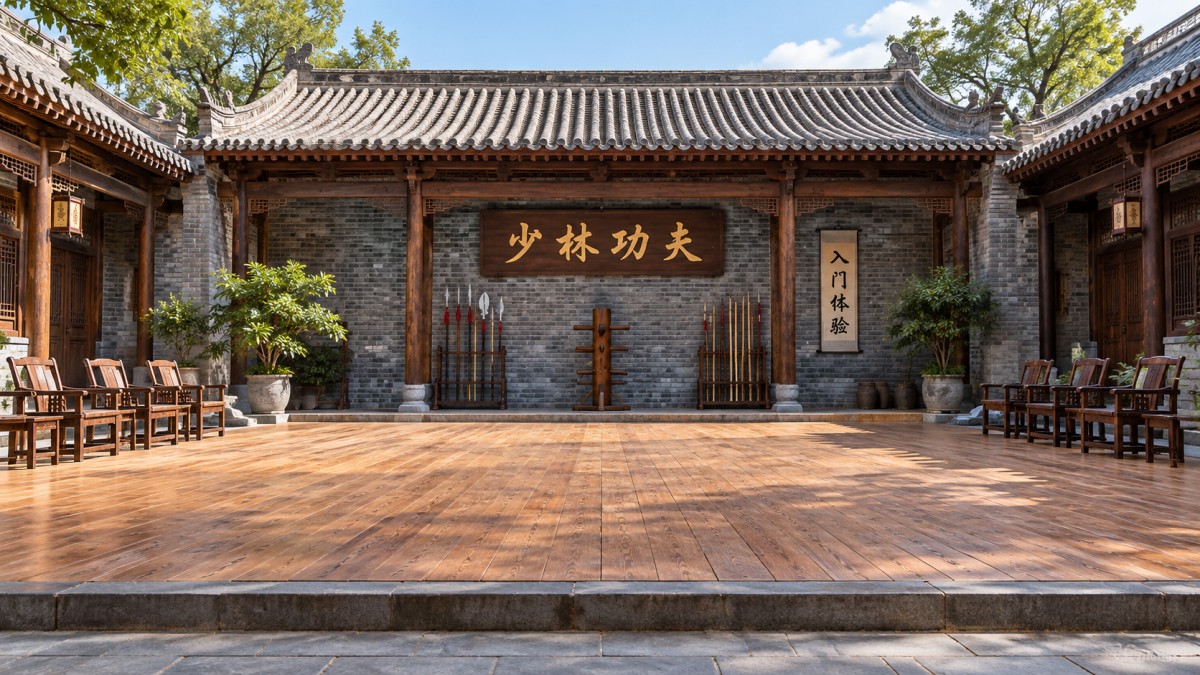
Will young children enjoy a lesson?
Children who like copying movements may find a short, clearly demonstrated lesson absorbing. Others may lose interest when practice involves waiting or repetition. Ask about minimum ages, adult supervision, and whether parents can participate alongside children.
A useful question is not “Is my child energetic enough?” but “Can my child follow instructions in an unfamiliar setting?” Enthusiasm helps, but safe participation also requires listening, keeping distance from others, and stopping when asked.
Which experience offers a better understanding of Shaolin culture?
Neither format automatically provides deeper cultural understanding. A show can be visually impressive yet leave visitors unsure what they have watched. A lesson can be enjoyable but feel like a general exercise session if no context is offered.
The difference is interpretation. A guide or instructor can help visitors understand the relationship between Shaolin’s Buddhist setting and its martial traditions, while making clear that a tourist performance or introductory class represents only one part of that heritage.
During a lesson, a simple explanation of respectful greetings, attention, posture, and repeated practice can give meaning to modest movements. During a show visit, a brief introduction and time afterward for questions can turn spectacle into a more thoughtful encounter.
Language support matters here. Confirm whether teaching is available in your preferred language or whether a guide will interpret. Visual demonstration helps with movement, but it does not replace clear explanations of safety instructions and cultural context.
Can part of the group take a lesson while everyone else watches?
Often this is the most balanced arrangement—but it depends on the venue’s rules. Do not assume nonparticipants can enter, sit nearby, take photographs, or remain without a separate charge. Confirm observer access, seating, shade or shelter where relevant, and any photography restrictions.
For a group with enthusiastic learners and reluctant participants, an optional lesson removes pressure. Nobody should have to perform simply to keep the family together. Equally, observers should not be left standing at the edge of a training area without somewhere comfortable to wait.
If the group separates, agree on a meeting place and time, keep children with a responsible adult, and clarify who is accompanying anyone needing assistance. Nearby activities are only useful alternatives if the walking distance and access genuinely suit the people choosing them.
Is doing both a show and a lesson worthwhile?
Yes, when interest is strong and the day has enough breathing room. Watching skilled performers and then trying a basic movement can help visitors appreciate the practice behind what looked effortless on stage.
But two kung fu experiences are not automatically better than one. A long temple visit, extensive walking, a performance, and a lesson can turn an enjoyable cultural day into an endurance test. If both are priorities, keep other activities modest and protect time for meals, toilets, and rest. The order should follow confirmed schedules and the group’s energy, rather than a rigid rule.
How should this fit into a Henan sightseeing itinerary?
Think about the whole day, not just the activity. A beginner lesson that sounds gentle in isolation may feel demanding after prolonged walking. A seated show may offer a welcome change of pace, but reaching it can still involve extra movement.
For travelers combining Shaolin with Luoyang or Zhengzhou, allow realistic transfer time and avoid tight onward connections. If your wider itinerary also includes Longmen Grottoes or other walking-focused attractions, balance active periods across the trip rather than concentrating every highlight into one crowded day.
Henan Le Journey Travel Agency Co., Ltd., based in Luoyang, can incorporate these preferences into a tailored Henan itinerary, coordinating transport, guiding, ticket reservations, and relevant activity arrangements. The useful starting point is a practical brief: group size, children’s ages, mobility needs, preferred language, and who wants to participate. Availability and suitability should then be checked with the specific provider.
Ask for an itinerary that identifies where walking, waiting, sitting, and physical participation occur. That is more informative for a mixed-age family than a schedule listing attractions without describing the effort between them.
What should you confirm before paying?
Prices and inclusions vary by provider and format. Instead of comparing headline prices alone, request written confirmation of the details that could affect your group’s day:
- The exact experience: performance, school demonstration, private lesson, or shared beginner class.
- Location and access: distance from drop-off, steps, seating, toilets, and any relevant accessibility arrangements.
- Timing: confirmed start, activity length, arrival requirements, and how schedule changes are handled.
- Inclusions: admission, instruction, interpretation, transport, and any optional extras.
- Lesson conditions: age requirements, group size, clothing guidance, intensity, and observer policy.
- Changes and cancellations: applicable terms, including arrangements for outdoor activities affected by weather.
For a lesson, comfortable clothing and secure footwear are generally sensible, but follow the provider’s specific guidance. Ask whether water and personal belongings can be kept nearby. Avoid promising children costumes, certificates, photographs with performers, or special access unless these are explicitly included.
Still undecided? Choose according to your least comfortable traveler
If everyone wants one shared activity and someone cannot comfortably manage standing exercise, a show is usually the better starting point—subject to suitable access and seating. If the group enjoys trying unfamiliar activities and adaptations are confirmed, a beginner lesson may become the more personal memory.
For sharply divided preferences, choose a shared performance with an optional lesson, or arrange a lesson with comfortable observation where permitted. The best Shaolin experience is not the one that asks everyone to do the most. It is the one that lets each person feel included, curious, and comfortable enough to enjoy being there.
Your 1:1 travel consultant will respond within 1 business day
How to plan your trip
- Heilongjiang to Issue RMB 100 Million in Consumer Vouchers and Launch a 100-Day Winter Ice and Snow Tourism Initiative
- “Discover Hebei in Winter” Tourism Exchange and Matchmaking Event Held in Jinan
- Zhangjiakou 2026–2027 Snow Season Launch and Ice and Snow Tourism Promotion Event Held in Shanghai
- Is a Three-City Henan Itinerary Too Rushed for Families?
- The Palace Museum Explained: From Imperial Residence to Public Museum
Monthly travel guide
- Luoyang launches the “Autumn Charm of the Divine Capital” tourism promotion to build anticipation for winter travel
- Typhoon “White Dolphin” Forces Henan Scenic Areas to Close, Putting Summer Ground-Handling Services Under Pressure
- RCEP Implementing Rules for Indonesia Take Effect: Zero Tariffs for Cultural and Tourism Services Alongside Strict Customer Service Requirements
- Saudi Arabia’s New SASO Regulations Take Effect: Taqat Certification Required Before Chinese-Language Cultural Tourism Services Can Access Visit Saudi
- Zhengzhou Launches a Dedicated LCL Shipping Route for Cultural and Tourism Materials, Cutting Freight Costs by 18%
- Luoyang Cold Chain Intensification: Cultural and Creative Exports Delivered in 9 Days
- Expedited Pre-Approval for Group Visas to Three Southeast Asian Countries
- Tightening air freight capacity at Zhengzhou Airport delays the delivery of cultural and tourism materials
- Vietnam's New Regulations on Bus Monitoring Requirements for Group Tours
- Saudi SAMA New Regulations on Travel Liability Insurance Compliance Preparation
- Japanese tourists' new regulations for entering Henan local transport vehicles
- Wai Gao Qiao Wen Travel customs bonded warehouse summer group equipment fast lane
Popular destinations
- How Do We Dispute Unapproved Charges on a Henan Cultural Tour Invoice?
- Should a Henan Cultural Tour Use One Ground Handler or City Suppliers?
- How Can We Verify Henan Cultural Tour Hotel Bookings in Peak Season?
- Do Guided Hiking Groups in Henan Need Extra Insurance?
- Forbidden City Tickets: Entry Prices and Separately Ticketed Galleries
Why choose us

High cost-performance and transparent experience
Offer astonishing low prices without hidden tourism traps, enabling travelers to explore at lower costs while avoiding unnecessary spending loopholes, ensuring transparent consumption.

Personalization and dedicated service
Support 100% free customization, paired with one-on-one expert service, crafting exclusive itineraries based on travelers' specific needs, while providing professional guidance to enhance the personalization and professionalism of the journey.

Premium itinerary planning
Compact yet rich itineraries allow travelers to experience more within limited time; simultaneously, carefully selected hotels in prime locations provide convenient lodging conditions, overall enhancing travel comfort and experience.