Welcome to Our Travel Agency!




Travel Guide
To dispute unapproved charges on a Henan cultural tour invoice, identify the exact items you challenge, compare them with your booking agreement and written changes, and ask the company that billed you for an explanation and correction in writing. Specify the amount in dispute and the outcome you want: removal of an unpaid charge, a revised invoice, or a refund.
A surprise charge is not automatically invalid. An extra may have been authorized through a group representative, or the contract may allow a particular adjustment. The central questions are whether the charge had an agreed basis, whether the person approving it had authority, and whether the service was actually provided.
Which charges are worth challenging?
Start with a line-by-line comparison between the invoice and your confirmed booking. For a Henan cultural itinerary, discrepancies may involve attraction admission, guide services, vehicle use, hotel rooms, meals, or optional experiences.
Be precise about what “included” means. Admission to a scenic area does not necessarily include every shuttle, cable car, performance, or specialist activity inside it. Conversely, an item expressly included in your package should not appear again as an additional payment without an explanation.
A complaint becomes clearer when it identifies the discrepancy: “The confirmed itinerary includes this admission, but the final invoice charges it again.” That gives the provider a specific issue to resolve.
What counts as approval for an extra tour expense?
Approval may appear in a signed amendment, email, booking-platform message, or WeChat conversation. A verbal agreement can also become relevant, although its scope and price may be harder to establish. Review the whole exchange, including messages immediately before and after the proposed change.
Distinguish agreement to an activity from agreement to its additional cost. A traveler saying “yes, let’s visit” may have understood that the visit was already covered. Equally, accepting a clearly priced optional activity can support the charge even without a separate paper signature.
For group tours, establish who was authorized to approve spending. A tour leader may have permission to adjust the itinerary but a limited budget for extras. Ask the provider to identify who approved the charge, what amount they accepted, and whether that approval applied to the entire group.
Supplier receipts answer a different question. A receipt may show that the agency paid for a service; it does not, by itself, establish that you agreed to reimburse that expense.
What evidence should we collect before contacting the agency?
Keep the documents that explain both the agreement and the payment history:
- The signed contract, accepted quotation, and confirmed itinerary.
- Booking terms covering exclusions, optional activities, overtime, and substitutions.
- The disputed invoice and records of deposits or later payments.
- Emails, platform messages, and WeChat conversations about changes.
- Relevant tickets, receipts, service timings, and evidence of cancellations or substitutions.
Preserve original files and complete message threads. Screenshots are useful for highlighting a disputed amount, but surrounding context may explain whether a quoted price was accepted, rejected, or left unanswered. If records are bilingual, keep both versions and identify the relevant passages.
Create a short reconciliation listing each disputed item, its amount and currency, the corresponding booking term, and your requested correction. Separate confirmed discrepancies from items that simply need clarification. This helps prevent a straightforward duplicate charge from getting buried in a broader argument about service quality.
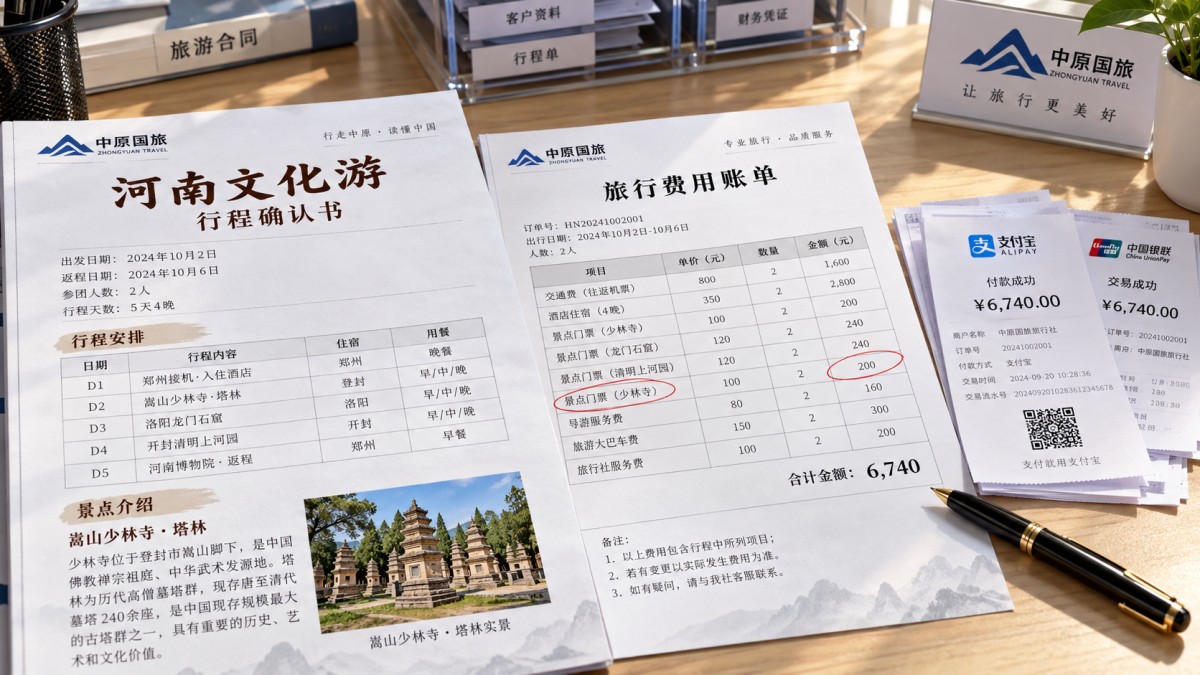
Check whether the document is an agency statement, a payment request, or a Chinese tax invoice, commonly called a fapiao. A fapiao records invoicing information; it does not independently prove approval of every underlying service. The accounting document and the payment may require separate corrections.
How should we write the invoice dispute?
Send the complaint to the company that contracted with you or issued the charge. Copy the booking contact when useful. A guide can help explain events, but may lack authority to revise an invoice or authorize a refund.
Keep the message factual and give the provider a clear action to take. You can adapt this wording:
Subject: Request to review disputed charges — booking [reference]
“We are disputing [amount and currency] on invoice [number] for our Henan tour on [dates]. The disputed items are [items and amounts]. Our confirmed booking states [relevant inclusion or term], and our records do not show approval of these additional costs.
Please provide the contractual basis, calculation, service details, and approval record for each item. We have attached the relevant booking documents and payment records.
We request [removal of the charges and a revised invoice / a refund of the amount already paid]. Please acknowledge this complaint and provide a written response by [reasonable date]. Please also confirm how the disputed balance will be handled during your review.”
Choose a response date that reflects the circumstances. An imminent payment deadline or ongoing tour needs a faster response than a completed trip with no immediate financial deadline. After any telephone discussion, send a brief written recap so that proposed resolutions are recorded.
Should we pay the invoice while the charges are disputed?
Separate the disputed amount from the amount you accept. Ask the provider to confirm whether it will accept payment of the undisputed balance while reviewing the remainder. State clearly what any payment covers, and request acknowledgment.
Withholding the entire balance can create a separate payment dispute, especially if most services were delivered as agreed. Paying everything without recording your objection can also complicate the discussion. The appropriate approach depends on the payment terms, service status, and consequences of nonpayment.
If the tour is still underway, ask the agency to explain whether the dispute affects any remaining transport, accommodation, or admission arrangements. Request written confirmation of how essential services will continue while the invoice is reviewed.
If you pay to avoid immediate disruption, record that you are still challenging the specified charges. This preserves evidence of your objection, but does not itself guarantee a refund or determine your legal rights.
Can delays or itinerary changes justify extra charges?
Sometimes. If your group requests an additional stop or extends an agreed service period, an extra charge may have a reasonable basis where the relevant rate or pricing method was accepted. Check the booking terms, the reason for the change, and the calculation.
For example, extending an evening in Luoyang beyond the booked vehicle hours is different from an agency supplying a larger vehicle because its original vehicle became unavailable. The first may reflect an additional service you requested; the second requires an explanation of why the substitution created a customer payment obligation.
Disruption also needs closer examination. A road closure, attraction restriction, or weather-related change may require a revised route. Ask what alternatives were offered, which extra costs were disclosed, and whether savings or refunds from canceled services were credited. A replacement activity should be considered alongside any unused inclusion.
Challenge unsupported costs without assuming that every operational change must be free. This keeps the discussion focused on responsibility, consent, and the actual financial adjustment.
What if the agency rejects the complaint or does not respond?
Request a written decision from a manager or the department responsible for billing. Ask it to address each disputed item separately. A general statement such as “these are normal tour expenses” does not explain an agreed price, a duplicate payment, or missing authorization.
If direct resolution stalls, choose the escalation route that matches how you booked and paid:
- Booking platform: Open a dispute through the platform and provide the booking terms, invoice, and correspondence. Keep communication within its case system where possible.
- Card issuer or payment service: Ask whether the transaction qualifies for a billing dispute and what evidence and deadlines apply. Describe the issue accurately: an authorized tour purchase with disputed extras differs from an entirely unauthorized transaction.
- Local complaint channels: China’s 12345 government service hotline can help direct local complaints, while 12315 handles consumer complaints. Provide the agency’s Chinese business name, booking details, and a concise explanation. Overseas callers may find an available online submission route more practical.
A payment dispute is not a guaranteed refund, and administrative complaint handling may involve referral or mediation. Act promptly because booking platforms and payment providers have their own filing periods. Keep any parallel cases consistent and disclose refunds already received so the same amount is not recovered twice.
For a substantial unresolved balance, review any mediation, arbitration, or court provisions in the contract before choosing the next route.
What should a satisfactory resolution include?
A useful resolution states the agreed adjustment, rather than simply saying the complaint is “closed.” Obtain confirmation of the items removed or reduced, the final balance, any refund amount and currency, and the expected processing arrangements.
If payment has already been made, ask how the refund will be returned and request a transaction reference once processed. If the invoice or fapiao also needs correction, ask the issuer to explain that process separately. A revised document alone does not return money.
Read any settlement wording before accepting it. An offer resolving one ticket charge may also contain language settling every complaint about the trip. Make sure its scope matches your agreement.
How can we prevent the same dispute on another Henan tour?
Before departure, ask for clear inclusions and exclusions, vehicle service hours, optional activity prices, and a named person authorized to approve changes. A practical approval message states the service, total extra cost, currency, and whether the price is per person or per group.
For customized arrangements with Henan Le Journey Travel Agency Co., Ltd., the same questions apply across its transport, hotel, ticketing, guide, and dining services. Its stated commitment to transparent pricing provides a useful starting point for agreeing how additional expenses will be documented.
For the invoice already in front of you, begin with the strongest discrepancy. Send the relevant booking term, the disputed line item, and a precise correction request together. That gives the provider a clear basis for reviewing the charge and gives you a documented record if further action becomes necessary.
Your 1:1 travel consultant will respond within 1 business day
How to plan your trip
- Heilongjiang to Issue RMB 100 Million in Consumer Vouchers and Launch a 100-Day Winter Ice and Snow Tourism Initiative
- “Discover Hebei in Winter” Tourism Exchange and Matchmaking Event Held in Jinan
- Zhangjiakou 2026–2027 Snow Season Launch and Ice and Snow Tourism Promotion Event Held in Shanghai
- Is a Three-City Henan Itinerary Too Rushed for Families?
- The Palace Museum Explained: From Imperial Residence to Public Museum
Monthly travel guide
- Luoyang launches the “Autumn Charm of the Divine Capital” tourism promotion to build anticipation for winter travel
- Typhoon “White Dolphin” Forces Henan Scenic Areas to Close, Putting Summer Ground-Handling Services Under Pressure
- RCEP Implementing Rules for Indonesia Take Effect: Zero Tariffs for Cultural and Tourism Services Alongside Strict Customer Service Requirements
- Saudi Arabia’s New SASO Regulations Take Effect: Taqat Certification Required Before Chinese-Language Cultural Tourism Services Can Access Visit Saudi
- Zhengzhou Launches a Dedicated LCL Shipping Route for Cultural and Tourism Materials, Cutting Freight Costs by 18%
- Luoyang Cold Chain Intensification: Cultural and Creative Exports Delivered in 9 Days
- Expedited Pre-Approval for Group Visas to Three Southeast Asian Countries
- Tightening air freight capacity at Zhengzhou Airport delays the delivery of cultural and tourism materials
- Vietnam's New Regulations on Bus Monitoring Requirements for Group Tours
- Saudi SAMA New Regulations on Travel Liability Insurance Compliance Preparation
- Japanese tourists' new regulations for entering Henan local transport vehicles
- Wai Gao Qiao Wen Travel customs bonded warehouse summer group equipment fast lane
Popular destinations
- How Do We Dispute Unapproved Charges on a Henan Cultural Tour Invoice?
- Should a Henan Cultural Tour Use One Ground Handler or City Suppliers?
- How Can We Verify Henan Cultural Tour Hotel Bookings in Peak Season?
- Do Guided Hiking Groups in Henan Need Extra Insurance?
- Forbidden City Tickets: Entry Prices and Separately Ticketed Galleries
Why choose us

High cost-performance and transparent experience
Offer astonishing low prices without hidden tourism traps, enabling travelers to explore at lower costs while avoiding unnecessary spending loopholes, ensuring transparent consumption.

Personalization and dedicated service
Support 100% free customization, paired with one-on-one expert service, crafting exclusive itineraries based on travelers' specific needs, while providing professional guidance to enhance the personalization and professionalism of the journey.

Premium itinerary planning
Compact yet rich itineraries allow travelers to experience more within limited time; simultaneously, carefully selected hotels in prime locations provide convenient lodging conditions, overall enhancing travel comfort and experience.