Welcome to Our Travel Agency!




Travel Guide
To avoid missing guests’ dietary requirements when arranging group meals, don’t rely solely on asking the group, “Is there anything you can’t eat?” before departure. A more reliable approach is to confirm each person’s needs, apply them to every meal, have the restaurant confirm whether it can accommodate them, and ask the tour guide to verify on arrival. Receiving the information does not mean the kitchen has acted on it.
In particular, handle food allergies separately from taste preferences. “I don’t like peanuts” and “I’m allergic to peanuts” require different instructions for the kitchen. Simply removing a dish from the menu also does not address risks from ingredients, seasonings, or shared utensils.
Replace “Do you have any dietary restrictions?” with questions people can answer clearly
Vague questions tend to get vague answers. “No seafood,” “vegetarian,” and “mild food” are not specific enough for a restaurant to act on. During registration or pre-trip confirmation, ask each guest separately whether they have any food allergies, religious or other dietary restrictions, dietary requirements that need to be accommodated, and preferences that are only a matter of taste.
Follow up on vague answers to clarify the specific ingredients and scope. For example, does “vegetarian” include eggs and dairy, scallions and garlic, or meat-based broth? Does “no seafood” refer specifically to fish, shrimp, crab, or shellfish, and is it due to an allergy? Does “no pork” also mean avoiding lard, meat broth, and related ingredients? Don’t interpret guests’ answers based on assumptions or infer that other foods are necessarily safe.
Guests should confirm their own requirements; a guardian can confirm for a child. The group leader or contact person can help compile the information, but should not fill in “no dietary restrictions for the group” without asking. Mark non-responses as “pending confirmation”; do not automatically treat them as “none.” If someone has no special requirements, record their explicit confirmation.
Keep the list traceable to each guest and linked to specific meals
An actionable dietary requirements list should include, at a minimum, information identifying each guest, specific restrictions, applicable meals, confirmation status, and the date it was last updated. Use the guest’s name together with a group ID to avoid confusion between people with the same name. For sensitive health information such as allergies, collect only what is necessary to arrange meals, explain in advance how the information will be used and who needs to receive it, and do not publish the full list in a large group chat.
Record different requirements in a way that allows the next person handling them to act without having to guess:
The list should also cover hotel breakfasts, meals en route, attraction meal packages, and packed meals—not just formal group meals. Use a mapping such as “meal—restaurant—guests concerned—alternative arrangement—confirmation status.” If a guest adds a restriction, check all subsequent meals rather than notifying only the next restaurant.
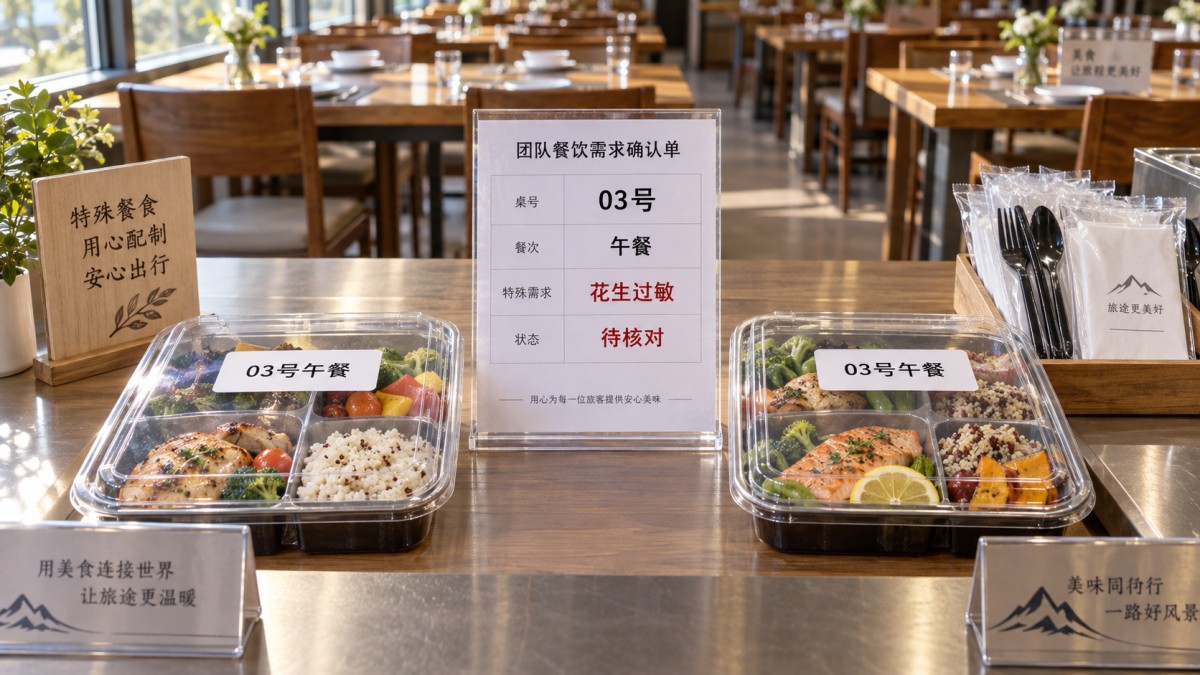
When a restaurant says “yes,” still ask how it will be done
When the travel coordinator sends requirements to a restaurant, they should be provided in writing and retained, with the group, date, meal, number of people, and specific requirements clearly stated. After the person responsible for the booking receives the information, they must also confirm that it has been passed on to the staff actually preparing and serving the food. Do not assume that a reply from the front desk means the kitchen has implemented the requirements.
For food allergies, check whether the dishes contain the relevant ingredients, sauces, or broth, and whether shared woks, frying oil, cutting boards, tongs, or other equipment could pose a risk of cross-contact. “It’ll be fine once it’s cooked” and “we’ll pick it out before serving” are not acceptable ways to control allergy risks. If the restaurant cannot verify the ingredients or meet the handling requirements, it should clearly explain the limitation, and another way of providing meals that meets the requirements should be arranged. Do not promise that the food is “absolutely safe.”
Specify exactly what each alternative dish involves: what it replaces, who it is for, when it will be served, and how it can be identified. A request for an individual meal should not be noted only in the menu remarks for the whole table. If it needs to be prepared in advance, packaged separately, or provided at a different meal price, agree on this when placing the order to avoid discovering on arrival that it cannot be done.
Check again before the meal, but don’t leave fixes until after the food is served
Once the pre-trip list has been confirmed, designate one up-to-date master record and assign a specific person to maintain it. Add any new requirements received by phone, private message, or group message to the record, then notify the affected restaurants and tour guide and confirm they have received the update. Otherwise, the office may update the list while the on-site team is still using an outdated menu.
Before each meal, the tour guide should check the record for that meal to confirm whether guests have added any requirements, whether the restaurant has made any last-minute changes to the dishes, and whether alternative meals are ready. If the restaurant changes, do not rely on the previous confirmation; verify the requirements with the new restaurant. If allergy information is received on site, first stop serving the guest any food that has not yet been confirmed, then verify the requirements or adjust the meal arrangement.
The food handoff must also be identifiable: verify special meals with the corresponding guest before handing them over, so they are not mistakenly taken by someone else at the table. When dining together, watch for contact risks from shared serving chopsticks or soup ladles and passing dishes around. Do not judge whether a dish meets the requirements by its appearance alone, and do not ask guests to taste it to “check.”
Record exceptions instead of leaving the next shift to guess
A restaurant running out of a dish, a guest changing seats, or packed meals being handed out incorrectly can all disrupt the original arrangement. After making an adjustment, record what was actually substituted, who confirmed it, and any issues that remain unresolved. During handover, don’t simply say, “This guest has dietary restrictions.” Explain the specific restrictions, which meals have been confirmed, and which still need attention.
If a guest develops suspected allergy symptoms after eating, stop them from eating more and seek medical assistance promptly. For emergencies such as difficulty breathing or altered consciousness, call 120 immediately. Keep the menu, ingredient information, and meal service records, and do not assume it is just an ordinary stomach upset. The key to preventing missed requirements is to ensure that every request has a clear status: who confirmed it, which meal it applies to, how the restaurant will handle it, and whether it was delivered to the right person on site.
Your 1:1 travel consultant will respond within 1 business day
How to plan your trip
- China Tourism Academy Releases Report on Autumn Trends in China's Domestic Customized Tour Market
- Visiting China for the First Time: How Many Cities Should You Include in a 15-Day Grand Tour?
- Is a geology exploration tour suitable for elementary school students?
- Is it worth hiring a guide for a visit to the Terracotta Army?
- Hebei Launches 5 “Trendy Hebei” Signature Tour Routes, Standardizing Inbound Tourism Services
Monthly travel guide
- Luoyang launches the “Autumn Charm of the Divine Capital” tourism promotion to build anticipation for winter travel
- Typhoon “White Dolphin” Forces Henan Scenic Areas to Close, Putting Summer Ground-Handling Services Under Pressure
- RCEP Implementing Rules for Indonesia Take Effect: Zero Tariffs for Cultural and Tourism Services Alongside Strict Customer Service Requirements
- Saudi Arabia’s New SASO Regulations Take Effect: Taqat Certification Required Before Chinese-Language Cultural Tourism Services Can Access Visit Saudi
- Zhengzhou Launches a Dedicated LCL Shipping Route for Cultural and Tourism Materials, Cutting Freight Costs by 18%
- Luoyang Cold Chain Intensification: Cultural and Creative Exports Delivered in 9 Days
- Expedited Pre-Approval for Group Visas to Three Southeast Asian Countries
- Tightening air freight capacity at Zhengzhou Airport delays the delivery of cultural and tourism materials
- Vietnam's New Regulations on Bus Monitoring Requirements for Group Tours
- Saudi SAMA New Regulations on Travel Liability Insurance Compliance Preparation
- Japanese tourists' new regulations for entering Henan local transport vehicles
- Wai Gao Qiao Wen Travel customs bonded warehouse summer group equipment fast lane
Popular destinations
- How should time for altitude acclimatization be planned for a Mount Siguniang and Bipenggou tour?
- How can you tell from an itinerary whether enough time has been set aside for photography?
- For a bilingual guide on a Grand China tour, should you choose full-tour accompaniment or service in separate segments?
- How can you plan a high-speed rail route for a panoramic tour of China without backtracking?
- How can you verify hotel check-in eligibility in advance for inbound tours covering all of China?
Why choose us

High cost-performance and transparent experience
Offer astonishing low prices without hidden tourism traps, enabling travelers to explore at lower costs while avoiding unnecessary spending loopholes, ensuring transparent consumption.

Personalization and dedicated service
Support 100% free customization, paired with one-on-one expert service, crafting exclusive itineraries based on travelers' specific needs, while providing professional guidance to enhance the personalization and professionalism of the journey.

Premium itinerary planning
Compact yet rich itineraries allow travelers to experience more within limited time; simultaneously, carefully selected hotels in prime locations provide convenient lodging conditions, overall enhancing travel comfort and experience.