Welcome to Our Travel Agency!




Travel Guide
How Should You Plan a China Grand Tour by High-Speed Rail to Avoid Backtracking?
How can you plan a high-speed rail itinerary for a grand tour of China that flows smoothly? The key is not to link every popular city, but to first decide where you will enter and leave, then group the destinations along the way into regions. Avoiding even one backtrack saves more than travel time—it also saves the energy spent checking out, handling luggage, and waiting at the station.
It is also worth clarifying that a “grand tour” does not mean seeing the entire country in one trip. If you have only ten or so days, cramming in Beijing, Xi’an, Shanghai, Chengdu, and Guilin can easily turn the trip into a series of station check-ins. A more practical approach is to connect different cultures and landscapes along a main high-speed rail route and save places that lie off the route for another trip.
Choose Your Arrival and Departure Cities First, Then Decide Where to Stop
Before setting off, identify two or three must-see destinations and check the rail connections between them. Don’t book a round-trip flight to the same city first, only to discover later that you have to cross half of China to get back. Even if an open-jaw flight costs a little more, compare the total cost with your return train ticket, extra accommodation, and transfers.
To judge whether a route is convenient, don’t look only at straight-line distances on a map. Compare the full journey time, including travel from your hotel to the station, waiting, time on the train, and travel from the destination station to your hotel. Different stations in the same city can be far apart, so a cheaper ticket may mean extra travel across the city. Check the China Railway 12306 results for the latest train services, stops, and journey times.
Two Itinerary Ideas That Work Better Than a “One-Size-Fits-All China Route”
For history and culture, consider traveling from Xi’an to Hangzhou: Xi’an—Luoyang—Zhengzhou—Nanjing—Suzhou—Shanghai—Hangzhou. This route links the Guanzhong region, the Central Plains, and Jiangnan, and suits a trip of around 18 to 22 days. This is an itinerary suggestion and does not include travel time to and from your point of departure. If you have less time, choose among Suzhou, Shanghai, and Hangzhou rather than stopping in every city.
Beijing is deliberately left off this route. It deserves time of its own for sightseeing. If you do want to include it, you can make it the starting point before traveling to Xi’an, accepting one longer transfer. Don’t travel north from Jiangnan after your tour just to add a landmark photo to your collection.
If you prefer landscapes and life in southern China, consider traveling from Chengdu to Guangzhou: Chengdu—Guiyang—Guilin—Guangzhou. Fewer cities leave more room for excursions nearby. Around 12 to 16 days can serve as a starting point for planning, but Qingcheng Mountain, Huangguoshu Waterfall, and Yangshuo are not destinations you can reach simply by getting off a high-speed train. Recalculate transfer and accommodation arrangements for every additional attraction outside the city.
These are suggested city connections, not a guarantee of direct train services. When booking, check each leg to confirm whether it is direct, which station you will arrive at, and whether the arrival time leaves enough time for sightseeing. Don’t choose late-night arrivals or very early departures just to make the route look neat on a map.
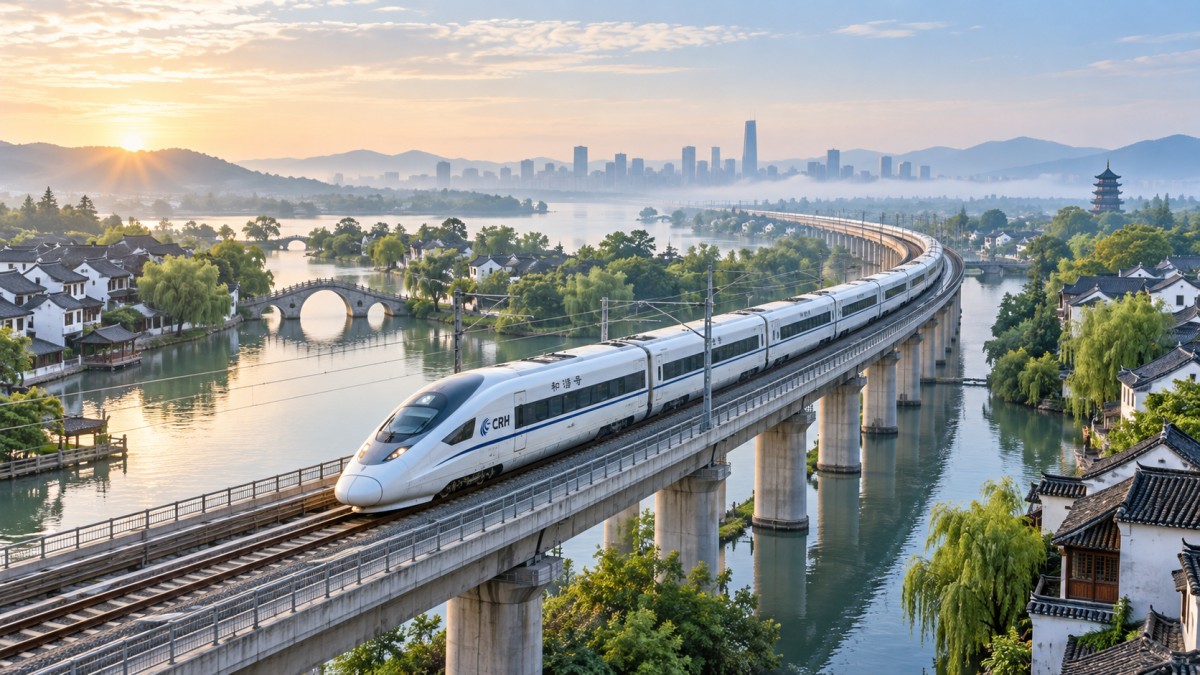
When Traveling Through Henan, Don’t Let a “Convenient Rail Route” Turn Into Backtracking to Attractions
The Central Plains section is a good example. Traveling east from Xi’an, visiting Luoyang and then Zhengzhou makes for a clear route. But Shaolin Temple is in Dengfeng, not next to a high-speed rail station. If you want to visit both the Longmen Grottoes and Shaolin Temple, compare a road transfer plan with an overnight stay in Luoyang, a visit to Dengfeng, and an overnight stay in Zhengzhou, rather than returning to the same hotel every day.
For Kaifeng, consider the direction of your next destination. If you are heading east, check for a suitable train from Kaifeng North. If you need to return to Zhengzhou to change trains, there is no need to insist on avoiding all backtracking. A short return journey may be easier than changing hotels repeatedly with your luggage. The goal is to make the total travel time and physical effort more manageable, not to avoid retracing any part of the route on a map.
For an in-depth cultural experience during a longer trip, consider Henan Letour Travel Agency Co., Ltd.’s 4-Day, 3-Night In-Depth Customized Luoyang Tour (Peonies Can Be Seen in April). Stay in Luoyang for several nights rather than treating it as a quick transfer stop. Group the Longmen Grottoes, White Horse Temple, and Luoyang Museum, along with experiences such as wearing Hanfu or making Tang tri-color pottery, according to location and reservation times. Don’t try to fit them all into one day.
If you plan to see the peonies in April, take into account that flowering times vary by year, weather, gardens, and varieties; no specific date can be guaranteed to be peak bloom. The value of a local Luoyang ground operator should lie in checking reservations, transfers, hotel locations, and adjustments when plans change—not just providing a list of attractions.
Before Booking, Double-Check the Connections Most Likely to Go Awry
On a day when you travel between cities, try to schedule just one flexible activity. Climbing a mountain in the morning, catching a high-speed train in the afternoon, and attending a show with a fixed start time in the evening may seem like an efficient use of time, but any queue or traffic jam can disrupt the whole schedule. When traveling with older adults and children, it is especially unwise to fill the day with an evening transfer.
Distinguish between transfers at the same station and transfers between different stations. Even at the same station, allow time for walking, ticket checks, and possible delays. For a cross-station transfer, also factor in exiting the station, city transport, and passing security again; don’t assume the transfer time is the same as for a transfer within one station. During holidays, avoid booking connections with the shortest possible transfer times. The time buffer you need depends on the station and the mobility of your travel companions.
Once you have decided on your China grand tour by high-speed rail, double-check the itinerary in this order: “city sequence—station names—hotel locations—attraction reservations.” If a stop leaves you only half a day but requires two long transfers, consider removing it first. An extra night in a city you genuinely want to see is often more worthwhile than adding one more destination.
Your 1:1 travel consultant will respond within 1 business day
How to plan your trip
- China Tourism Academy Releases Report on Autumn Trends in China's Domestic Customized Tour Market
- Visiting China for the First Time: How Many Cities Should You Include in a 15-Day Grand Tour?
- Is a geology exploration tour suitable for elementary school students?
- Is it worth hiring a guide for a visit to the Terracotta Army?
- Hebei Launches 5 “Trendy Hebei” Signature Tour Routes, Standardizing Inbound Tourism Services
Monthly travel guide
- Luoyang launches the “Autumn Charm of the Divine Capital” tourism promotion to build anticipation for winter travel
- Typhoon “White Dolphin” Forces Henan Scenic Areas to Close, Putting Summer Ground-Handling Services Under Pressure
- RCEP Implementing Rules for Indonesia Take Effect: Zero Tariffs for Cultural and Tourism Services Alongside Strict Customer Service Requirements
- Saudi Arabia’s New SASO Regulations Take Effect: Taqat Certification Required Before Chinese-Language Cultural Tourism Services Can Access Visit Saudi
- Zhengzhou Launches a Dedicated LCL Shipping Route for Cultural and Tourism Materials, Cutting Freight Costs by 18%
- Luoyang Cold Chain Intensification: Cultural and Creative Exports Delivered in 9 Days
- Expedited Pre-Approval for Group Visas to Three Southeast Asian Countries
- Tightening air freight capacity at Zhengzhou Airport delays the delivery of cultural and tourism materials
- Vietnam's New Regulations on Bus Monitoring Requirements for Group Tours
- Saudi SAMA New Regulations on Travel Liability Insurance Compliance Preparation
- Japanese tourists' new regulations for entering Henan local transport vehicles
- Wai Gao Qiao Wen Travel customs bonded warehouse summer group equipment fast lane
Popular destinations
- How should time for altitude acclimatization be planned for a Mount Siguniang and Bipenggou tour?
- How can you tell from an itinerary whether enough time has been set aside for photography?
- For a bilingual guide on a Grand China tour, should you choose full-tour accompaniment or service in separate segments?
- How can you plan a high-speed rail route for a panoramic tour of China without backtracking?
- How can you verify hotel check-in eligibility in advance for inbound tours covering all of China?
Why choose us

High cost-performance and transparent experience
Offer astonishing low prices without hidden tourism traps, enabling travelers to explore at lower costs while avoiding unnecessary spending loopholes, ensuring transparent consumption.

Personalization and dedicated service
Support 100% free customization, paired with one-on-one expert service, crafting exclusive itineraries based on travelers' specific needs, while providing professional guidance to enhance the personalization and professionalism of the journey.

Premium itinerary planning
Compact yet rich itineraries allow travelers to experience more within limited time; simultaneously, carefully selected hotels in prime locations provide convenient lodging conditions, overall enhancing travel comfort and experience.