Welcome to Our Travel Agency!




A photography itinerary for Shanxi’s ancient architecture needs to balance morning light with travel between locations. The most practical approach is to: choose one primary subject to photograph each day, stay near the next day’s shooting location, and connect attractions while traveling in the same direction. Don’t start by pinning every famous temple and historic site on a map and then trying to rush between them. Whether you can capture the morning light depends not only on sunrise time, but also on the building’s orientation, hills blocking the light, opening hours, and whether you can access a suitable vantage point.
If you have only four or five days, you could start with the Datong–Yingxian–Wutai County–Taiyuan route; Pingyao, Shuanglin Temple, and Zhenguo Temple are better suited to a separate extension. Trying to fit northern, central, and southeastern Shanxi into a short trip often means spending both early mornings and evenings on the road.
First, decide: do you want to photograph the sunrise or ancient architecture in the morning?
The low-angle light around sunrise is well suited to capturing roofline silhouettes, the layers of timber construction, and the relationship between buildings and their surroundings. However, this does not mean you can necessarily go inside at that time. If courtyards and halls are not yet open, you may only be able to photograph from permitted areas outside; walls, trees, and nearby buildings may also block the view you had in mind.
It is therefore best to prepare two approaches for each priority location: photograph the surroundings from outside before opening, then photograph the courtyard and architectural details once inside. If your goal is to photograph statues, murals, or roof trusses indoors, prioritize visitor and photography rules. Do not build your itinerary on the assumption that arriving early will let you take the photos you want.
Morning is not necessarily the best time for every facade, either. East-facing facades are more likely to receive direct sunlight in the morning, while west-facing facades are worth considering in the afternoon; components beneath deep eaves may remain in shadow throughout the day. Before setting out, use a map and a sun-position tool to check the orientation, then account for obstructions on site. This is more effective than simply chasing the sunrise.
How to plan four days so there is time for both photography and travel
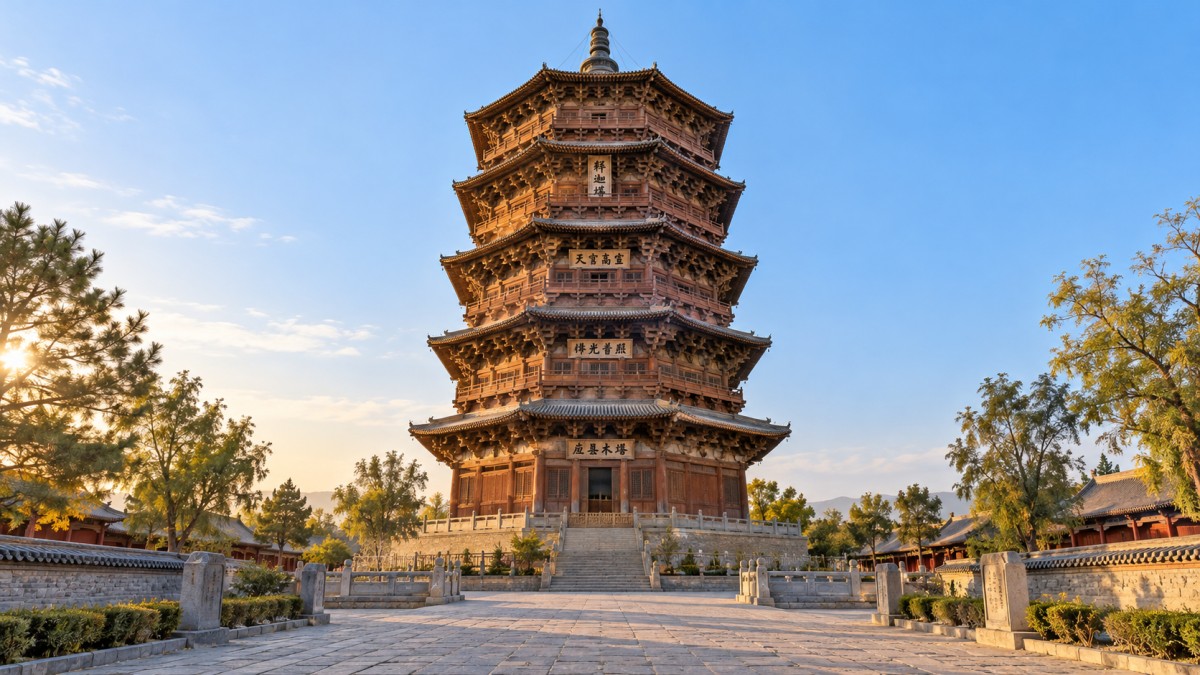
The route below is suitable for a trip focused on the exteriors of ancient buildings, courtyard spaces, and timber construction details. Four days requires some compromises; adding a day gives you more flexibility to wait for the right light and photograph locations more than once. Ideally, arrive in Datong before the first day so you do not have to treat your arrival day as a full photography day.
The key to this route is keeping each day’s schedule under control. If you need to travel onward after photographing Yingxian, avoid adding several villages at the last minute. Although Foguang Temple and Nanchan Temple are both in Wutai County, do not assume that being in the same county makes them convenient stops on the way; you still need to allow separate travel time between them.
If you want to spend the third day carefully observing Foguang Temple’s architecture and waiting for the light in the courtyard, move Nanchan Temple to an additional day. Time for photographing ancient architecture in Wutai County and time for visiting the Wutai Mountain scenic area should also be planned separately. Do not add a full mountain sightseeing itinerary simply because the names are similar.
Build travel time into the schedule; don’t rely on driving times alone
The driving time shown by navigation does not include checking out and loading the vehicle, parking and walking, collecting tickets and entering the site, lunch, or organizing equipment. Photography trips also often involve extra time spent “waiting for one more beam of light.” When planning, work backward from the time you want to arrive at the next location and allow time for each of these steps.
On days when you need to travel between regions, try to schedule just one primary photography location. Midday, when the light is often harsh, is usually a good time to travel. However, overcast weather, short winter days, or a location where details beneath the eaves are the main subject can make midday photography worthwhile too. There is no need to mechanically use every midday period for travel.
Choose your accommodation based on your photography priorities, too. Hotels in cities offer convenient dining, while accommodation in towns may shorten the next day’s journey. Even staying nearby can be less advantageous if you need to take a detour to reach the scenic area. When choosing a place to stay, consider breakfast availability, parking, and ease of access early in the morning, not just the straight-line distance on a map.
When the weather changes, adapting what you photograph is more effective than rushing to a vantage point
On sunny days, focus on rooftops, facades, and the interplay of light and shadow. Overcast light is even, making it suitable for observing dougong brackets, carvings, and the layers of a courtyard. In rainy weather, you can use views from beneath the eaves where permitted and look for reflections on stone paths. Do not cross barriers, step on raised foundations, or touch architectural components to get a shot.
Indoor photography must follow site rules. Do not assume that flash, tripods, or supplemental lighting equipment are allowed. You do not need to carry every kind of equipment, either: a standard zoom lens is useful for recording spatial relationships, while a medium-to-telephoto lens helps frame rooflines and architectural components. Carrying too much adds to the burden of climbing steps and traveling between locations.
If your companions are more interested in the cultural experience, plan a day around “one in-depth photography location plus a guided visit or a rest.” If the photographer repeatedly waits for the light while everyone else is left waiting in place, even a well-planned itinerary can become tiring.
Be specific about your photography goals before booking
When asking a travel agency to help design your itinerary, you can list the three buildings you most want to photograph, whether you need to set out early in the morning, how long you are willing to travel by car without a break, and whether you are willing to change the order based on the weather. In addition to the price, clarify vehicle service hours, early departures, driver rest periods, and fees for last-minute route changes so that your photography needs are properly incorporated into the itinerary.
Henan Le Travel Agency Co., Ltd. offers customized domestic tours, and these requirements are best discussed separately during the planning stage. If you would also like to plan a cultural trip in Henan, you can consider the Luoyang Longmen Grottoes + Shaolin Kung Fu Tour to learn about cultural experiences at the Longmen Grottoes and Shaolin Temple. It is better suited to a separate trip than to an already packed photography itinerary in Shanxi.
Before finalizing the route, mark one building each day as a place “worth allowing time for,” then check where you will stay the previous night and what time you will leave that day. Once you have clear answers to these two questions, it is easier to balance morning photography with travel between locations.
Your 1:1 travel consultant will respond within 1 business day
How to plan your trip
- China Tourism Academy Releases Report on Autumn Trends in China's Domestic Customized Tour Market
- Visiting China for the First Time: How Many Cities Should You Include in a 15-Day Grand Tour?
- Is a geology exploration tour suitable for elementary school students?
- Is it worth hiring a guide for a visit to the Terracotta Army?
- Hebei Launches 5 “Trendy Hebei” Signature Tour Routes, Standardizing Inbound Tourism Services
Monthly travel guide
- Luoyang launches the “Autumn Charm of the Divine Capital” tourism promotion to build anticipation for winter travel
- Typhoon “White Dolphin” Forces Henan Scenic Areas to Close, Putting Summer Ground-Handling Services Under Pressure
- RCEP Implementing Rules for Indonesia Take Effect: Zero Tariffs for Cultural and Tourism Services Alongside Strict Customer Service Requirements
- Saudi Arabia’s New SASO Regulations Take Effect: Taqat Certification Required Before Chinese-Language Cultural Tourism Services Can Access Visit Saudi
- Zhengzhou Launches a Dedicated LCL Shipping Route for Cultural and Tourism Materials, Cutting Freight Costs by 18%
- Luoyang Cold Chain Intensification: Cultural and Creative Exports Delivered in 9 Days
- Expedited Pre-Approval for Group Visas to Three Southeast Asian Countries
- Tightening air freight capacity at Zhengzhou Airport delays the delivery of cultural and tourism materials
- Vietnam's New Regulations on Bus Monitoring Requirements for Group Tours
- Saudi SAMA New Regulations on Travel Liability Insurance Compliance Preparation
- Japanese tourists' new regulations for entering Henan local transport vehicles
- Wai Gao Qiao Wen Travel customs bonded warehouse summer group equipment fast lane
Popular destinations
- How should time for altitude acclimatization be planned for a Mount Siguniang and Bipenggou tour?
- How can you tell from an itinerary whether enough time has been set aside for photography?
- For a bilingual guide on a Grand China tour, should you choose full-tour accompaniment or service in separate segments?
- How can you plan a high-speed rail route for a panoramic tour of China without backtracking?
- How can you verify hotel check-in eligibility in advance for inbound tours covering all of China?
Why choose us

High cost-performance and transparent experience
Offer astonishing low prices without hidden tourism traps, enabling travelers to explore at lower costs while avoiding unnecessary spending loopholes, ensuring transparent consumption.

Personalization and dedicated service
Support 100% free customization, paired with one-on-one expert service, crafting exclusive itineraries based on travelers' specific needs, while providing professional guidance to enhance the personalization and professionalism of the journey.

Premium itinerary planning
Compact yet rich itineraries allow travelers to experience more within limited time; simultaneously, carefully selected hotels in prime locations provide convenient lodging conditions, overall enhancing travel comfort and experience.