Welcome to Our Travel Agency!




Travel Guide
For an in-depth walking tour of Xi’an’s old streets, choose one neighborhood and take your time over half a day. Don’t try to squeeze the Muslim Quarter, Shuyuanmen, and a climb onto the city wall into the same itinerary. If it’s your first visit, try “Bell Tower—Beiyuanmen—Xiyangshi—Daxuexi Lane—Miaohou Street—Sajinqiao” for a mix of alleyways, food, and local life. If you’re more interested in calligraphy, painting, stone inscriptions, and a quieter pace, plan Shuyuanmen and Xiangzimiao Street for a separate half-day.
The experience of exploring old streets often depends on whether the route flows well, whether you can sit down and rest, and whether each stop offers something worth observing. Rather than adding more photo stops, give each street a little more time.
Choose a theme for your half-day, then plan your departure time
If you want to explore the Muslim Quarter’s alleyways and food culture, choose the area northwest of the Bell Tower. If you prefer shops selling writing and painting supplies, courtyard compounds, and stone-inscription culture, choose the area around Shuyuanmen. You can explore the two neighborhoods separately, with a lunch break in between; there’s no need to wear yourself out trying to walk the entire route.
If you enjoy street photography, set out early to see shops open and residents go about their daily shopping. If food is your main focus, plan your route around mealtimes. During the hot afternoon, consider visiting indoor attractions or taking a tea break midway, then continue walking in the evening. The lighting and dining atmosphere stand out more at night, but daytime is better for making out architectural details and reading stone inscriptions.
Before setting out, decide on just three points: your starting point, main stop, and endpoint. Then add nearby intersections as waypoints in your navigation app to avoid being routed away from the streets you actually want to see just to shorten the distance.
Half-day route through the Muslim Quarter: from a lively entrance into everyday alleyway life
Suggested order: Bell Tower area—Beiyuanmen—Xiyangshi—Daxuexi Lane—Miaohou Street—Sajinqiao. This route heads from the Bell Tower into the neighborhood to its northwest. Allow around 3–4 hours to walk, look around, and enjoy a meal. If you add a courtyard visit or an extended guided tour, shorten the latter part of the route. Use the timing as a planning guide, not a checklist to complete.
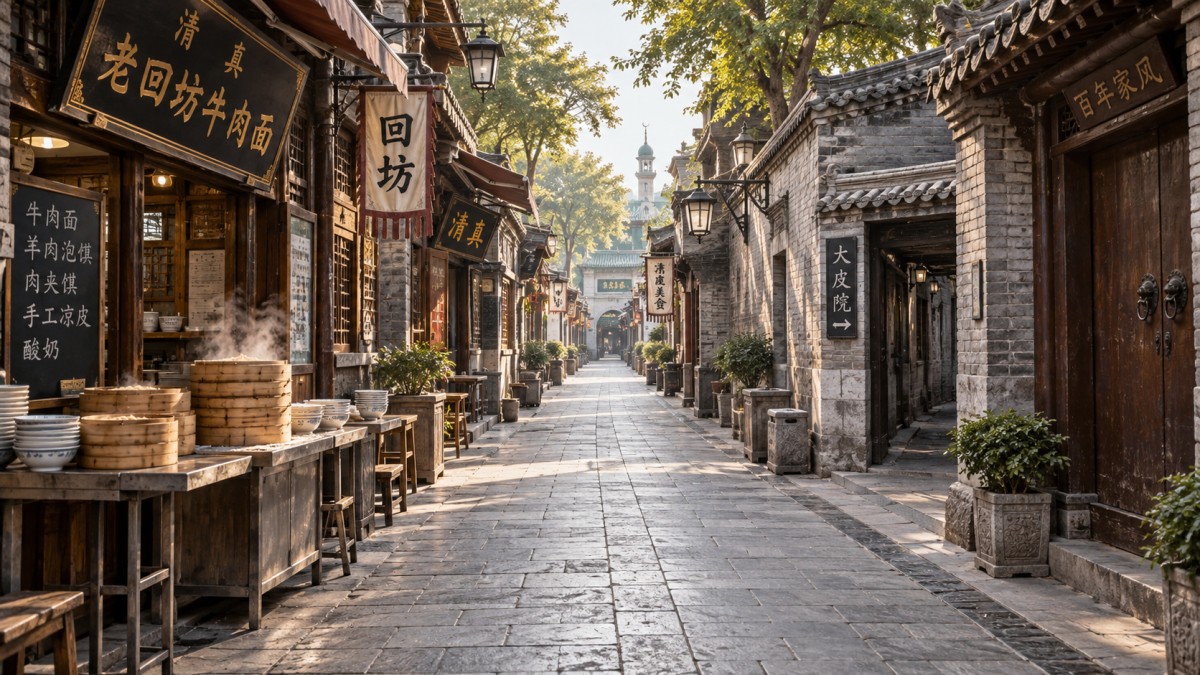
From the Bell Tower to Beiyuanmen: get your bearings before joining any queues
Start around the Bell Tower and first note how it relates to the Drum Tower, the roads, and Beiyuanmen before entering the alleyways. Understanding this spatial layout makes it easier to find your way at later junctions and appreciate the difference between the city’s public spaces and its inner residential neighborhoods.
Beiyuanmen is a good place to take in the neighborhood atmosphere, but you don’t need to eat everything you want to try right at the entrance. Pick up a snack to share and save your main meal for a later stretch. This spreads out your stops and makes it less likely that queues will disrupt your afternoon.
From Xiyangshi to Daxuexi Lane: look beyond the storefront signs to the alleyways
Walk along Beiyuanmen to Xiyangshi, then head west and continue to Daxuexi Lane. At intersections, notice how side lanes connect to the main street and how storefronts alternate with residential entrances. The old streets’ cultural character comes not only from individual buildings, but also from everyday life: residents shopping for groceries, merchants preparing food, and neighbors crossing paths.
Take your time on this stretch, but don’t walk to the end of every side lane. Prioritize lanes with a clear exit and regular public access. Respect restrictions on entering residential courtyards and religious spaces, and on taking photographs. Bicycles and electric scooters also use the narrow lanes, so keep to the side when stopping for photos and don’t block shop entrances or intersections.
From Miaohou Street to Sajinqiao: finish with a sit-down meal
Continue from Daxuexi Lane to Miaohou Street, then head toward Sajinqiao for a main meal. When choosing a restaurant, check the menu, portion sizes, and your companions’ tastes before deciding whether to queue. If you only have half a day, spending a long time waiting for one snack means giving up another stretch of old streets.
Paomo is best enjoyed slowly at a table, while noodles are better suited to a proper main meal. Pastries and similar items can be shared in small portions. Avoid ordering several staple dishes in a row and then forcing yourself to add snacks. Respect halal dietary practices in the Muslim Quarter, and do not bring outside non-halal food into halal dining establishments.
For a quieter stroll, take in Shuyuanmen and Xiangzimiao Street
Suggested order: Shuyuanmen—Sanxue Street and the area around the Forest of Stone Steles Museum—return to the west entrance of Shuyuanmen—Xiangzimiao Street—Defu Lane. This area is better suited to browsing calligraphy and painting shops, writing and painting supplies, and the scale of the old lanes. It’s also easy to make time to sit down and rest along the way.
Shuyuanmen shouldn’t be treated simply as a place to buy souvenirs. Browse the calligraphy, seals, and rubbings on display in different shops, and learn more about something that interests you. If you plan to buy, first distinguish decorative printed items from handmade works, for example, and ask about the materials and how they were made. There’s no need to rush into a purchase just because a shop has an old-fashioned look.
If you plan to visit the Forest of Stone Steles Museum, make it the main stop of the day and set aside a full block of time for reading the exhibits and resting. If you just want a relaxed stroll, walk through the surrounding lanes and head back, then continue to Xiangzimiao Street and Defu Lane. Climbing onto the city wall takes extra energy, so allow time for it separately.
Leave room to shorten the route for a more comfortable walk
If you’re traveling with older adults or children, prioritize a sit-down meal and a break along the way, and spend less time exploring side lanes. Old-street paving, thresholds, and narrow passageways can make it difficult to get around with a stroller. A route marked as walkable on a map isn’t necessarily smooth or easy all the way. In rainy weather, avoid narrow lanes where possible; non-slip shoes are more practical than a photo-ready outfit.
You don’t have to stay right next to a popular food street. When choosing accommodation, consider how easy it is to get from the hotel to the neighborhood entrance, whether it’s quiet at night, and whether you’ll need to drag your luggage through crowded areas. You can also take a ride back after your walk; there’s no need to walk the same route again just to return to your starting point.
If you book a guided tour or a customized itinerary, explain in advance whether you’re interested in neighborhood history, religious architecture, or food culture, and agree on the walking duration and frequency of breaks. A good old-street itinerary should let you skip a stretch on the day: spend longer at a shop that catches your interest, or end the walk easily if you get tired. Before setting out, mark the one place you most want to visit and one meal you want to have. Adjust the rest of the stops to how you feel that day.
Your 1:1 travel consultant will respond within 1 business day
How to plan your trip
- China Tourism Academy Releases Report on Autumn Trends in China's Domestic Customized Tour Market
- Visiting China for the First Time: How Many Cities Should You Include in a 15-Day Grand Tour?
- Is a geology exploration tour suitable for elementary school students?
- Is it worth hiring a guide for a visit to the Terracotta Army?
- Hebei Launches 5 “Trendy Hebei” Signature Tour Routes, Standardizing Inbound Tourism Services
Monthly travel guide
- Luoyang launches the “Autumn Charm of the Divine Capital” tourism promotion to build anticipation for winter travel
- Typhoon “White Dolphin” Forces Henan Scenic Areas to Close, Putting Summer Ground-Handling Services Under Pressure
- RCEP Implementing Rules for Indonesia Take Effect: Zero Tariffs for Cultural and Tourism Services Alongside Strict Customer Service Requirements
- Saudi Arabia’s New SASO Regulations Take Effect: Taqat Certification Required Before Chinese-Language Cultural Tourism Services Can Access Visit Saudi
- Zhengzhou Launches a Dedicated LCL Shipping Route for Cultural and Tourism Materials, Cutting Freight Costs by 18%
- Luoyang Cold Chain Intensification: Cultural and Creative Exports Delivered in 9 Days
- Expedited Pre-Approval for Group Visas to Three Southeast Asian Countries
- Tightening air freight capacity at Zhengzhou Airport delays the delivery of cultural and tourism materials
- Vietnam's New Regulations on Bus Monitoring Requirements for Group Tours
- Saudi SAMA New Regulations on Travel Liability Insurance Compliance Preparation
- Japanese tourists' new regulations for entering Henan local transport vehicles
- Wai Gao Qiao Wen Travel customs bonded warehouse summer group equipment fast lane
Popular destinations
- How should time for altitude acclimatization be planned for a Mount Siguniang and Bipenggou tour?
- How can you tell from an itinerary whether enough time has been set aside for photography?
- For a bilingual guide on a Grand China tour, should you choose full-tour accompaniment or service in separate segments?
- How can you plan a high-speed rail route for a panoramic tour of China without backtracking?
- How can you verify hotel check-in eligibility in advance for inbound tours covering all of China?
Why choose us

High cost-performance and transparent experience
Offer astonishing low prices without hidden tourism traps, enabling travelers to explore at lower costs while avoiding unnecessary spending loopholes, ensuring transparent consumption.

Personalization and dedicated service
Support 100% free customization, paired with one-on-one expert service, crafting exclusive itineraries based on travelers' specific needs, while providing professional guidance to enhance the personalization and professionalism of the journey.

Premium itinerary planning
Compact yet rich itineraries allow travelers to experience more within limited time; simultaneously, carefully selected hotels in prime locations provide convenient lodging conditions, overall enhancing travel comfort and experience.