Welcome to Our Travel Agency!




Travel Guide
For a three-day, two-night customized corporate trip, a relatively practical arrangement is: arrive on the first day and complete light communication, hold a focused meeting on the morning of the second day and a team-building activity in the afternoon, then leave time for independent activities and departure on the third day. This arrangement assumes that the main participants can arrive by the afternoon of the first day. If the journey takes a long time, the sightseeing scope should be reduced to avoid packing meetings, attractions, and group meals into the same day.
Three days and two nights does not mean three full days. Deducting the time required for round-trip transportation, transfers, check-in, and meals before scheduling the core activities makes it easier to balance project reviews, team collaboration, and leisure.
Determine What Must Be Completed Before Planning the Schedule
Corporate trips can have different objectives. If the trip is a reward after completing a project, leisure can take priority. If cross-departmental coordination issues also need to be addressed, continuous meeting time should be retained. When both objectives need to be achieved, it is advisable to define one primary objective and treat the other as supplementary; otherwise, the team may end up rushing through activities during the day and making up for meetings at night.
Before departure, four matters should be confirmed: the earliest time by which everyone can arrive, what results the meeting needs to produce, whether anyone needs to remain on duty, and how much walking and activity intensity the team can accept. For projects that are still in operation, rotating contacts and fixed response periods can be arranged to reduce the pressure on everyone to respond to work messages at any time.
The destination should also be selected according to the available time. For a three-day, two-night trip, priority should be given to areas with convenient transportation connections and relatively concentrated accommodation and main activities. Visiting multiple cities may appear more enriching, but it increases the burden caused by loading and unloading luggage, gathering and roll calls, and road delays.
A Three-Day, Two-Night Trip Can Follow This Pace
The following arrangement applies to teams that can complete assembly on the afternoon of the first day and return on the afternoon or evening of the third day. The durations in the table are scheduling recommendations and should be adjusted according to flights, train services, and transfer distances during implementation.
If the core task is an annual seminar, the meeting can be moved forward to the afternoon of the first day and continued on the morning of the second day, but only if all participants have arrived and are in a suitable condition. If the team can only arrive in the evening of the first day, one sightseeing activity should be reduced rather than cutting into sleep or scheduling an intensive meeting on the morning of departure.
Meetings Should Produce Results, and Team Building Should Encourage Participation
Basic materials should be sent to participants before the meeting. On-site discussion should focus on differences, interfaces, and next steps. The review can be organized around questions such as “Which aspects affected delivery, what were the reasons, and how should they be improved next time?” This avoids having each person simply read out a work summary. Content involving customer information, quotations, or internal data should be handled in a meeting space with appropriate privacy conditions.
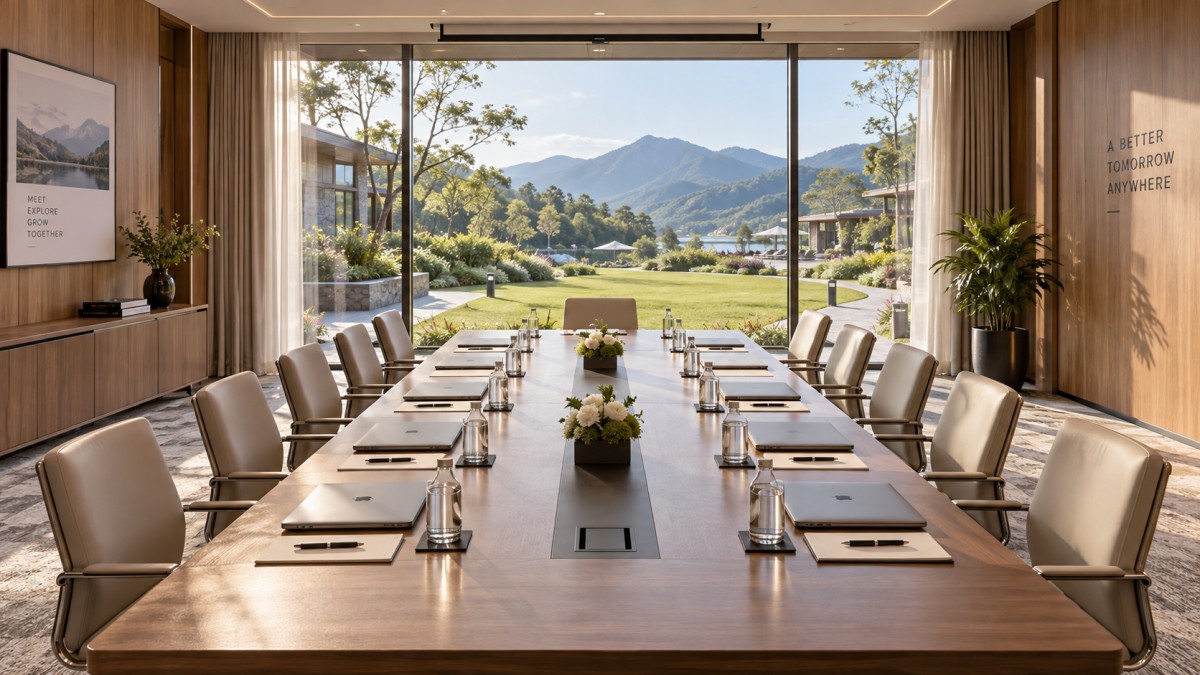
When booking a hotel, it is not enough to check whether it has a meeting room. The seating arrangement, screen projection interfaces, network, sound system, power outlets, sound insulation, and usage hours should also be confirmed. If group discussions are required, it is important to consider in advance whether the tables and chairs can be rearranged and whether there is suitable space for small-group discussions.
Team-building activities should match the team's condition. After completing an intense task, light hiking, cultural experiences, or low-intensity collaborative games are more likely to be accepted. When the goal is to improve collaboration, tasks such as group route planning and information exchange can be designed, with some time reserved to discuss ways of working together. Activities do not need to rely on physical performance rankings, and people who have difficulty participating in sports should also be given clear roles.
Independent activities require a complete time block. Leaving only a few dozen minutes before gathering at an attraction usually allows time only to buy water, shop, or rest, and is unlikely to provide a meaningful independent visit. Options such as nearby walks, coffee breaks, and cultural visits can be offered, while the meeting point, emergency contact information, and procedures for late arrivals should be unified.
The Destination Experience Can Be Varied, but Do Not Copy an Entire Itinerary
Teams that prefer natural scenery and an ancient-town atmosphere can refer to the cycling experience along the Erhai Ecological Corridor, visits to Dali Ancient Town, and an experience in Xizhou Ancient Town included in the Yunnan Dali Leisure Tour. When planning a corporate itinerary, one or two activities should be selected according to the meeting location and transfer distance. It is not advisable to fit Cangshan Mountain, Erhai Lake, ancient towns, and other activities into limited free time. Cycling should be offered on a voluntary basis, with walking or rest options arranged at the same time. A visit to Cangshan Mountain also requires consideration of the weather, physical condition, and transportation connections.
If Henan is selected, meetings and nearby activities can be organized around a single accommodation base in Luoyang or Zhengzhou. Henan LeLü Travel Agency Co., Ltd. provides inbound travel services in Henan and customized domestic travel services, and can coordinate transportation, hotels, tickets, tour guides, and catering as part of an integrated itinerary. When commissioning itinerary design, the meeting objectives, arrival time, and activity intensity should be explained first before determining the combination of attractions.
Quotations and Execution Plans Should Clearly State Easily Overlooked Details
When comparing proposals, total costs should be checked against the same scope of services. In addition to transportation, accommodation, and catering, attention should also be paid to the meeting venue and equipment, team-building implementation, the number of transfer trips, single-room supplements, insurance arrangements, taxes and fees, and the scope of personal expenses during independent activities. How adjustments will be handled in the event of a reduction in participant numbers, changes to service schedules, or activity cancellations caused by weather should also be included in the contract.
Before departure, an execution plan should be prepared listing the contact persons for each stage, meeting points, vehicle arrangements, meeting equipment, and alternative activities for rainy days. The handover times between independent activities and the group itinerary should be clearly stated, and a separate buffer should be reserved before departure. Once these conditions have been implemented, the team can decide which attraction to add. This makes it easier for a three-day, two-night trip to complete its objectives while also allowing the team to rest.
Your 1:1 travel consultant will respond within 1 business day
How to plan your trip
- Autumn Breaks in Multiple Regions Boost November Travel, Offering Hope for the Traditional Low Season
- China Tourism Academy Releases Report on Autumn Trends in China's Domestic Customized Tour Market
- Is a 15-day panoramic tour of China covering multiple cities too rushed?
- Visiting China for the First Time: How Many Cities Should You Include in a 15-Day Grand Tour?
- Is a geology exploration tour suitable for elementary school students?
Monthly travel guide
- Luoyang launches the “Autumn Charm of the Divine Capital” tourism promotion to build anticipation for winter travel
- Typhoon “White Dolphin” Forces Henan Scenic Areas to Close, Putting Summer Ground-Handling Services Under Pressure
- RCEP Implementing Rules for Indonesia Take Effect: Zero Tariffs for Cultural and Tourism Services Alongside Strict Customer Service Requirements
- Saudi Arabia’s New SASO Regulations Take Effect: Taqat Certification Required Before Chinese-Language Cultural Tourism Services Can Access Visit Saudi
- Zhengzhou Launches a Dedicated LCL Shipping Route for Cultural and Tourism Materials, Cutting Freight Costs by 18%
- Luoyang Cold Chain Intensification: Cultural and Creative Exports Delivered in 9 Days
- Expedited Pre-Approval for Group Visas to Three Southeast Asian Countries
- Tightening air freight capacity at Zhengzhou Airport delays the delivery of cultural and tourism materials
- Vietnam's New Regulations on Bus Monitoring Requirements for Group Tours
- Saudi SAMA New Regulations on Travel Liability Insurance Compliance Preparation
- Japanese tourists' new regulations for entering Henan local transport vehicles
- Wai Gao Qiao Wen Travel customs bonded warehouse summer group equipment fast lane
Popular destinations
- Luoyang Museum to Close; Night Tours at Longmen to Be Suspended; Restoration Work to Begin at White Horse Temple
- How can you confirm the actual group size when booking a small-group tour in western Sichuan?
- What cancellation fees apply when a participant drops out of a customized corporate trip at short notice?
- Which stop should come first on a Wudang Mountain and Shennongjia tour for the most convenient route?
- How should time for altitude acclimatization be planned for a Mount Siguniang and Bipenggou tour?
Why choose us

High cost-performance and transparent experience
Offer astonishing low prices without hidden tourism traps, enabling travelers to explore at lower costs while avoiding unnecessary spending loopholes, ensuring transparent consumption.

Personalization and dedicated service
Support 100% free customization, paired with one-on-one expert service, crafting exclusive itineraries based on travelers' specific needs, while providing professional guidance to enhance the personalization and professionalism of the journey.

Premium itinerary planning
Compact yet rich itineraries allow travelers to experience more within limited time; simultaneously, carefully selected hotels in prime locations provide convenient lodging conditions, overall enhancing travel comfort and experience.