Welcome to Our Travel Agency!




Travel Guide
If a participant drops out of a customized corporate trip at short notice, costs may arise for flight or train ticket refunds, hotel cancellations, transport and activity bookings already secured, and accommodation adjustments for the remaining participants. The amount that can be refunded depends on when the notice of the participant reduction is given, the change and cancellation terms for each resource, and the costs that cannot actually be recovered after cancellation.
Procurement teams can start with this principle: per-person items may be refundable when the number of participants decreases; items purchased for the group as a whole, those past their cancellation deadlines, or services already provided may not be reduced accordingly. Final settlement should be based on applicable laws, valid contractual terms, and supporting cost documentation. The amount to be deducted from the total trip price cannot be determined solely by how many days before departure the cancellation occurs.
Break down the costs to see what can be refunded
A company may receive a quote showing only a total price per person, but travel agencies use different billing units when booking hotels, vehicles, and tickets. One participant dropping out at short notice does not mean that every booked item can be reduced by one unit.
Transport: account for individual tickets and vehicle charters separately
Flight and train ticket refunds should be calculated according to the applicable ticket type and the timing of the refund request. Group air tickets may be subject to restrictions on submitting passenger lists, ticket issuance, name changes, and refunds; individual ticket rules should not be applied directly. If tickets have not yet been issued, check whether any seat reservation fees have already been paid and cannot be refunded.
Tour coaches, by contrast, depend more on the number and type of vehicles and the number of days they are used. If a smaller group still uses the original vehicle, the vehicle cost may not decrease. If the group reduction allows the operator to switch to a smaller vehicle or cancel one vehicle, calculate the resulting savings as well as the cancellation costs for the original booking. Do not deduct the cost of the original vehicle while ignoring a refund that has already been received.
Hotels: fewer participants do not necessarily mean fewer rooms
Check hotel costs against the number of rooms, number of nights, and cancellation deadlines. If two people share a room and one drops out, the other still needs accommodation, so the room charge may still apply. If two people who drop out were sharing a room and that room can still be canceled free of charge, there is a stronger basis for refunding the corresponding room charge.
If a single-room supplement is charged after the number of participants decreases, the calculation should also be explained: how accommodation costs were allocated in the original quote, whether the current room assignments can be rearranged, and how much of the room charge for the participants who dropped out is non-refundable. The cost of the same room should not be charged twice—both as a deduction from the participants who drop out and as an additional charge to those who remain.
Tickets, meals, and activities: check cancellation deadlines and booking units
For attraction tickets, show tickets, cable cars, and similar items, check the reservation, ticket issuance, and usage terms for each item. A real-name reservation does not necessarily mean a ticket is non-refundable, and an unused ticket is not necessarily fully refundable; the applicable product rules determine the outcome.
When group meals are booked by table, team-building activities by session, or guided tours by session, one fewer participant may not reduce the cost. Items purchased per person may be adjusted if they have not yet been committed. Custom clothing, souvenirs, and activity materials may also incur costs if they have already been produced, but completed items should be distinguished from those that can still be canceled.
Even when the contract specifies a cancellation fee percentage, check what the fee covers
When reviewing cancellation charges, procurement teams should compare the contract terms with the actual booking records. If the contract sets different percentage-based charges depending on how long before departure the cancellation occurs, check which costs each percentage covers and whether losses for flights, hotels, and other items will be added separately, to avoid charging twice for the same item.
For arrangements subject to rules governing package-tour contracts, if a traveler terminates the contract before the trip ends, the handling of necessary expenses and refunds of the remaining balance must be addressed. The contractual relationship may differ where a company signs a group contract, employees enroll separately, or meeting services are purchased under a separate arrangement. A cancellation percentage in one travel contract should not be applied to all items.
Statements such as “the resources have been secured” or “the supplier does not offer refunds” are not, by themselves, enough to explain the settlement amount. Procurement teams can ask the travel agency to provide the booking, change and cancellation rules, payment records, or supplier confirmation of the charge related to each deduction, with unrelated information redacted. The fact that a payment has been made does not mean that the entire amount is an unrecoverable loss; any refunds received later should be included in the settlement.
Also note the distinction between an advance payment and a deposit with legal effect. The name, agreement, and actual nature of the payment may affect how it is handled. An advance payment should not automatically be considered non-refundable when a participant drops out, and a deposit deduction, liquidated damages, and the full cost of all resources should not be combined without supporting grounds.
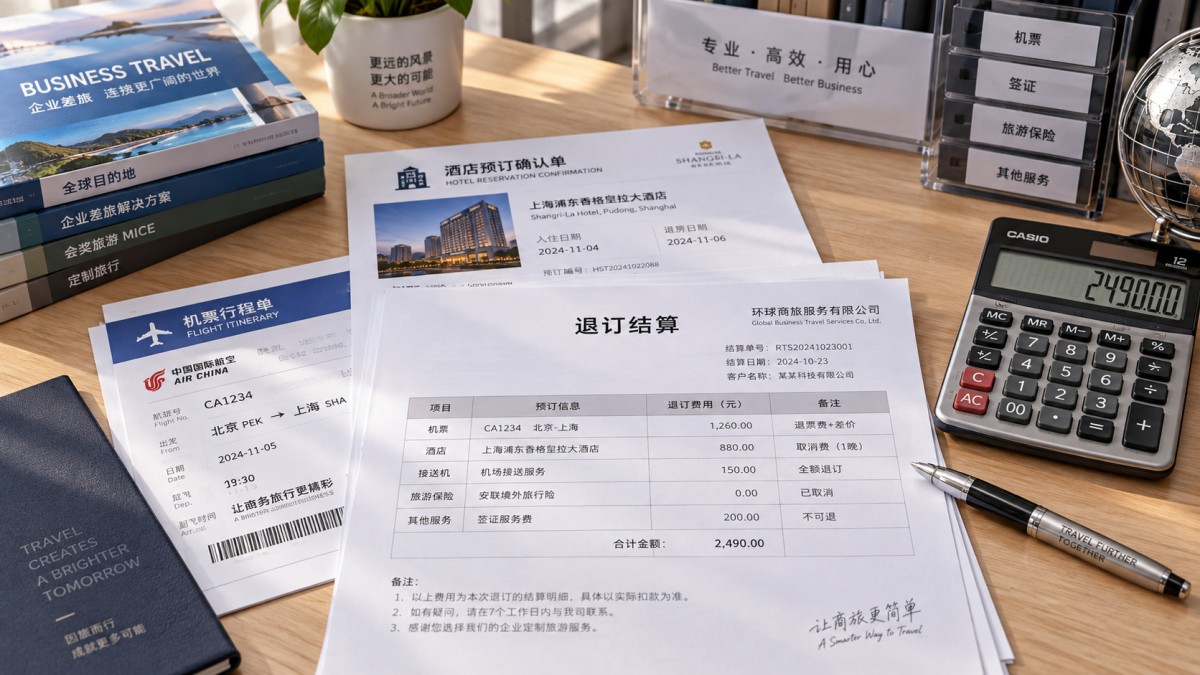
After a participant drops out, mitigate losses first, then settle the final deduction
The later the notice, the more free adjustment deadlines may have been missed. Once the company confirms internally that a participant is dropping out, it should promptly send written notice through the channel agreed by both parties. The notice should specify the participant, relevant dates, and whether the trip is being canceled or a replacement participant is being requested. Keep a record of when the travel agency receives the notice.
The company can then request the following three adjustments at the same time:
- Cancel items for which tickets have not yet been issued, production has not yet begun, or the free cancellation period is still open, and confirm the deadline for each action.
- Rearrange accommodation, dining tables, and vehicles, and calculate whether the reduced group size allows an entire room, table, or vehicle to be released.
- Assess whether a replacement participant is feasible, and confirm separately whether transport tickets, hotels, attraction tickets, and insurance can be changed, as well as any change fees.
A replacement participant is not a solution that can be applied to every booking. For bookings involving real-name tickets or special reservations, it may be necessary to cancel and rebook, potentially at a different price. If a participant drops out due to illness or other reasons, check whether the product has special change or cancellation terms and whether any purchased insurance covers the relevant circumstances, but do not promise in advance that fees will be waived or compensation paid.
For procurement settlement, obtain a verifiable breakdown of the difference
A settlement statement for a participant reduction that can be submitted for company approval should, at a minimum, specify the original order amount, the number of participants or rooms affected, the cancellation time, the refundable amount, the amount charged, and the supporting basis for each charge. If a refund is still being processed, distinguish between a provisional hold and a final deduction, and agree on how any later refund will be returned.
Also distinguish between “the refund due to the participant who drops out” and “the change in per-person costs for the remaining group.” Fixed costs for vehicles, guides, and other services may still be incurred, increasing the per-person cost for those who remain, but this alone does not justify a new deduction. If the travel agency proposes both a deduction for the participant reduction and an additional charge to the remaining participants, it should provide a comparison of the total group cost before and after the adjustment so that any duplicate calculation can be identified.
For future bookings, list the cancellation and change deadlines for individual tickets, rooms, vehicle charters, and activity sessions separately in a contract appendix, and specify deadlines for adjusting participant numbers and the required settlement documentation. When the group size is not yet settled, include “how the settlement will be calculated if the group decreases by a certain number of participants” in quote comparisons. A lower initial per-person price does not necessarily mean lower final spending if it is tied to strict resource booking conditions.
Your 1:1 travel consultant will respond within 1 business day
How to plan your trip
- Autumn Breaks in Multiple Regions Boost November Travel, Offering Hope for the Traditional Low Season
- China Tourism Academy Releases Report on Autumn Trends in China's Domestic Customized Tour Market
- Visiting China for the First Time: How Many Cities Should You Include in a 15-Day Grand Tour?
- Is a geology exploration tour suitable for elementary school students?
- Is it worth hiring a guide for a visit to the Terracotta Army?
Monthly travel guide
- Luoyang launches the “Autumn Charm of the Divine Capital” tourism promotion to build anticipation for winter travel
- Typhoon “White Dolphin” Forces Henan Scenic Areas to Close, Putting Summer Ground-Handling Services Under Pressure
- RCEP Implementing Rules for Indonesia Take Effect: Zero Tariffs for Cultural and Tourism Services Alongside Strict Customer Service Requirements
- Saudi Arabia’s New SASO Regulations Take Effect: Taqat Certification Required Before Chinese-Language Cultural Tourism Services Can Access Visit Saudi
- Zhengzhou Launches a Dedicated LCL Shipping Route for Cultural and Tourism Materials, Cutting Freight Costs by 18%
- Luoyang Cold Chain Intensification: Cultural and Creative Exports Delivered in 9 Days
- Expedited Pre-Approval for Group Visas to Three Southeast Asian Countries
- Tightening air freight capacity at Zhengzhou Airport delays the delivery of cultural and tourism materials
- Vietnam's New Regulations on Bus Monitoring Requirements for Group Tours
- Saudi SAMA New Regulations on Travel Liability Insurance Compliance Preparation
- Japanese tourists' new regulations for entering Henan local transport vehicles
- Wai Gao Qiao Wen Travel customs bonded warehouse summer group equipment fast lane
Popular destinations
- Luoyang Museum to Close; Night Tours at Longmen to Be Suspended; Restoration Work to Begin at White Horse Temple
- What cancellation fees apply when a participant drops out of a customized corporate trip at short notice?
- Which stop should come first on a Wudang Mountain and Shennongjia tour for the most convenient route?
- How should time for altitude acclimatization be planned for a Mount Siguniang and Bipenggou tour?
- How can you tell from an itinerary whether enough time has been set aside for photography?
Why choose us

High cost-performance and transparent experience
Offer astonishing low prices without hidden tourism traps, enabling travelers to explore at lower costs while avoiding unnecessary spending loopholes, ensuring transparent consumption.

Personalization and dedicated service
Support 100% free customization, paired with one-on-one expert service, crafting exclusive itineraries based on travelers' specific needs, while providing professional guidance to enhance the personalization and professionalism of the journey.

Premium itinerary planning
Compact yet rich itineraries allow travelers to experience more within limited time; simultaneously, carefully selected hotels in prime locations provide convenient lodging conditions, overall enhancing travel comfort and experience.