



A corporate customized travel budget should not be based solely on the per-person quotation. Procurement personnel should carefully verify single-room supplements, activity execution fees, and amendment and cancellation charges, while reasonably reserving contingency funds to reduce the risk of overspending. During approval, basic expenses, optional items, and spending limits should be listed separately.
What procurement personnel really need to confirm is which services are covered by the quotation, how charges will be calculated if the number of participants or the itinerary changes, and whether final settlement can be made according to the agreed terms. Only after these pricing criteria are aligned can the per-person prices of different suppliers be meaningfully compared.
Before preparing the budget, first determine the departure location, dates, participant range, number of days, accommodation standards, and activity objectives. Employee benefit trips, client reception trips, and team-building activities have different resource requirements. The budget should first meet the core objectives before arranging experience upgrades.
1. Break Down the Per-Person Quotation First and Confirm Which Costs Are Included
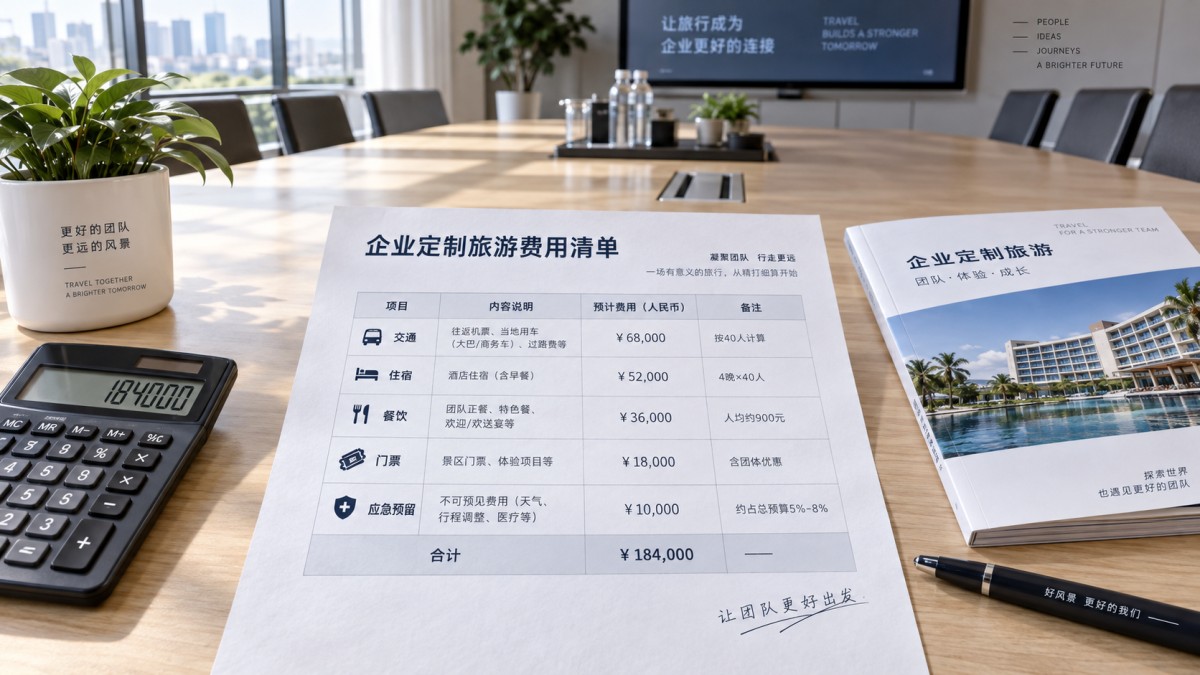
Require the supplier to list transportation, accommodation, meals, admission tickets, tour guides, and organizational services item by item, while clearly specifying the quantity, standard, and billing unit. Statements such as “transportation throughout the trip” and “scenic spot admission included” are too vague and may create disputes during final settlement.
For transportation, verify whether transfers from the meeting point, local transportation, and high-speed rail or air tickets are fully covered, and clarify how parking, road and bridge tolls, drivers’ meals and accommodation, and overtime charges will be handled. For itineraries covering two cities, also confirm whether station transfers and luggage transportation are charged separately.
For accommodation, specify the hotel name or acceptable range, room type, number of nights, and number of breakfasts. For meals, specify the meal standard, number of tables, beverages, and private-room charges. For scenic areas, distinguish between admission to the main attraction, sightseeing vehicles, cable cars, and experience programs to avoid omissions.
When comparing prices, organize each supplier’s quotation in the same checklist, then compare the total price and service terms. Also verify the quotation validity period, minimum group size, and tax treatment. Avoid directly comparing a quotation based on a low number of participants with one based on a higher number, which could lead to incorrect conclusions.
2. Beyond the Per-Person Quotation, Prioritize Clarifying These Five Types of Costs
The first type is costs arising from room arrangements. Single-room requests from employees, an uneven male-to-female ratio that prevents room pairing, or the temporary addition of accompanying personnel may all increase accommodation costs. Single-room supplements should be calculated based on the actual number of additional rooms and nights, with the party responsible for payment— the company or the individual—agreed in advance.
The second type is activity execution fees. Meeting rooms, audio equipment, projectors, backdrops, photography, hosts, and team-building instructors may not be included in the travel quotation. Procurement personnel should require the supplier to price each item separately and clarify setup, transportation, dismantling, and overtime service charges.
The third type is optional consumption during the itinerary. Night tours and performances, special experiences, meal upgrades, and souvenirs can easily be added temporarily on site. It should be clarified in advance which items will be purchased centrally by the company and which will be voluntarily paid for by employees, so that verbal commitments do not become company-funded expenses.
The fourth type is special requirements and protection costs, such as special meals, accessibility arrangements, and additional staff. Insurance should also be checked for the type of coverage, scope of protection, and applicable activities. Travel agency liability insurance and travel accident insurance cover different parties and cannot replace each other.
The fifth type is amendment and cancellation charges. Different rules may apply to high-speed rail refunds and changes, hotel room reductions, activity cancellations, and materials that have already been produced. During the budgeting stage, obtain the deadlines, fee standards, and list of non-refundable items to avoid negotiating only after cancellation.
3. How Much Contingency Funding Should Be Reserved? Consider Which Costs May Change
The total amount submitted for approval can be prepared as “confirmed basic expenses + selected additional items + contingency reserve.” Basic expenses should be calculated according to the confirmed procurement scope, additional items should be subject to selection, and the contingency reserve should be used for reasonable expenses caused by changes in participant numbers, transportation, or weather.
There is no uniform standard for the reserve ratio. For routine groups with stable requirements and fixed dates, 5% to 10% of basic expenses can be used as the starting point for internal estimates. During peak seasons, for multi-city trips, or when there are many outdoor activities, the reserve should be calculated separately according to the specific risks.
For example, if the basic expenses for a 40-person group are RMB 120,000 and the activity execution fee is RMB 10,000, reserving 8% of the basic expenses would result in a contingency fund of RMB 9,600 and a total amount for approval of RMB 139,600. This is for calculation purposes only.
Reserved funds do not mean that they can be spent in full without further control. An approver, single-transaction authorization limit, and documentation requirements should be designated, and it should be clarified which adjustments require reconfirmation. Known mandatory costs, such as single-room supplements or activity fees, should be included directly in the budget rather than hidden in the contingency fund.
4. For a Customized Two-City Itinerary, How Can Experience and Cost Be Balanced?
Taking Xi’an + Luoyang, Customized Two-City Tour as an example, procurement personnel can establish the itinerary around historical and cultural experiences, then arrange night tours, cuisine, and free activities in suitable time slots. The number of attractions should be determined by the group’s pace, avoiding increased travel costs caused by trying to include too many activities.
In Xi’an, the itinerary can include the Terracotta Warriors, the Forest of Stone Steles, or a city wall experience depending on the number of days, followed by a high-speed rail journey to Luoyang to connect attractions such as the Longmen Grottoes, White Horse Temple, or the Sui and Tang Luoyang City. Specific opening hours, reservation requirements, and availability should be based on actual information for the travel dates.
For this type of itinerary, special attention should be paid to the coordination of tour guides in the two cities, hotel and station transfers, high-speed rail seats, and luggage arrangements. If cycling or nighttime activities are added, the participation requirements, organizational services, and return transportation after the activity should also be confirmed to ensure that the costs match the execution requirements.
To control costs, priority can be given to reducing repeated transfers, frequent hotel changes, and low-value activities. Properly scheduling free meal and activity time can also accommodate individual preferences. However, the boundaries of expenses covered centrally by the company should be clearly stated in the departure notice.
5. How Should the Budget and Settlement Rules Be Written When the Number of Participants Changes?
Group expenses generally consist of two parts: per-person charges and per-group charges. Admission tickets and meals may vary with the number of participants, while vehicle, tour guide, and venue costs may not decrease accordingly. Therefore, one fewer participant does not necessarily mean that the full per-person quotation can be refunded.
Require the supplier to provide total prices for different participant ranges and specify changes in vehicle capacity and room configuration. If a reduction in participants may trigger a minimum charge, or if additional participants require a larger vehicle or more rooms, the triggering conditions and additional payment rules should be listed in advance.
Before payment, also check the contract, payment milestones, invoice items, and final settlement documents, and require any additional items to be confirmed in writing before execution. Internally setting a registration deadline and a time for confirming the participant list can reduce amendment and cancellation losses caused by repeated adjustments.
6. When Submitting for Approval, Make the Total Amount, Boundaries, and Responsibilities Clear at a Glance
An executable corporate customized travel budget should include the itinerary, detailed expenses, included and excluded items, rules for changes in participant numbers, and amendment and cancellation terms. The approval form should focus on the budget limit, major additional items, and the conditions for using contingency funds.
Henan Letu Travel Agency Co., Ltd. can coordinate vehicle services, accommodation, admission tickets, and activity arrangements based on local resources in Henan and domestic customized travel requirements. Providing the dates, participant range, and budget limit when requesting quotations can help obtain a solution that better matches the requirements.
To determine whether the budget is complete, check three points: whether each expense corresponds to a service, whether there is a charging rule for changes, and whether there is a basis for final settlement. Only by incorporating these three points into the quotation and contract can procurement efficiency, the travel experience, and cost control be balanced.


