Welcome to Our Travel Agency!




Travel Guide
Winter clothing for a trip to Harbin and Mohe needs to provide warmth, wind protection, and moisture management at the same time: keep the base layer dry, use the mid-layer to retain heat, and let the outer layer block the wind. Also seal gaps around your feet, hands, ears, and neck. Simply wearing a thicker coat will not keep you warm for long if wind gets in through your trouser legs, your shoes and socks become damp, or your fingers are exposed. Before setting out, prepare your clothing based on the local forecast, wind conditions, and how long you plan to spend outdoors. Do not assume that an outfit suitable for walking around a city will also work for waiting for a ride in Mohe during the early morning or spending a long time in the snow.
Choose your clothing based on how you will spend time outdoors
Your body generates very different amounts of heat when you are walking continuously, standing to take photos, or sitting on a snow-based attraction. Wearing too many layers while walking can make you sweat. Once you stop, a sweat-dampened base layer can accelerate heat loss. When waiting for a ride, watching the sunrise, or traveling in open snow vehicles, you will be less active and more exposed to the wind, so add insulation and limit the length of time you remain continuously exposed.
In Harbin, itineraries often alternate between shopping malls, restaurants, and streets, so a coat that is easy to unzip or take off is more practical. If your Mohe itinerary includes an early-morning departure, walking through villages, or taking photos in open areas, check in advance whether you can quickly get into a heated building or vehicle. If the weather deteriorates significantly, the wind picks up, or adequate shelter and warmth are unavailable, adjust your activities. Thicker clothing cannot replace proper protection from the cold.
Layer your upper body and leave room for layers under your coat
For the base layer, choose thermal underwear made from synthetic fibers or wool, paying particular attention to moisture management, fit, and comfort. Cotton worn next to the skin absorbs sweat and dries slowly, so it is not suitable for itineraries that involve continuous walking and are likely to make you sweat. Thermal underwear should not be too tight; you should be able to raise your arms and bend over without feeling restricted.
Use fleece, a wool sweater, or a lightweight insulated garment as the mid-layer, adjusting the thickness as needed. If you feel the cold easily or will be stationary for a long time, you can add another layer, but make sure you have room to move in every layer. When you enter a well-heated indoor space, take off your coat or remove a mid-layer promptly to avoid getting your base layer damp while eating or traveling by vehicle.
For the outer layer, choose a thick down jacket with wind-resistant fabric, a hood, and adjustable cuffs. If you will be spending a lot of time in the snow, also check whether the shell is water-repellent or waterproof. When choosing a down jacket, do not look only at its loft: fill weight, jacket length, fill distribution, and wind-blocking details around the collar and zipper all affect warmth. Choose a size that allows you to move freely with all your inner layers on; a jacket that is too tight compresses the insulation.
The lower body also needs layers. Thermal leggings under wind-resistant trousers with an insulating layer are better suited to extended outdoor activities than thick jeans worn on their own. If you will often sit or kneel in the snow to take photos, protect your hips and knees from moisture as well. The trouser cuffs should meet the tops of your boots to prevent snow from getting in through gaps.
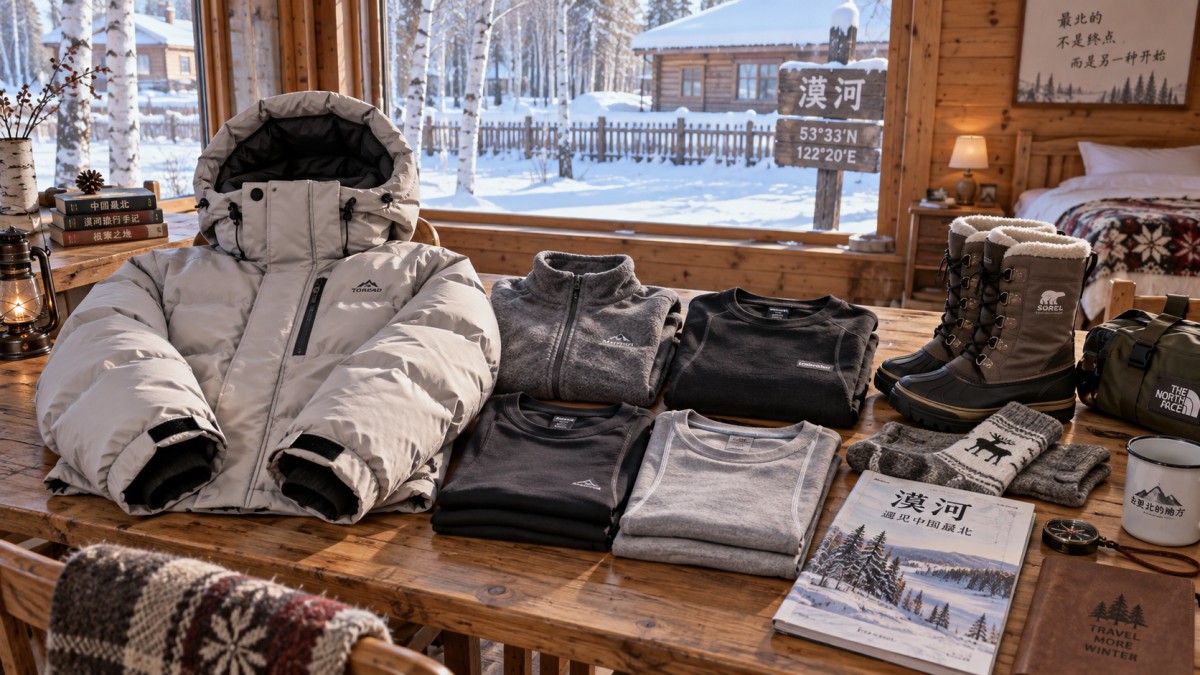
The fit of your shoes and socks directly affects how warm your feet stay
Shoes should provide insulation, moisture protection, underfoot insulation from the cold, and traction on snow and ice. Insulated boots with thick soles can reduce heat loss from contact with cold ground, but deep tread does not necessarily make them slip-proof on smooth ice. Take short, slow steps and watch out for hidden ice under the snow.
When trying on shoes, wear the socks you plan to use on your trip. Your toes should be able to move slightly, and there should be no pressure on the top of your feet. Forcing several pairs of thick socks into shoes that already fit can squeeze your feet and make them colder. Warm socks made from wool blends or with good moisture-wicking properties are better suited to this kind of trip. Bring an extra pair of dry socks and change promptly if yours become damp with sweat or snow.
When you return to your accommodation each day, remove the insoles, open the boots to air them out, and dry them according to the care instructions for the material. Do not dry them right next to a high-temperature heat source. If moisture remains inside your shoes, it will be difficult to stay comfortable the next day, even with dry socks.
Coordinate your hat, gloves, and face protection
Your hat should cover your ears, with the jacket hood providing extra wind protection. A neck warmer or face covering should cover your neck and meet your collar. If your face covering becomes wet from condensation or frosts over, go indoors to deal with it or replace it. Do not let wet fabric remain against your face. If your glasses fog up, stop in a safe place to clear them; do not wipe them while walking.
You can wear thin liner gloves under warm mittens. Liner gloves make it easier to handle things briefly, while outer mittens are better for staying outdoors or waiting for a ride. If you need to take photos repeatedly, set up quick-access controls on your phone beforehand to reduce how often you remove your gloves. If your hands are already numb with cold, warm them up before handling your device.
Heat packs should only be used as an extra aid. Follow the product instructions, do not apply them directly to your skin, and do not put them inside tight-fitting shoes. Prolonged pressure, reduced sensation, or being asleep and unable to notice temperature changes in time can lead to low-temperature burns.
Adjust your layers promptly if you get hot, and get out of the cold immediately if you feel numb
If your back quickly feels hot and damp or your forehead starts to sweat after going outside, slow down and unzip your jacket slightly in a sheltered spot. Remove a mid-layer if needed. Do not wait until your clothes are soaked before adjusting them, and do not suddenly open all your layers in an exposed, windy area. Before stopping to take photos, zip up and put on your gloves to reduce heat loss when you stop moving.
Do not rely on a fixed time limit for outdoor stays. Wind, whether your clothing is dry, your activity level, and your physical condition all affect how long you can tolerate the cold. You can break your itinerary into shorter outdoor periods with indoor breaks in between. Keep spare gloves, socks, and base layers in a waterproof bag in your day pack so they are easy to reach when needed.
If your hands, feet, ears, or nose remain numb, or the skin turns pale or feels hard, go indoors to a warm place immediately. Do not rub the affected area, warm it over a fire, or use very hot water. If you become slow to respond, slur your speech, or have difficulty walking, seek medical help as soon as possible. If an area affected by frostbite could be exposed to freezing conditions again, do not repeatedly thaw it yourself; contact emergency services and follow their instructions.
Your 1:1 travel consultant will respond within 1 business day
How to plan your trip
- Multiple regions announce autumn break dates for primary and secondary schools; attractions offer benefits such as discounted admission
- China’s Civil Aviation Industry to Implement the 2026/2027 Winter-Spring Flight Schedule from October 25
- Autumn Breaks in Multiple Regions Boost November Travel, Offering Hope for the Traditional Low Season
- China Tourism Academy Releases Report on Autumn Trends in China's Domestic Customized Tour Market
- What should I wear for a winter trip to Harbin and Mohe to cope with the extreme outdoor cold?
Monthly travel guide
- Luoyang launches the “Autumn Charm of the Divine Capital” tourism promotion to build anticipation for winter travel
- Typhoon “White Dolphin” Forces Henan Scenic Areas to Close, Putting Summer Ground-Handling Services Under Pressure
- RCEP Implementing Rules for Indonesia Take Effect: Zero Tariffs for Cultural and Tourism Services Alongside Strict Customer Service Requirements
- Saudi Arabia’s New SASO Regulations Take Effect: Taqat Certification Required Before Chinese-Language Cultural Tourism Services Can Access Visit Saudi
- Zhengzhou Launches a Dedicated LCL Shipping Route for Cultural and Tourism Materials, Cutting Freight Costs by 18%
- Luoyang Cold Chain Intensification: Cultural and Creative Exports Delivered in 9 Days
- Expedited Pre-Approval for Group Visas to Three Southeast Asian Countries
- Tightening air freight capacity at Zhengzhou Airport delays the delivery of cultural and tourism materials
- Vietnam's New Regulations on Bus Monitoring Requirements for Group Tours
- Saudi SAMA New Regulations on Travel Liability Insurance Compliance Preparation
- Japanese tourists' new regulations for entering Henan local transport vehicles
- Wai Gao Qiao Wen Travel customs bonded warehouse summer group equipment fast lane
Popular destinations
- China’s Civil Aviation Industry to Implement the 2026/2027 Winter-Spring Flight Schedule from October 25
- What should I wear for a winter trip to Harbin and Mohe to cope with the extreme outdoor cold?
- CATARC upgrades snow and ice testing standards, affecting import certification for Nordic winter tourism equipment
- Lelv Travel Student Group Discounts: How to Plan Your Winter Trip
- Henan Winter Travel 2026: Hot Spring and Skiing Routes
Why choose us

High cost-performance and transparent experience
Offer astonishing low prices without hidden tourism traps, enabling travelers to explore at lower costs while avoiding unnecessary spending loopholes, ensuring transparent consumption.

Personalization and dedicated service
Support 100% free customization, paired with one-on-one expert service, crafting exclusive itineraries based on travelers' specific needs, while providing professional guidance to enhance the personalization and professionalism of the journey.

Premium itinerary planning
Compact yet rich itineraries allow travelers to experience more within limited time; simultaneously, carefully selected hotels in prime locations provide convenient lodging conditions, overall enhancing travel comfort and experience.