Welcome to Our Travel Agency!




Travel Guide
For a Beijing–Xi'an–Shanghai trip, if you travel in the order Beijing–Xi'an–Shanghai, a good starting point is usually to compare high-speed rail from Beijing to Xi'an and a direct flight from Xi'an to Shanghai. For the first leg, consider the hotel location and how well the train schedule fits your plans; for the second, flights are generally worth comparing first. To determine which option saves time, calculate from the time you leave one hotel to the time you arrive at the next—not just the travel time shown on the ticket.
If your itinerary also includes travel between Shanghai and Beijing, calculate that leg separately. High-speed rail may take up a substantial part of the day; although flights have shorter airtime, you also need to factor in transfers to and from the airport, arrival time requirements, and baggage collection. For travelers, the time saved is more meaningful if it can be used for sightseeing than if it simply means arriving a few dozen minutes earlier.
Calculate hotel-to-hotel travel time first, then see how much time remains for sightseeing
To compare the two modes of transport on the same basis, use: time from the departure hotel to the station or airport + waiting time + journey time + time to exit the station or airport after arrival + time to reach the next hotel. For flights with checked baggage, include baggage drop-off and collection; for high-speed rail, allow enough time for security screening, entering the station, and finding your platform.
These calculations need to be based on specific stations and airports. Beijing's different airports, Shanghai Hongqiao and Pudong, and Xi'an North Railway Station and Xi'an Xianyang International Airport all have different transfer options. Simply saying “departing from Beijing” or “arriving in Shanghai” is not enough to determine which option is faster. The result will also depend on which transport links are near your hotel and whether you are likely to encounter road congestion when you set off.
Waiting time should not be cut to a minimum, either. Check-in and boarding requirements may vary by airline, airport, and route, so plan according to the rules for your booked flight. For rail travel, allow enough time to enter the station based on its size, the number of people traveling with you, and your luggage. Traveling with older adults or children, making frequent transfers, carrying luggage, and walking between connections can also be tiring.
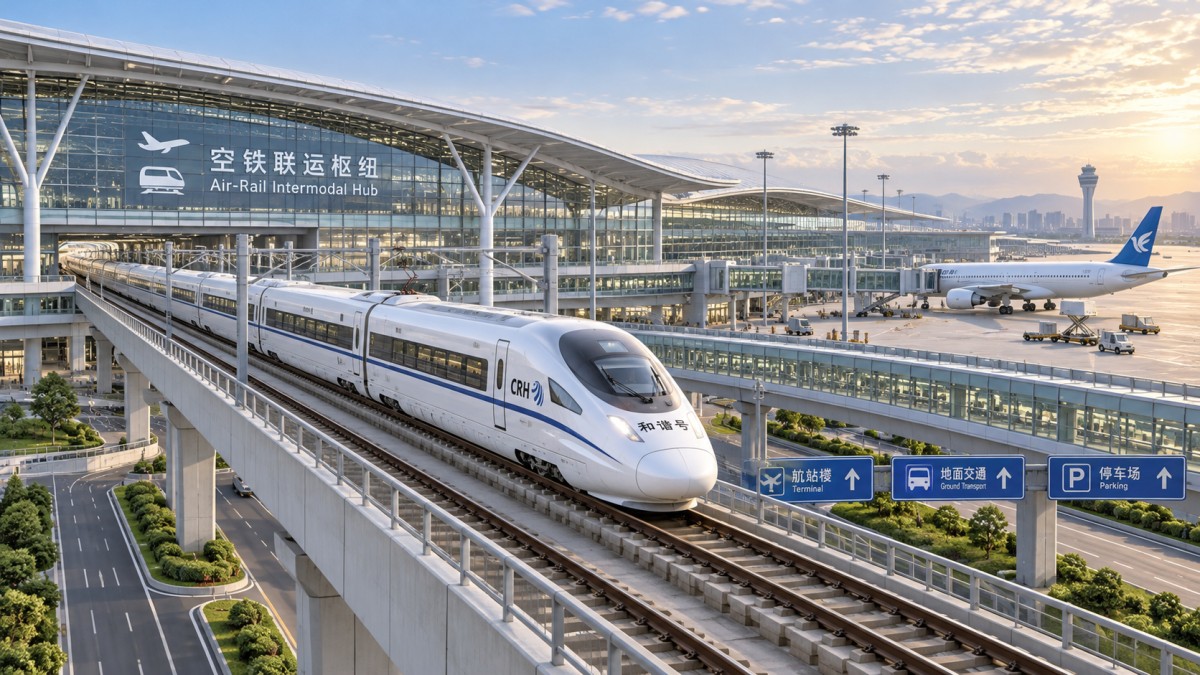
You should also calculate the “usable sightseeing time.” Arriving in the morning and needing to leave your luggage at the hotel is not equivalent, in terms of itinerary value, to arriving in the afternoon and going straight to check in. If the time saved by a particular mode lets you make a timed reservation, that time is valuable; if it only leaves a short gap that is difficult to use, adding a transfer may not be worthwhile.
How to choose for each of the three legs
Beijing to Xi'an: Check high-speed rail first, and weigh the benefits of airport access for flights
Do not assume that flying will necessarily save time on this leg. High-speed rail is worth comparing first, particularly for travelers who want to avoid extra procedures, are carrying more luggage, or prefer a less rushed transfer day. When choosing a train, consider both the departure and arrival times. Avoid sacrificing too much rest the night before just to catch an early train.
Flights become more appealing when the airport is easy to reach from your departure hotel, the direct-flight schedule works well, and onward transport after landing is convenient. If your accommodation is far from the high-speed rail station, or a suitable train would take up your main sightseeing hours, a flight may leave you with more time. Compare train tickets and air tickets for two options you would genuinely consider buying; do not compare an ideal flight with an unsuitable train.
Xi'an to Shanghai: If time is tight, compare direct flights first
The rail journey on this leg is long. For travelers with only a few days of vacation who want to preserve time for sightseeing in Shanghai, a direct flight is worth considering first. The arrival airport is especially important when choosing a flight: whether you arrive at Hongqiao or Pudong should be assessed in light of your hotel's location and onward transport options.
High-speed rail remains an option if you are comfortable spending most of the day in transit, want to be able to get up and move around along the way, or prefer to avoid the hassle of getting to and from an airport. However, your itinerary should account for the amount of the day this journey takes up, and you should avoid packing in attractions after arrival. If you choose an evening flight, consider what time you will reach your hotel so you do not cut short your sleep before a demanding day of sightseeing.
Beijing to Shanghai: First decide whether you need this leg at all
If you can fly into one city and out of another, there is no need to add a Beijing–Shanghai leg just to “connect” the cities. Compare this leg only if your round-trip flights, family visits, or other itinerary requirements make a return necessary.
If you do need to travel this leg, a flight is more likely to reduce total travel time when the schedule and airport transfers are convenient; high-speed rail suits travelers who value a more straightforward departure and arrival. For those staying near the Hongqiao transport hub, high-speed rail becomes more attractive in comparison. If the only available flight uses an inconvenient airport or time slot, its advantage in airtime may be offset by ground transportation.
Before booking, adjust the order first, then decide on your transport combination
You do not have to use the same mode of transport for all three legs of a Beijing–Xi'an–Shanghai trip. A more practical approach is to decide where to start and finish, then choose transport for each leg. For example, flying into Beijing and out of Shanghai, with Xi'an in between, can avoid backtracking. If Shanghai is easier to reach from your departure city, you could arrange the trip in reverse. Compare the order of the cities alongside your inbound and outbound long-distance transport.
Leave some flexibility in your daily schedule. Flights can be affected by factors such as weather and airspace restrictions, while trains may also be delayed or subject to schedule changes. Avoid scheduling a non-refundable performance, a hard-to-book attraction, or another transfer with little connection time immediately after arrival. If you must be somewhere that day, prioritize a service that leaves a sufficient buffer.
Before booking, put the options you are considering into a simple table: what time you leave the hotel, what time you depart, what time you arrive at the next hotel, and what you can still do that day. Then compare the effort of handling luggage, the number of transfers, and your family's stamina. If flying genuinely gives you an extra, uninterrupted stretch of sightseeing time, it may be worth choosing; if both options get you to the hotel at about the same time, the one with an easier departure and simpler transfers is often a better fit for the trip.
Your 1:1 travel consultant will respond within 1 business day
How to plan your trip
- Multiple regions announce autumn break dates for primary and secondary schools; attractions offer benefits such as discounted admission
- China’s Civil Aviation Industry to Implement the 2026/2027 Winter-Spring Flight Schedule from October 25
- Autumn Breaks in Multiple Regions Boost November Travel, Offering Hope for the Traditional Low Season
- China Tourism Academy Releases Report on Autumn Trends in China's Domestic Customized Tour Market
- What should I wear for a winter trip to Harbin and Mohe to cope with the extreme outdoor cold?
Monthly travel guide
- Luoyang launches the “Autumn Charm of the Divine Capital” tourism promotion to build anticipation for winter travel
- Typhoon “White Dolphin” Forces Henan Scenic Areas to Close, Putting Summer Ground-Handling Services Under Pressure
- RCEP Implementing Rules for Indonesia Take Effect: Zero Tariffs for Cultural and Tourism Services Alongside Strict Customer Service Requirements
- Saudi Arabia’s New SASO Regulations Take Effect: Taqat Certification Required Before Chinese-Language Cultural Tourism Services Can Access Visit Saudi
- Zhengzhou Launches a Dedicated LCL Shipping Route for Cultural and Tourism Materials, Cutting Freight Costs by 18%
- Luoyang Cold Chain Intensification: Cultural and Creative Exports Delivered in 9 Days
- Expedited Pre-Approval for Group Visas to Three Southeast Asian Countries
- Tightening air freight capacity at Zhengzhou Airport delays the delivery of cultural and tourism materials
- Vietnam's New Regulations on Bus Monitoring Requirements for Group Tours
- Saudi SAMA New Regulations on Travel Liability Insurance Compliance Preparation
- Japanese tourists' new regulations for entering Henan local transport vehicles
- Wai Gao Qiao Wen Travel customs bonded warehouse summer group equipment fast lane
Popular destinations
- Luoyang Museum to Close; Night Tours at Longmen to Be Suspended; Restoration Work to Begin at White Horse Temple
- Is it worth staying overnight in Fenghuang Ancient Town on a trip to Zhangjiajie and Fenghuang Ancient Town?
- Is it faster to travel between Beijing, Xi’an, and Shanghai by high-speed train or plane?
- How can you confirm the actual group size when booking a small-group tour in western Sichuan?
- What cancellation fees apply when a participant drops out of a customized corporate trip at short notice?
Why choose us

High cost-performance and transparent experience
Offer astonishing low prices without hidden tourism traps, enabling travelers to explore at lower costs while avoiding unnecessary spending loopholes, ensuring transparent consumption.

Personalization and dedicated service
Support 100% free customization, paired with one-on-one expert service, crafting exclusive itineraries based on travelers' specific needs, while providing professional guidance to enhance the personalization and professionalism of the journey.

Premium itinerary planning
Compact yet rich itineraries allow travelers to experience more within limited time; simultaneously, carefully selected hotels in prime locations provide convenient lodging conditions, overall enhancing travel comfort and experience.