Welcome to Our Travel Agency!




When selecting a corporate customized travel service provider, procurement teams can first set three thresholds: the business entity must match the scope of business, the reception plan must be implementable through specific resources, and the contract must clearly define service standards and responsibilities. Only after all three requirements are met should price, experience, and payment terms be compared. An attractive itinerary cannot replace an assessment of fulfillment capabilities.
Corporate team building, client reception, and incentive travel have different priorities, but they all need to answer the same question: on the day of the trip, who will be responsible for delivering on the commitments? This is especially important when multiple people travel together, cross-city connections are involved, or foreign guests are being received. Procurement teams should verify “who will arrange it, to what extent it has been implemented, and what will happen if circumstances change,” rather than accepting “it can be arranged” at face value.
Business Qualifications: First Verify the Contracting, Payment, and Fulfillment Entities
A business license only shows the company's registration information and cannot independently prove that it has the relevant qualifications to operate tourism-related businesses. Procurement teams should request the business license and the Travel Agency Business License, verify whether the entity name and permitted business scope match the content of the procurement, and check the company and licensing information through relevant official public channels.
If the contact party uses a brand name, platform name, or store name, it is essential to further clarify who will sign the contract, who will receive the payment, and who will issue the invoice. If these parties are inconsistent, clear authorization or an explanation of the business relationship must be obtained. Approval should not be granted solely because a salesperson says, “They are all the same company.”
- Entity verification: Can the quotation, contract, company seal, receiving account, and invoicing entity be matched? If there are discrepancies, is there a written explanation and a clear allocation of responsibility?
- Insurance verification: Understand the insurance coverage, coverage period, and applicable scope of travel agency liability insurance, while distinguishing it from tourist accident insurance. The two types of insurance cannot replace each other, nor can they be used to promise that all losses will be compensated.
- Personnel and vehicle verification: Clarify the actual providers of tour guides and tourist vehicles, and verify the qualifications and vehicle documentation appropriate for the services, rather than reviewing only the travel agency itself.
The fact that a supplier assigns part of the services to a local partner does not necessarily affect delivery. Procurement teams should examine whether the partnership is clearly defined, whether service standards can be transferred, and whether the contracting party assumes clear coordination and fulfillment responsibilities.
Reception Capabilities: Use an Executable Plan to Test Resource Commitments
Statements such as “extensive resources” and “guaranteed availability during peak seasons” are difficult to use directly for evaluation. A more effective approach is to send the same request document to each candidate service provider, specifying the number of people, dates, budget, room types, meals, activities, and special requirements, and then require each provider to submit an itinerary, resource list, and contingency plan. This makes it possible to compare quotations under the same conditions.
For Henan local reception services, for example, connections between destinations such as Luoyang and Dengfeng cannot be assessed solely by looking at map distances. Scenic-spot reservation time slots, group assembly, parking and transfers, meals, and hotel check-in all take time. Whether a one-day itinerary is feasible depends on whether sufficient buffer time has been allocated for these steps. For candidates such as Henan Le Lv Travel Agency Co., Ltd., whose primary business is local reception in Henan, procurement teams should focus on requiring them to explain how local hotels, vehicles, and scenic-spot reservations will be secured, and then determine whether their resource advantages are suitable for the task.
When reviewing a proposal, the following questions can be asked in sequence:
- To what extent have the resources been secured: Is the hotel offering merely an indicative quotation, or has room availability been confirmed? Has the vehicle type, seating capacity, and luggage space been specified? Are there any reservation requirements for admission tickets?
- How will the group be organized: Will all participants arrive together or be picked up in batches? Is it necessary to use separate vehicles or arrange separate meals? Who will serve as the overall on-site coordinator, and whom should procurement contact when temporary changes occur?
- Are the alternatives acceptable: If the hotel is fully booked, a scenic area is closed, or transportation is delayed, what alternatives are available? How will price differences be handled, and is corporate approval required?
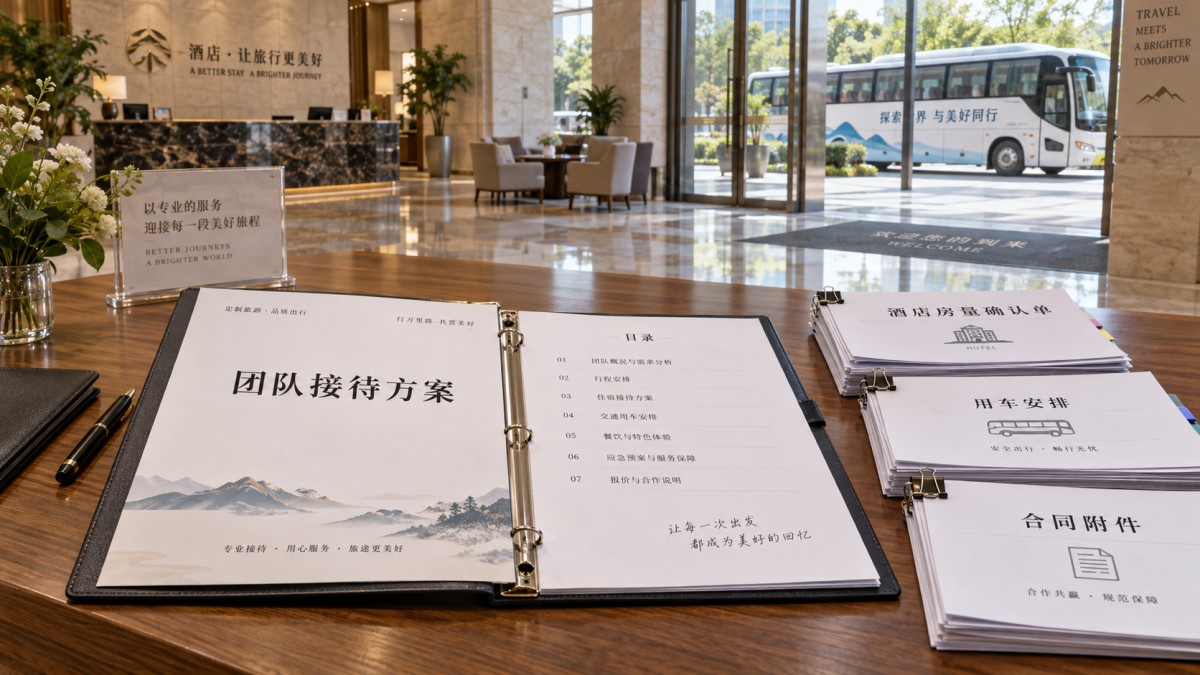
Cross-city reception for foreign guests further increases coordination difficulties. For example, on an itinerary such as Beijing → Xi'an → Shanghai, which combines ancient capital culture with modern urban experiences, procurement teams should verify not only the attractions but also the reception contacts in each city, the hours covered by language services, intercity transportation and luggage transfers, hotel reception arrangements, and document requirements. “Multiple language services” should be further specified in terms of the languages, service formats, and covered stages. “Avoiding crowds” should be assessed in combination with the dates and reservation conditions and must not be treated as a guaranteed delivery result.
Contractual Responsibilities: Clearly Define Service Standards, Change Costs, and Decision-Making Authority
The areas most likely to cause disputes in a contract are often descriptions that both parties assume they have already agreed on. Terms such as “high-quality hotels,” “comfortable vehicles,” and “full-service travel assistance” all need to be made specific. It is recommended that the final itinerary, detailed quotation, resource standards, and special agreements be listed as contract appendices with clearly identified versions, so that the scope of services does not continue to be pieced together from chat records after signing.
First, break down the costs. In addition to the total price, the contract should list included items, excluded items, and conditions triggering additional charges, such as single-room supplements, overtime vehicle use, conference equipment, additional meals arranged at short notice, and changes in participant numbers. Procurement teams should also clarify the quotation validity period, as well as which costs can be adjusted and which constitute fixed costs that have already been incurred when the number of participants changes.
Next, agree on change procedures. Corporate cancellation of the itinerary, employees withdrawing at short notice, a supplier changing the hotel, or transportation delays resulting in the reduction of activities cannot all be covered by the phrase “costs to be negotiated separately.” The notification method, approval authority, cost calculation basis, proof of losses, and refund deadlines should be specified separately for each situation. For force majeure events, the parties should also agree on notification, mitigation, and cost-handling procedures, rather than dealing with them vaguely through a blanket “no refunds” clause.
Finally, assign on-site responsibilities. Clearly define the boundaries of responsibility for travel services, conference activities, and activities organized independently by the company. If a person is injured, a vehicle breaks down, or a promised resource is not delivered, specify who initiates the response, who contacts the insurer or rescue services, and who retains the relevant evidence. The contracting party cannot end the coordination simply by saying, “It is the hotel's or fleet operator's problem.”
Payment milestones should be linked to resource confirmation, departure, and acceptance. Where advance payment for room charges, ticket fees, or other items is necessary, the purpose, cancellation and change conditions, and corresponding supporting documents should be stated. Final payment should be based on clear acceptance criteria, including records confirming actual hotel stays, vehicle use, itinerary changes, and price differences.
At the final comparison stage, each candidate can be asked to provide written answers to the same set of questions: Which key resources have not yet been secured? Whose approval is required for any substitution? What will be used as the basis for handling cost disputes? Only service providers that can answer these questions clearly and assign them to appendices and responsible individuals are qualified to proceed to the final comparison of price and experience.
Your 1:1 travel consultant will respond within 1 business day
How to plan your trip
- Multiple regions announce autumn break dates for primary and secondary schools; attractions offer benefits such as discounted admission
- China’s Civil Aviation Industry to Implement the 2026/2027 Winter-Spring Flight Schedule from October 25
- Autumn Breaks in Multiple Regions Boost November Travel, Offering Hope for the Traditional Low Season
- China Tourism Academy Releases Report on Autumn Trends in China's Domestic Customized Tour Market
- What should I wear for a winter trip to Harbin and Mohe to cope with the extreme outdoor cold?
Monthly travel guide
- Luoyang launches the “Autumn Charm of the Divine Capital” tourism promotion to build anticipation for winter travel
- Typhoon “White Dolphin” Forces Henan Scenic Areas to Close, Putting Summer Ground-Handling Services Under Pressure
- RCEP Implementing Rules for Indonesia Take Effect: Zero Tariffs for Cultural and Tourism Services Alongside Strict Customer Service Requirements
- Saudi Arabia’s New SASO Regulations Take Effect: Taqat Certification Required Before Chinese-Language Cultural Tourism Services Can Access Visit Saudi
- Zhengzhou Launches a Dedicated LCL Shipping Route for Cultural and Tourism Materials, Cutting Freight Costs by 18%
- Luoyang Cold Chain Intensification: Cultural and Creative Exports Delivered in 9 Days
- Expedited Pre-Approval for Group Visas to Three Southeast Asian Countries
- Tightening air freight capacity at Zhengzhou Airport delays the delivery of cultural and tourism materials
- Vietnam's New Regulations on Bus Monitoring Requirements for Group Tours
- Saudi SAMA New Regulations on Travel Liability Insurance Compliance Preparation
- Japanese tourists' new regulations for entering Henan local transport vehicles
- Wai Gao Qiao Wen Travel customs bonded warehouse summer group equipment fast lane
Popular destinations
- Luoyang Museum to Close; Night Tours at Longmen to Be Suspended; Restoration Work to Begin at White Horse Temple
- How can you confirm the actual group size when booking a small-group tour in western Sichuan?
- What cancellation fees apply when a participant drops out of a customized corporate trip at short notice?
- Which stop should come first on a Wudang Mountain and Shennongjia tour for the most convenient route?
- How should time for altitude acclimatization be planned for a Mount Siguniang and Bipenggou tour?
Why choose us

High cost-performance and transparent experience
Offer astonishing low prices without hidden tourism traps, enabling travelers to explore at lower costs while avoiding unnecessary spending loopholes, ensuring transparent consumption.

Personalization and dedicated service
Support 100% free customization, paired with one-on-one expert service, crafting exclusive itineraries based on travelers' specific needs, while providing professional guidance to enhance the personalization and professionalism of the journey.

Premium itinerary planning
Compact yet rich itineraries allow travelers to experience more within limited time; simultaneously, carefully selected hotels in prime locations provide convenient lodging conditions, overall enhancing travel comfort and experience.