Welcome to Our Travel Agency!




Travel Guide
When deciding whether to stay inside or outside an ancient town’s scenic area, first consider how you want to spend your time: if night tours, early-morning photos, and leisurely walks are your priorities, consider staying inside the scenic area; if you plan to visit only during the day and value parking and accommodation facilities, staying outside is usually more suitable. When traveling with older adults or children, don’t focus only on whether the hotel is inside or outside the area. Check the actual routes from the hotel to the entrance, parking lot, and main attractions.
A common booking mistake is to focus on the apparent savings on room rates, only to find yourself waiting for a ride after the evening crowds leave. You might assume that staying in the ancient town will make it easy to rest, but then find that your room faces a busy street and you have to drag your luggage over stone-paved roads. What you really need to compare is the total cost of accommodation, the effort required to travel back and forth, and sleep quality—not whether the hotel is on one side or the other of a scenic-area boundary on the map.
First, find out exactly what “inside the scenic area” means
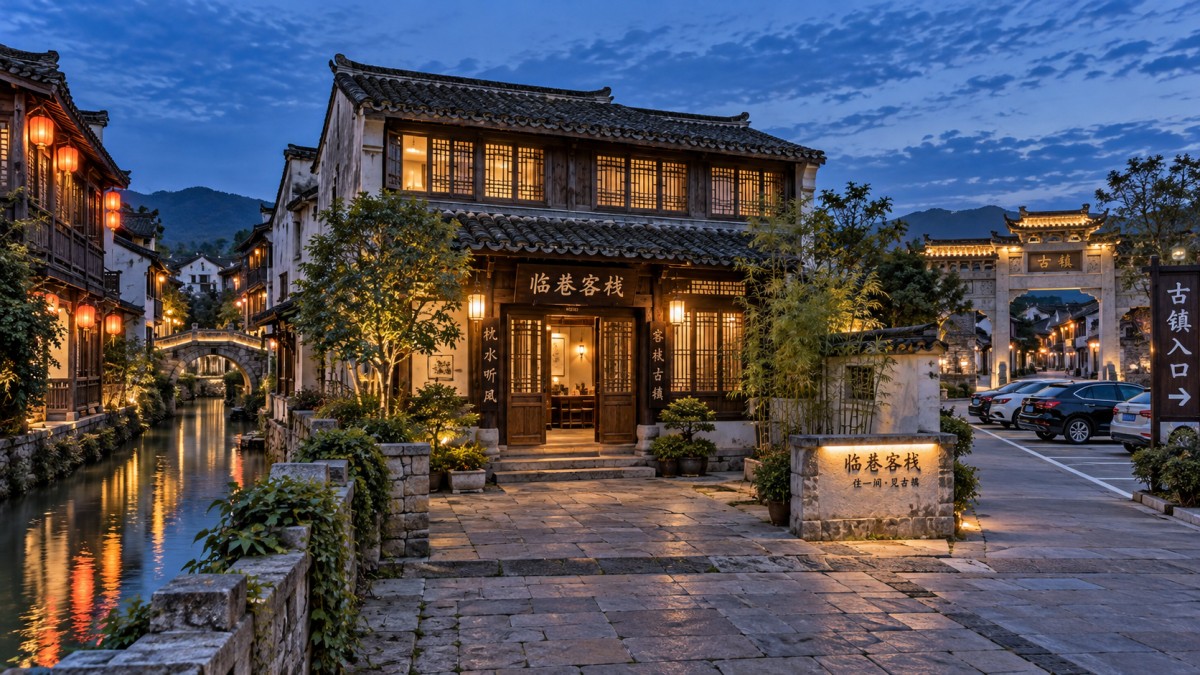
Ancient towns are managed in different ways. Some are open neighborhoods, some have ticketed areas, and others charge admission only for certain courtyards or exhibition halls. So a hotel described as being “inside the ancient town” is not necessarily within the ticketed area, or near the main streets you want to explore.
When choosing a room, check the hotel’s location, which entrances are accessible, and the actual walking route. Two places may appear close in a straight line on the map, but a river, wall, or closed courtyard gate may lie between them. This is especially important when arriving with luggage: ask how far vehicles can go and whether you will need to cross a bridge or climb steps after getting out. Don’t just ask, “How far is it from the scenic area?”
Staying inside the scenic area does not necessarily mean free admission or unrestricted re-entry. Confirm separately with the accommodation and the scenic-area operator whether admission is included in the room rate, whether your booking confirmation allows you to enter and exit, and whether there is a designated entrance at night. Don’t assume based on the hotel’s name.
Consider your sightseeing schedule to make the choice clearer
“Consider staying” is not an absolute rule. A remote guesthouse inside the scenic area may involve a longer walk than a hotel just outside the entrance. Staying near the ancient town’s central street may also mean nighttime noise that keeps children awake. Whether a location is suitable depends on the specific entrance and room.
Calculate the full cost of a night’s stay, not just the room rate
When comparing two accommodations, use the same basis for both: room rate + parking fee + round-trip shuttle costs + any additional admission fees. Ask in advance whether breakfast or luggage handling costs extra. Fees depend on the actual policies; don’t assume that something described as “possibly free” is included.
Consider the time involved separately. If you stay outside, will you be willing to return to your room to rest at midday? Will transport be convenient after you finish viewing the night scenery? If you stay inside, will you have to drag your luggage through crowded streets the next day? These inconveniences are hard to convert accurately into a room-rate equivalent, but they can directly affect your itinerary.
If you’re on a tight budget but still want to see the night scenery, start by looking for accommodation near an entrance outside the scenic area, with a flat walking route that remains accessible at night. This can be a good compromise to compare, but make sure it is near an open entrance, not just the edge of the scenic area shown on the map.
A good night’s sleep matters more than labels like “riverside” or “traditional architecture”
Conditions can vary widely among accommodations in ancient towns. A riverside location, a street-facing room, or a traditional courtyard may have atmosphere, but that does not automatically mean it will be quiet and comfortable. Some older buildings may have limited soundproofing, narrow stairs, or little natural light. Modern hotels outside the scenic area may also be affected by traffic or nearby construction.
- For a quieter stay: Ask which way the room faces and whether it overlooks a main street, outdoor dining area, or public activity space. Don’t rely only on general photos of the hotel.
- When traveling with older adults or children: Check for an elevator, the room’s floor, non-slip bathroom features, and nighttime lighting. Ask whether there are high thresholds or steep stairs.
- If comfort is a priority: Check recent reviews for dampness, odors, hot water, and air conditioning, and see whether the same issues are mentioned repeatedly.
When contacting the accommodation, describe your needs specifically. For example, “We need a room that doesn’t face the street and doesn’t require climbing stairs” is more actionable than simply asking for “a quieter room.” Rooms with the same category name may be in different buildings, so confirm the location before booking if possible.
The key considerations differ for drivers and public-transport travelers
If you’re driving, sort out parking first, then decide where to stay. Accommodation inside the scenic area may require you to park in an outer lot and walk or transfer to enter. Confirm whether parking needs to be reserved, whether you can take your vehicle out and return during your stay, and whether you can leave it parked after checking out. During holiday traffic controls, roads that are accessible on ordinary days may be closed to vehicles.
For public-transport travelers, focus on arrival time and the final leg of the journey. If you arrive late, ask about nighttime entrances and check-in arrangements. If you need to catch an early bus or train the next day, consider the actual travel time from the hotel to the boarding point. Don’t make your departure the next day too stressful just to spend a little longer exploring that evening.
Before booking, walk through the route for your itinerary that day
Link these steps in order—“arrive and get dropped off → store luggage → explore the town → dinner and a night tour → return to your room → leave the next day”—and check for unnecessary backtracking. Then confirm three things with the accommodation: how to get there with luggage, how to return after the night tour, and what to do with your luggage and vehicle after checkout. For access to the scenic area, check the current rules published by the scenic-area operator.
If you’re still torn between two accommodations, focus on the part of your itinerary you’re least willing to compromise on: choose the easiest return route if you don’t want extra hassle after a night tour; choose a flat route if older adults in your group have difficulty with steps; or choose the more reliable transport connection if you need to travel the next day. Then compare room rates, room types, and cancellation terms. This is more useful than debating whether to stay inside or outside the scenic area in the abstract.
Your 1:1 travel consultant will respond within 1 business day
How to plan your trip
- China Tourism Academy Releases Report on Autumn Trends in China's Domestic Customized Tour Market
- Visiting China for the First Time: How Many Cities Should You Include in a 15-Day Grand Tour?
- Is a geology exploration tour suitable for elementary school students?
- Is it worth hiring a guide for a visit to the Terracotta Army?
- Hebei Launches 5 “Trendy Hebei” Signature Tour Routes, Standardizing Inbound Tourism Services
Monthly travel guide
- Luoyang launches the “Autumn Charm of the Divine Capital” tourism promotion to build anticipation for winter travel
- Typhoon “White Dolphin” Forces Henan Scenic Areas to Close, Putting Summer Ground-Handling Services Under Pressure
- RCEP Implementing Rules for Indonesia Take Effect: Zero Tariffs for Cultural and Tourism Services Alongside Strict Customer Service Requirements
- Saudi Arabia’s New SASO Regulations Take Effect: Taqat Certification Required Before Chinese-Language Cultural Tourism Services Can Access Visit Saudi
- Zhengzhou Launches a Dedicated LCL Shipping Route for Cultural and Tourism Materials, Cutting Freight Costs by 18%
- Luoyang Cold Chain Intensification: Cultural and Creative Exports Delivered in 9 Days
- Expedited Pre-Approval for Group Visas to Three Southeast Asian Countries
- Tightening air freight capacity at Zhengzhou Airport delays the delivery of cultural and tourism materials
- Vietnam's New Regulations on Bus Monitoring Requirements for Group Tours
- Saudi SAMA New Regulations on Travel Liability Insurance Compliance Preparation
- Japanese tourists' new regulations for entering Henan local transport vehicles
- Wai Gao Qiao Wen Travel customs bonded warehouse summer group equipment fast lane
Popular destinations
- How should time for altitude acclimatization be planned for a Mount Siguniang and Bipenggou tour?
- How can you tell from an itinerary whether enough time has been set aside for photography?
- For a bilingual guide on a Grand China tour, should you choose full-tour accompaniment or service in separate segments?
- How can you plan a high-speed rail route for a panoramic tour of China without backtracking?
- How can you verify hotel check-in eligibility in advance for inbound tours covering all of China?
Why choose us

High cost-performance and transparent experience
Offer astonishing low prices without hidden tourism traps, enabling travelers to explore at lower costs while avoiding unnecessary spending loopholes, ensuring transparent consumption.

Personalization and dedicated service
Support 100% free customization, paired with one-on-one expert service, crafting exclusive itineraries based on travelers' specific needs, while providing professional guidance to enhance the personalization and professionalism of the journey.

Premium itinerary planning
Compact yet rich itineraries allow travelers to experience more within limited time; simultaneously, carefully selected hotels in prime locations provide convenient lodging conditions, overall enhancing travel comfort and experience.