Welcome to Our Travel Agency!




Travel Guide
When booking a small-group tour in western Sichuan, the itinerary may promise “no shopping,” while the contract lists only hotels, vehicles, and attractions. This can lead to disputes along the way over “a convenient stop at a local specialty shop” or “a product presentation during a break.” A stop may seem to add no cost, but it can cut into sightseeing time, and refusing to buy may affect the travel experience.
The no-shopping promise for a small-group tour in western Sichuan should be clearly stated. The key is to specify in the contract or an attachment confirmed by both parties which activities are prohibited, the boundaries for permitted stops, who is responsible for carrying out the arrangement, and how breaches will be handled. Merely stating “purchases are voluntary” or “shopping is not compulsory” does not mean that shopping stops will not be arranged. Make sure to distinguish between these two commitments before signing.
First, ask what “no shopping” actually excludes
To determine whether a stop is a shopping arrangement, look beyond whether it is called a “shop” and consider what visitors are taken there to do. Specialty-product displays, cultural experiences, health lectures, and factory visits should all be covered by the agreement if their main purpose is to promote or sell products or organize orders.
You can ask the travel agency to include the following wording in a supplementary clause as a proposed agreement:
“No shopping activities will be included in this itinerary. Tourists will not be taken to venues whose primary purpose is product promotion or sales. Shopping will not be arranged under the guise of cultural experiences, visits, rest stops, restroom breaks, gift collection, or any other pretext. Products will not be promoted in vehicles or through tour service groups. No minimum spending requirement or purchase quota may be imposed, and service standards may not be lowered because a tourist chooses not to buy.”
This wording restricts organized activities; it does not prohibit tourists from making purchases. A tourist buying a souvenir independently during free time is different from a travel agency, tour guide, or driver taking the entire group to a designated retailer. Do not accept the explanation that “it isn’t shopping as long as nobody forces you to pay.”
Clarify which stops along the way in western Sichuan could be confused with shopping stops
Western Sichuan itineraries often involve long drives, and service areas, restaurants, and supply stops may also sell products. The contract should not simply state that “the group must not enter any venue that sells goods at any point during the trip.” A more practical approach is to specify the purpose of each stop and what may take place there.
For supply stops whose names cannot be confirmed in advance, you can require the tour guide and driver to explain why they are stopping and the expected duration. This allows for necessary safety breaks while preventing “temporary resupply” from becoming an excuse to take the group into a shop.
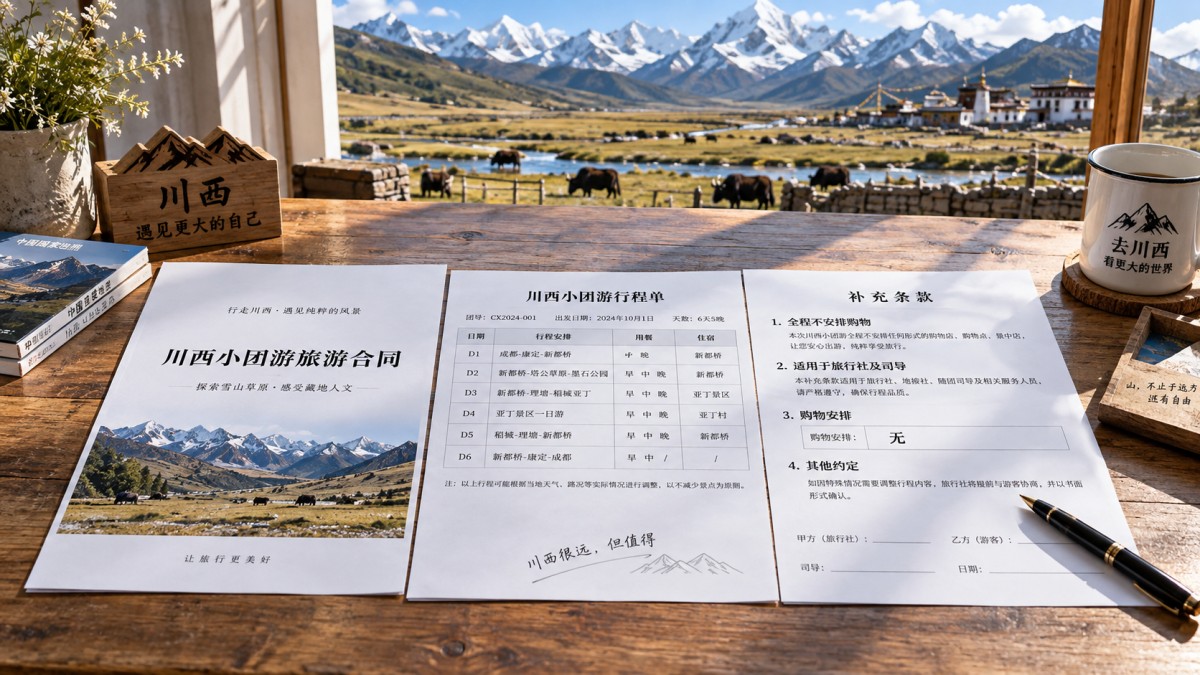
The contract, itinerary, and actual tour operator must be consistent
A no-shopping clause should not stand alone. When signing, review the itinerary, the list of included and excluded costs, and any attachments covering shopping and optional paid activities. Pay particular attention to vague descriptions such as “local specialty experiences” and “comprehensive service stations,” and ask for specific details. No shopping does not mean that all activities are included; fees for attraction transport and experience activities must still be listed separately.
- Do not leave fields blank: Enter “None” in the shopping arrangements field. Cross out attachments that have not been agreed upon or mark them “Not applicable” to prevent them from being filled in after signing.
- Revise conflicting clauses: If the main contract says “no shopping” but an attachment allows shopping to be arranged, remove the conflicting wording and specify which terms apply if the supplementary agreement conflicts with other documents.
- Cover everyone involved in performance: Specify that the no-shopping promise applies to local operators, tour guides, drivers, and other personnel arranged by the travel agency, not just the customer-service representative who takes the booking.
The contract should also identify the travel agency with which the contract is signed and the actual receiving operator. Consumers should make clear that the travel agency they contract with bears the corresponding contractual responsibilities. “This was the driver’s personal conduct” or “the local partner arranged it” should not be used as grounds for exemption from liability.
Supplementary clauses must correspond to the contract number, tour dates, and itinerary, and must be validly confirmed by both parties. For electronic contracts, retain the complete documents and signing records; paper amendments should be signed or stamped by both parties. Keep customer-service chat promises as well, but do not rely on screenshots alone in place of written contractual terms.
How to handle a breach: “resolve through consultation” is not enough
“You may file a complaint if you discover shopping” does not explain how the problem will be remedied. It is advisable to set out the order of steps clearly: stop the arrangement first, resume the itinerary, and then address costs and liability. The following wording may be used as a proposed agreement:
“If an arrangement violates the no-shopping agreement, tourists have the right to refuse to participate. The travel agency must promptly stop the activity and continue providing the agreed services, without charging additional fees, reducing sightseeing time, or treating tourists differently. If any sightseeing activity is curtailed as a result, a reasonable remedy must be arranged. If no remedy is possible, the corresponding fees must be refunded based on the fees or calculation method for the relevant activity clearly agreed by both parties. The amount of liquidated damages or the method for calculating them must be specified separately by both parties. Other losses and liabilities shall be handled in accordance with the law.”
Do not sign with the liquidated-damages amount left blank, and do not assume that every dispute over a stop at a shop automatically entitles you to a fixed payment. Agree on and specify the calculation basis, applicable circumstances, and processing deadline. The agreement must not waive any rights consumers are entitled to under the law.
If you find a disguised shopping stop, keep evidence first and then ask for it to be corrected
Provided it is safe and does not disrupt normal order, keep records of the itinerary, stop duration, venue name, sales pitch, and notifications from the tour guide and driver. Promptly contact the travel agency you contracted with in writing, clearly requesting that the shopping arrangement stop and that the itinerary continue as agreed. Do not argue only with sales staff at the venue, and do not leave the group and enter unfamiliar high-altitude roads on your own because of a dispute.
If you have already made a purchase, keep the proof of payment and product information. Whether a return, refund, or liability applies should be assessed based on how the purchase occurred, the evidence, and the applicable rules. If the issue cannot be resolved, you may contact the relevant tourism complaint channel.
This checklist also applies to other in-depth itineraries. For example, when reviewing products such as Harbin–Mohe Arctic Village, Six Days and Five Nights that include experiences such as visiting original villages and feeding reindeer, distinguish sightseeing experiences from separately paid activities and product sales. Do not infer contractual commitments solely from the product description. When booking a tour in western Sichuan, if the other party is unwilling to put the scope of “no shopping” and the associated responsibilities in writing, resolve the issue before making payment.
Your 1:1 travel consultant will respond within 1 business day
How to plan your trip
- China Tourism Academy Releases Report on Autumn Trends in China's Domestic Customized Tour Market
- Visiting China for the First Time: How Many Cities Should You Include in a 15-Day Grand Tour?
- Is a geology exploration tour suitable for elementary school students?
- Is it worth hiring a guide for a visit to the Terracotta Army?
- Hebei Launches 5 “Trendy Hebei” Signature Tour Routes, Standardizing Inbound Tourism Services
Monthly travel guide
- Luoyang launches the “Autumn Charm of the Divine Capital” tourism promotion to build anticipation for winter travel
- Typhoon “White Dolphin” Forces Henan Scenic Areas to Close, Putting Summer Ground-Handling Services Under Pressure
- RCEP Implementing Rules for Indonesia Take Effect: Zero Tariffs for Cultural and Tourism Services Alongside Strict Customer Service Requirements
- Saudi Arabia’s New SASO Regulations Take Effect: Taqat Certification Required Before Chinese-Language Cultural Tourism Services Can Access Visit Saudi
- Zhengzhou Launches a Dedicated LCL Shipping Route for Cultural and Tourism Materials, Cutting Freight Costs by 18%
- Luoyang Cold Chain Intensification: Cultural and Creative Exports Delivered in 9 Days
- Expedited Pre-Approval for Group Visas to Three Southeast Asian Countries
- Tightening air freight capacity at Zhengzhou Airport delays the delivery of cultural and tourism materials
- Vietnam's New Regulations on Bus Monitoring Requirements for Group Tours
- Saudi SAMA New Regulations on Travel Liability Insurance Compliance Preparation
- Japanese tourists' new regulations for entering Henan local transport vehicles
- Wai Gao Qiao Wen Travel customs bonded warehouse summer group equipment fast lane
Popular destinations
- How should time for altitude acclimatization be planned for a Mount Siguniang and Bipenggou tour?
- How can you tell from an itinerary whether enough time has been set aside for photography?
- For a bilingual guide on a Grand China tour, should you choose full-tour accompaniment or service in separate segments?
- How can you plan a high-speed rail route for a panoramic tour of China without backtracking?
- How can you verify hotel check-in eligibility in advance for inbound tours covering all of China?
Why choose us

High cost-performance and transparent experience
Offer astonishing low prices without hidden tourism traps, enabling travelers to explore at lower costs while avoiding unnecessary spending loopholes, ensuring transparent consumption.

Personalization and dedicated service
Support 100% free customization, paired with one-on-one expert service, crafting exclusive itineraries based on travelers' specific needs, while providing professional guidance to enhance the personalization and professionalism of the journey.

Premium itinerary planning
Compact yet rich itineraries allow travelers to experience more within limited time; simultaneously, carefully selected hotels in prime locations provide convenient lodging conditions, overall enhancing travel comfort and experience.