Welcome to Our Travel Agency!




Travel Guide
Yes—a one-day Luoyang tour can comfortably include both Longmen Grottoes and the old town if you have a full sightseeing day and keep the route focused. The most practical arrangement is to visit the grottoes in the morning, allow a proper lunch and transfer break, and explore the old town from late afternoon into the evening.
The important distinction is between seeing the highlights and covering everything. A focused visit to Longmen’s major carvings followed by historic streets, local food, and an evening stroll is realistic. An exhaustive grottoes visit, several additional attractions, and an early departure train are not a comfortable combination.
How much usable time do you actually have?
For planning purposes, reserve roughly eight to ten hours for the two areas, including lunch, transfers, and short breaks. This is a suggested time budget, not a fixed tour duration. Your walking pace, the sections you visit at Longmen, traffic, and admission queues will determine how much you can cover.
A day beginning at a central Luoyang hotel is considerably easier to organize than one beginning with a late-morning train arrival. Equally, staying overnight gives you more freedom than returning to a railway station before dinner.
Count usable hours from when you are ready to leave your hotel or arrival station—not from your train’s scheduled arrival. Getting through the station, finding transport, storing luggage, and reaching the scenic-area entrance all consume time without adding sightseeing.
Why Longmen usually belongs in the morning
Longmen Grottoes is the less flexible half of the day. It has admission arrangements, a substantial outdoor walking component, and steps around important viewing areas. The old town is easier to shorten or extend according to your energy and departure plans.
Starting with Longmen also protects the attraction most likely to suffer from a rushed schedule. The carvings reward time spent looking closely: their scale, surviving details, and relationship to the river landscape are difficult to appreciate when every stop becomes a quick photograph.
For a first visit, the West Hill grottoes are the logical priority. This side includes major highlights such as Fengxian Temple and its monumental Buddhist sculptures. A focused visit here is different from attempting every component of the wider scenic area, which also includes East Hill grottoes, Xiangshan Temple, and Bai Garden.
Allow approximately three to four hours for a focused Longmen visit, including access, entry procedures, walking, and pauses. Treat that as a planning allowance rather than a promise. Adding more sections, listening to detailed interpretation, or traveling during a busy holiday can require longer.
Check the current visitor route before starting. The place where a vehicle drops you off may not be the most convenient place to collect you afterward, and extending the visit across the river changes the walking and pickup arrangements. A confirmed meeting point is more useful than a vague instruction to meet “outside Longmen.”
A realistic sequence, with room to breathe
The following schedule assumes you are already in Luoyang, can reach Longmen near the start of its operating day, and do not need to catch an early-evening train. Adjust it to the published opening hours and your confirmed admission arrangements.
The apparent spare time in the afternoon is deliberate. It prevents a slow lunch, a longer transfer, or tired legs from turning the entire day into a race. If everything runs smoothly, that time becomes an opportunity to linger rather than an obligation to add another ticketed site.
Travelers staying overnight can extend the evening. Those leaving Luoyang should work backward from their train departure and shorten the old-town visit accordingly.
What does “the old town” mean for this itinerary?
In travel descriptions, “old town” can refer to different combinations of historic streets, food lanes, gates, and nearby visitor attractions. Before booking a tour, ask for actual street names and stops rather than accepting the phrase as a clearly defined sightseeing area.
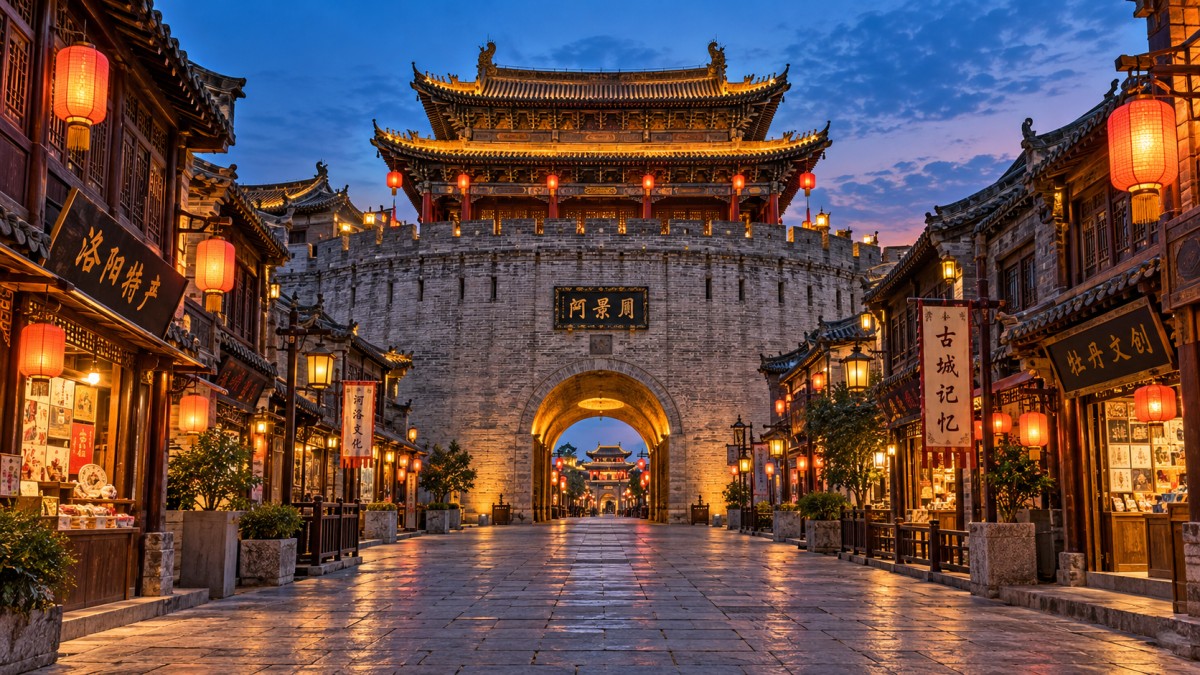
The Lijing Gate and Luoyi Ancient City areas are useful reference points, but they should not be treated as interchangeable. Lijing Gate provides an architectural landmark and access to surrounding old-city streets. Luoyi Ancient City is a managed visitor precinct where heritage presentation, leisure, photography, and evening atmosphere form part of the experience.
Neither requires you to turn the afternoon into an exhaustive historical survey. For this particular day, choose one anchor area and explore nearby lanes, food stalls, and places to sit. Add another area only if the transfer and walking distance suit your remaining time.
Also distinguish street access from admission to individual buildings, exhibitions, or activities. An itinerary that includes “old-town sightseeing” does not necessarily include entry to every attraction encountered along the way.
Late afternoon into evening offers a useful balance: some daylight for seeing architectural details, followed by dinner and illuminated streets where lighting is operating. Do not make a particular performance or lighting display essential to the plan unless its schedule has been confirmed.
Choose transport for the whole route, not just the first journey
Longmen and the old town are separate parts of the city, so the transfer deserves its own time allowance. For an initial schedule, leave roughly 45–75 minutes between finishing at Longmen and being ready to explore the old-town area by road. This is a planning buffer, not a guaranteed driving time; walking to pickup points, waiting for a vehicle, and traffic all matter.
A private vehicle is useful when traveling with children, carrying luggage, managing limited mobility, or coordinating a same-day train. Its main advantage is a clearly arranged pickup and fewer transport decisions. It does not remove queues, scenic-area walking, or restrictions on where vehicles can stop.
Taxis or app-based rides can work well for independent travelers, provided you have mobile connectivity and a usable payment method. Save destinations in Chinese as well as English, and confirm the precise pickup location before leaving the attraction.
Public transport can keep costs down, but compare the complete journey: access walks, transfers, waiting, and the final walk to your destination. A route that looks efficient on a map may be less attractive after several hours on foot.
Check the station name carefully. Luoyang Longmen railway station and Luoyang railway station are different departure points. Proximity to Longmen Grottoes does not make a return journey from the old town instantaneous, nor does it eliminate the need for station security and boarding time.
Walking, weather, and crowds can change the answer
The main physical constraint is not simply the distance between attractions. Longmen involves outdoor paths and steps, and the old town adds more standing and walking later. A vehicle-supported tour can still be a demanding day.
If someone in your party has difficulty with stairs, ask about access to specific viewing areas rather than whether the attraction is generally “accessible.” Likewise, do not assume that an available shuttle replaces all walking. Confirm what it serves and what remains on foot.
During hot weather, an early visit, drinking water, sun protection, and a seated lunch become important scheduling choices. In wet conditions, allow additional care on steps and exposed paths. In colder months, plan around shorter daylight and check seasonal admission and last-entry times.
Public holidays and the peony flowering season deserve extra caution. Accommodation, transport, and attraction access may face stronger demand, while congestion can reduce the value of a tightly timed schedule. On such dates, keeping only Longmen and one old-town area is more sensible than adding extra stops.
A morning start is therefore a risk-management choice, not a guarantee of empty paths. Book required admissions through recognized channels and check current notices close to your travel date.
What should a one-day tour quote actually include?
When comparing organized options, judge the usable itinerary rather than the number of attractions advertised. A tour covering two places with adequate time can deliver more than one listing several stops that are mostly transfers and photographs.
Ask how much time is allocated inside Longmen, which sections are included, and whether guiding continues throughout the visit. A driver and an English-speaking guide provide different services; the presence of one should not be taken to imply the other.
Clarify whether the price includes admission, any relevant internal transport, hotel or station pickups, parking, guide service, and additional waiting time. For a private booking, also establish whether the vehicle remains available during dinner and whether the return journey is included.
Food arrangements matter too. An included meal can simplify logistics, but a fixed group lunch may take longer than expected. Independent dining gives more choice, provided you leave enough time and can communicate dietary requirements. Neither option is automatically better; the right choice depends on whether convenience or flexibility matters more that day.
When splitting the visit is the better decision
Choose two days if the grottoes are a major reason for your trip and you want extended interpretation, several scenic-area sections, or unhurried photography. The same applies if you want a substantial old-town evening with dining, photography, and time to wander without checking a departure clock.
A short transit stop is a different proposition. If your available time only supports a hurried grottoes visit and a brief walk through one street, selecting one attraction can be more satisfying than claiming both.
For a full day, however, the pairing works well: make Longmen the main sightseeing commitment, protect the lunch and transfer break, and let the old town provide the more flexible finish. The strongest itinerary is not the one that fills every hour—it is the one that still works when a queue, a meal, or a walk takes longer than expected.
Your 1:1 travel consultant will respond within 1 business day
How to plan your trip
- Xinjiang Production and Construction Corps Holds Meeting to Advance Winter Tourism Consumption Promotion
- A first-time Luoyang travel guide to choosing where to stay
- Heilongjiang to Issue RMB 100 Million in Consumer Vouchers and Launch a 100-Day Winter Ice and Snow Tourism Initiative
- Planning a photography tour of historic architecture in winter
- “Discover Hebei in Winter” Tourism Exchange and Matchmaking Event Held in Jinan
Monthly travel guide
- Luoyang launches the “Autumn Charm of the Divine Capital” tourism promotion to build anticipation for winter travel
- Typhoon “White Dolphin” Forces Henan Scenic Areas to Close, Putting Summer Ground-Handling Services Under Pressure
- RCEP Implementing Rules for Indonesia Take Effect: Zero Tariffs for Cultural and Tourism Services Alongside Strict Customer Service Requirements
- Saudi Arabia’s New SASO Regulations Take Effect: Taqat Certification Required Before Chinese-Language Cultural Tourism Services Can Access Visit Saudi
- Zhengzhou Launches a Dedicated LCL Shipping Route for Cultural and Tourism Materials, Cutting Freight Costs by 18%
- Luoyang Cold Chain Intensification: Cultural and Creative Exports Delivered in 9 Days
- Expedited Pre-Approval for Group Visas to Three Southeast Asian Countries
- Tightening air freight capacity at Zhengzhou Airport delays the delivery of cultural and tourism materials
- Vietnam's New Regulations on Bus Monitoring Requirements for Group Tours
- Saudi SAMA New Regulations on Travel Liability Insurance Compliance Preparation
- Japanese tourists' new regulations for entering Henan local transport vehicles
- Wai Gao Qiao Wen Travel customs bonded warehouse summer group equipment fast lane
Popular destinations
- Are private Luoyang tours worth the extra cost over group tours?
- Can a one-day Luoyang tour fit in Longmen Grottoes and the old town?
- How to plan a Henan tour around high-speed rail connections
- Is a Longmen Grottoes Guide Worth the Extra Cost for Overseas Groups?
- What Should We Do if a Booked Shaolin Kung Fu Session Is Cancelled?
Why choose us

High cost-performance and transparent experience
Offer astonishing low prices without hidden tourism traps, enabling travelers to explore at lower costs while avoiding unnecessary spending loopholes, ensuring transparent consumption.

Personalization and dedicated service
Support 100% free customization, paired with one-on-one expert service, crafting exclusive itineraries based on travelers' specific needs, while providing professional guidance to enhance the personalization and professionalism of the journey.

Premium itinerary planning
Compact yet rich itineraries allow travelers to experience more within limited time; simultaneously, carefully selected hotels in prime locations provide convenient lodging conditions, overall enhancing travel comfort and experience.