Welcome to Our Travel Agency!




Travel Guide
Build a winter photography tour of historic architecture around one principal location each day, with a nearby alternative for poor weather. In Henan, short daylight hours, shaded courtyards, and time spent walking between entrances and monuments can quickly consume a shooting session. Reserve your strongest light for the building or carvings that matter most, and arrange transport, meals, and indoor breaks around that priority.
Luoyang’s Longmen Grottoes and the temple architecture of Shaolin offer distinct photographic subjects, so they deserve separate schedules. Plan for the images you want: broad architectural views, carved surfaces, roof details, or relationships between buildings and their surroundings. Snow adds possibilities when it occurs, but a workable itinerary should also succeed in dry, overcast, or windy conditions.
Choose locations by the photographs they support
A famous name does not guarantee the composition you have in mind. Before choosing a site, identify its architectural character, accessible viewpoints, and likely walking demands. A rock-cut monument calls for different lenses and timing from a courtyard complex, even when both appear under the same “historic architecture” heading.
For a short trip, pairing Luoyang with Dengfeng keeps the subject focused. Adding Kaifeng introduces another transfer and works best when there is enough time for a separate shooting day. A tightly packed route often produces entrance photographs and hurried departures; extended time at fewer sites allows you to observe shadows, revisit a courtyard, and wait for a clear composition.
Research individual buildings rather than assuming that everything within a heritage district has the same age or construction history. Restoration does not remove photographic value, but accurate descriptions matter. Record the name shown on site interpretation, and distinguish a building’s founding history from the age of the fabric visible today.
Let access hours shape the light plan
Winter’s low sun creates long shadows and emphasizes surface relief. It also leaves some façades in shade for much of the day. Use a map and a sun-position tool to estimate which direction a façade faces, then consider nearby trees, cliffs, walls, and buildings. A theoretical sunrise angle is of little use when a ridge blocks the light or the entrance opens later.
Before fixing transport times, establish opening hours, last admission, available routes, and any temporary restrictions. Ask specifically about tripod use and photography inside halls or caves. Permission to carry a camera does not automatically include flash, support equipment, commercial work, or access to every interior.
Give each day a primary lighting objective. Side light suits weathered stone because small projections cast readable shadows. Soft overcast light is useful for painted details and façades with strong differences between bright and shaded areas. Backlit rooflines emphasize silhouette, though they reveal less surface information.
Do not make sunrise or sunset essential to a photograph inside a ticketed site unless access is confirmed. Public viewpoints outside a complex sometimes offer early or late opportunities, but confirm that the route is open and the stopping place is safe. Allow time to leave before gates close.
A three-day structure with room to photograph
The following outline suits a trip centered on Luoyang and Dengfeng. It is a planning framework; site conditions, arrival times, and winter road conditions should determine the final order.
- Arrival and a modest first session in Luoyang. Leave the major monument for a rested day. Choose an accessible streetscape or exterior setting near your accommodation, establish camera settings, and observe the available light. An arrival delay then affects a flexible session rather than the trip’s main objective.
- A dedicated day for Longmen Grottoes. Prioritize the most important accessible subjects while concentration and energy are high. Allow for security, walking, pauses, and the return route. Keep the later session flexible enough to revisit a viewpoint or finish early if exposed paths become uncomfortable.
- Dengfeng and the Shaolin setting. Confirm the transfer time for the actual accommodation and entrance. Give temple architecture and the Pagoda Forest separate blocks of attention, and avoid squeezing them between unrelated appointments. A long onward journey requires an earlier photographic finish.
Build in a warm midday break wherever the route permits. A comfortable meal and a chance to restore feeling in your hands often improve the afternoon’s results more than another rushed stop. Keep an optional fourth day uncommitted when weather-sensitive images are central to the trip.
For a broader family travel calendar, keep this winter itinerary separate from differently timed programs such as Shanghai Research Summer Camp. Dates, destinations, and program details need their own review; a summer activity should not determine the daylight or transfer assumptions used for a winter architecture trip.
Make the building readable in the frame
Begin with an establishing image that explains the structure’s setting. Then move toward a doorway, a roof junction, a carved panel, or a sequence of columns. This approach creates a connected set of photographs and reduces the temptation to collect isolated details with no sense of scale or place.
A very wide lens is useful in confined spaces, but standing close and tilting upward makes vertical lines converge strongly. Step back when space allows, keep the camera level, and leave room around the subject for modest perspective correction later. For tall structures, decide whether you want a measured architectural view or an expressive upward view before composing.
A longer focal length helps isolate roof ornaments, compress layers of buildings, and exclude distracting surroundings. At Longmen, it also supports tighter studies from permitted viewing positions. Lens reach does not justify stepping beyond barriers or approaching fragile surfaces.
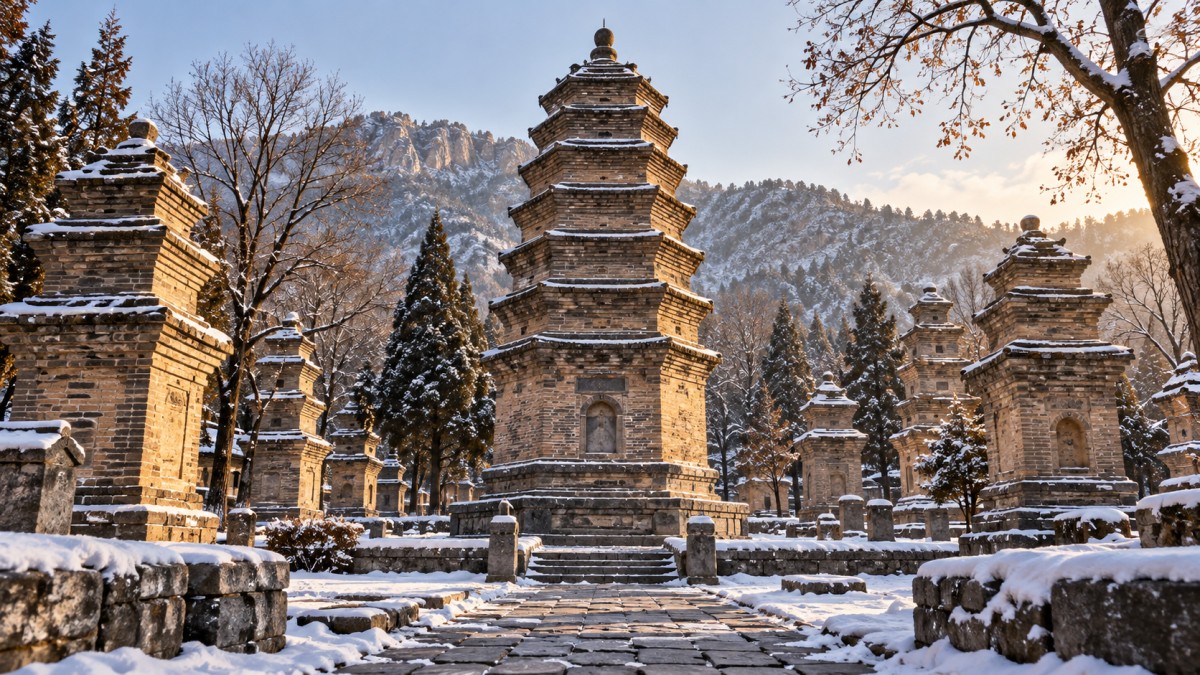
When documenting carving, compare frontal and oblique light. Frontal illumination reveals overall form with fewer deep shadows; light from the side makes shallow relief easier to read but can obscure recessed features. Take a wider contextual frame before the close-up so the detail remains identifiable when you review the images later.
Include people deliberately. A figure can establish scale, while a busy foreground can interrupt an otherwise clear composition. Wait from a position that leaves circulation routes open. In active religious spaces, prioritize the conduct of worship and follow any restrictions on photographing ceremonies or individuals.
Exposure decisions for stone, snow, and dark interiors
Snow and pale stone can confuse automatic exposure because the camera attempts to place bright surfaces closer to a middle tone. Review the histogram and highlight warnings after a test frame. Increase exposure only as far as needed to retain a bright appearance without losing important texture. A fixed compensation value will not suit every mixture of snow, shadow, and dark timber.
For static façades, a moderate aperture often provides useful depth of field without the softness associated with very small apertures. Focus on the main architectural plane and inspect detail at playback magnification. When foreground carvings and a distant building both matter, reassess camera position before assuming that a smaller aperture will solve everything.
Wind changes the shutter-speed decision. Bare branches, hanging decorations, and people will blur during a long exposure even when a tripod holds the building sharp. Raise ISO when a faster shutter is necessary. A slightly noisier photograph with clear detail is often more useful than an image softened by movement.
Interior photography requires particular restraint. If photography is permitted but flash is prohibited, use available light and suitable handheld settings. Do not brace equipment against painted surfaces, sculptures, doors, or historic fittings. Where tripods are allowed, place them without blocking circulation and remain within designated areas.
Cold-weather preparation that protects shooting time
Carry spare batteries close to your body in a secure inner pocket, with terminals protected. Cold reduces available battery performance, so rotate batteries when needed and recharge them according to the manufacturer’s temperature guidance. Keep enough storage available that changing cards does not become a prolonged task with numb fingers.
Condensation deserves more attention than cold alone. Before moving a cold camera into a warm, humid room, enclose it in a sealed bag while still outside, then let it warm gradually before opening. Remove anything needed immediately beforehand. Repeatedly taking the camera between heated interiors and outdoor air creates avoidable interruptions.
Use a weather cover when snow is falling or melting from roofs, and carry a clean cloth for exterior moisture. Avoid breathing directly onto a cold viewfinder or lens. Thin liner gloves under warmer gloves make camera controls easier to manage, while footwear with appropriate traction matters on damp stone, steps, and shaded paths.
Pack around the expected walking route. One versatile lens and a compact telephoto are often easier to manage than a full collection of equipment. Bring a tripod only when its use is allowed and the intended photographs justify carrying it. Never place a support on a parapet or monument to gain height.
Keep one useful alternative ready
Weather alternatives should preserve the photographic purpose. Under flat cloud, concentrate on painted surfaces, repeated structural forms, and details that benefit from even light. During strong wind, favor sheltered courtyards where access remains safe. If ice makes a route unsafe or a site closes, move to a verified accessible location instead of trying to recover the original schedule.
Snow needs its own decision. Fresh snow simplifies backgrounds and outlines roof geometry, but snowfall does not guarantee safe access or an unobstructed view. Confirm operating conditions before departure, and allow the possibility that clearing work or barriers will change the composition.
At the end of each day, back up photographs and add brief notes on building names, viewpoints, and any uncertain identifications. Review a small selection at full size for missed focus or camera movement. If a return visit is possible, that review gives it a concrete purpose: a better angle, clearer context, or a detail that deserves different light.
Your 1:1 travel consultant will respond within 1 business day
How to plan your trip
- Xinjiang Production and Construction Corps Holds Meeting to Advance Winter Tourism Consumption Promotion
- A first-time Luoyang travel guide to choosing where to stay
- Heilongjiang to Issue RMB 100 Million in Consumer Vouchers and Launch a 100-Day Winter Ice and Snow Tourism Initiative
- Planning a photography tour of historic architecture in winter
- “Discover Hebei in Winter” Tourism Exchange and Matchmaking Event Held in Jinan
Monthly travel guide
- Luoyang launches the “Autumn Charm of the Divine Capital” tourism promotion to build anticipation for winter travel
- Typhoon “White Dolphin” Forces Henan Scenic Areas to Close, Putting Summer Ground-Handling Services Under Pressure
- RCEP Implementing Rules for Indonesia Take Effect: Zero Tariffs for Cultural and Tourism Services Alongside Strict Customer Service Requirements
- Saudi Arabia’s New SASO Regulations Take Effect: Taqat Certification Required Before Chinese-Language Cultural Tourism Services Can Access Visit Saudi
- Zhengzhou Launches a Dedicated LCL Shipping Route for Cultural and Tourism Materials, Cutting Freight Costs by 18%
- Luoyang Cold Chain Intensification: Cultural and Creative Exports Delivered in 9 Days
- Expedited Pre-Approval for Group Visas to Three Southeast Asian Countries
- Tightening air freight capacity at Zhengzhou Airport delays the delivery of cultural and tourism materials
- Vietnam's New Regulations on Bus Monitoring Requirements for Group Tours
- Saudi SAMA New Regulations on Travel Liability Insurance Compliance Preparation
- Japanese tourists' new regulations for entering Henan local transport vehicles
- Wai Gao Qiao Wen Travel customs bonded warehouse summer group equipment fast lane
Popular destinations
- Xinjiang Production and Construction Corps Holds Meeting to Advance Winter Tourism Consumption Promotion
- Heilongjiang to Issue RMB 100 Million in Consumer Vouchers and Launch a 100-Day Winter Ice and Snow Tourism Initiative
- Planning a photography tour of historic architecture in winter
- “Discover Hebei in Winter” Tourism Exchange and Matchmaking Event Held in Jinan
- Zhangjiakou 2026–2027 Snow Season Launch and Ice and Snow Tourism Promotion Event Held in Shanghai
Why choose us

High cost-performance and transparent experience
Offer astonishing low prices without hidden tourism traps, enabling travelers to explore at lower costs while avoiding unnecessary spending loopholes, ensuring transparent consumption.

Personalization and dedicated service
Support 100% free customization, paired with one-on-one expert service, crafting exclusive itineraries based on travelers' specific needs, while providing professional guidance to enhance the personalization and professionalism of the journey.

Premium itinerary planning
Compact yet rich itineraries allow travelers to experience more within limited time; simultaneously, carefully selected hotels in prime locations provide convenient lodging conditions, overall enhancing travel comfort and experience.