Welcome to Our Travel Agency!




Travel Guide
For a first visit to Luoyang, the most useful accommodation choices are the old town for evening walks and food, Xigong for a central urban base, and Luolong for modern hotels and access to the southern part of the city. Staying near Luoyang Longmen Railway Station makes sense for a short stop or an early train, but it is not the same as staying beside the Longmen Grottoes.
The best choice depends less on which attraction looks closest on a booking map than on how you want to spend your evenings. A daytime excursion can be planned around transport; dinner, a late walk, and the return to your room happen every night. For a two- or three-night stay, prioritize the neighborhood you want to return to rather than moving hotels to follow individual sights.
Understand the geography before comparing hotels
Luoyang’s visitor attractions are spread across several areas. The historic streets around Lijing Gate and Luoyi Ancient City are in the older eastern part of the urban area. Xigong lies farther west and offers a practical city-center setting. Across the Luo River to the south, Luolong includes modern commercial areas, Luoyang Museum, and the high-speed railway station. The Longmen Grottoes lie farther south.
This layout creates a common booking mistake: assuming that “central,” “old town,” and “near Longmen” describe roughly the same location. They do not. Even within Luolong, two hotels can serve quite different purposes—one might suit museum visits and restaurant access, while another is mainly convenient for catching a train.
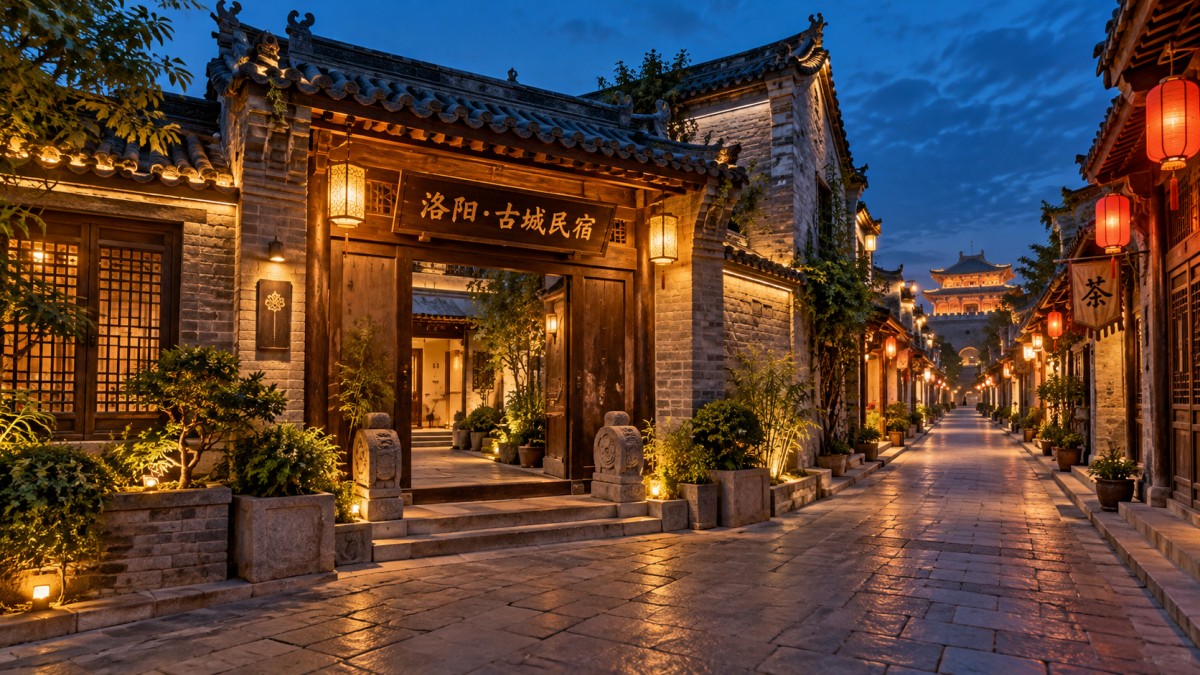
Stay in the old town if your evenings matter most
The old-town area is the strongest fit for travelers who want to step outside after dinner and continue exploring. Lijing Gate, the surrounding historic streets, and Luoyi Ancient City provide different focal points, so check the exact address rather than treating every “old town hotel” as equally convenient.
The practical advantage is flexibility. You can return to your room for a rest, go out again for food, and spend an evening walking without organizing another cross-city journey. This is especially useful when daytime sightseeing includes a substantial excursion to the Longmen Grottoes.
However, atmospheric surroundings do not automatically mean a comfortable room. A guesthouse opening onto a lively lane may have more evening noise than a hotel a few streets away. Courtyard-style or adapted older buildings can also differ considerably in sound insulation, bathroom layout, daylight, and stair access.
Before booking, establish whether a car can reach the entrance, whether there is an elevator, and whether the room faces a busy street or an entertainment area. With large suitcases, a short-looking walk over uneven paving can be more troublesome than a slightly longer ride to a hotel with direct road access.
A useful compromise is the edge of the historic area: close enough to walk to the streets you want to explore, but outside the busiest pedestrian stretch. Check the actual walking route; a straight-line distance on a booking platform does not show road crossings or restricted vehicle access.
Xigong offers balance without making the hotel location the attraction
Xigong suits a mixed itinerary: one day at the grottoes, another exploring historic sites, and evenings when you want several dining options rather than a particular scenic setting. Around Wangcheng Square and neighboring commercial streets, the appeal is everyday convenience.
This can be a sensible first-time choice when you are unsure which part of Luoyang you will enjoy most. You are choosing an urban base rather than committing to either the old town or the southern station area. A hotel with a straightforward metro connection and easy taxi access can work better than a more picturesque property with awkward transfers.
Do not confuse Luoyang Railway Station with Luoyang Longmen Railway Station. They are separate stations in different parts of the city. Check the exact station printed on your ticket before interpreting a hotel’s “near railway station” description.
The trade-off in Xigong is atmosphere. If the point of your stay is to walk directly into historic lanes every evening, a central commercial location may feel too ordinary. But if you value dependable room facilities, nearby meals, and flexible transport, that ordinary setting can be an advantage.
Choose Luolong for the right neighborhood, not just a modern hotel
Luolong deserves consideration if you prefer contemporary accommodation, are including Luoyang Museum, or expect to use private transfers for sightseeing. Its southern location can also suit an itinerary involving the Longmen Grottoes and the high-speed station, although the exact hotel position remains important.
“Luolong” covers too much ground to function as a precise accommodation recommendation. A hotel beside an established shopping and dining area offers a different stay from one on a broad road with few places to walk to. Look beyond room photographs and inspect the surrounding blocks.
For families and travelers who need downtime, accessible meals and practical room arrangements may outweigh proximity to historic streets. Confirm bed sizes, occupancy limits, and whether a “family room” actually provides suitable separate sleeping spaces. A larger room is not necessarily a better layout.
The principal cost of staying south of the river is the return from old-town evenings. One planned visit may be easy to accommodate; repeated journeys become less attractive if your preferred restaurants and evening activities are all in the older city. Compare that recurring journey against the benefits of the hotel itself.
When does a station or grottoes hotel make sense?
A hotel near Luoyang Longmen Railway Station is a logistical choice. It is valuable when you arrive late, leave early, or have a short stop built around a prearranged sightseeing trip. For a longer visit, the benefit of saving time on one station transfer may be outweighed by repeated journeys elsewhere.
Check what “near the station” means in practice. The entrance you need, road layout, pedestrian crossings, and luggage route matter more than a promotional distance. Ask whether a station transfer is available, what it costs, and when it operates rather than assuming a shuttle is included.
Staying near the Longmen Grottoes is a separate decision. It can suit someone whose main purpose is to visit the site and then rest nearby, but it is not the default recommendation for a first visit covering several parts of Luoyang. Also distinguish proximity to the scenic area from proximity to the entrance and visitor access arrangements you will actually use.
For a single-night stop, let the least flexible commitment decide. An early train may justify a station hotel; a fixed morning visit may favor accommodation closer to the sightseeing route. If neither applies, a neighborhood with convenient dinner options is generally more rewarding than a transport-focused location.
April changes the booking calculation
If peony viewing is a priority, select the garden or viewing area before selecting the hotel. Luoyang’s peony attractions are not all concentrated in one neighborhood, and flowering conditions vary with the weather. An accommodation listing that advertises “peony access” is not enough to establish whether its location suits your intended visit.
For April dates, compare cancellation terms alongside the room rate. Flexibility matters when you are coordinating garden visits, rail tickets, and other attractions. Avoid basing a nonrefundable booking on an assumed peak-bloom date alone.
A customized outing such as the Luoyang Essence One-Day Tour (customized tour, peony viewing in April) is relevant when you want to combine seasonal viewing with other stops. Before choosing accommodation around it, confirm the actual itinerary, hotel pickup coverage, and return arrangements. An organized day trip can reduce the need to sleep beside one attraction, but only if the transport arrangements support your chosen base.
Compare the complete stay, not just the nightly price
A useful Luoyang travel guide should distinguish a cheap room from an economical location. A lower rate can lose its advantage if it adds separate taxi journeys for meals, sightseeing, and station transfers. Conversely, paying a premium to stay beside one attraction may deliver little benefit if you visit it only once.
Use your planned days to test each shortlisted address. Map the arrival journey, the main sightseeing departure, an evening meal, and the final station transfer. Check walking sections as well as vehicle travel. Metro access is valuable only when the station entrance and onward route work for you.
Then check the property details that can change the experience:
- Room-specific noise: Read recent comments about the room category and street-facing position, not only the hotel’s overall score.
- Access: Confirm elevators, steps at the entrance, and vehicle pickup points if mobility or luggage is a concern.
- Seasonal comfort: Ask about heating or air-conditioning operation for your travel dates, particularly during seasonal changeovers.
- Check-in arrangements: For an international arrival, confirm that the property can complete check-in using your passport and establish how to contact reception if you arrive late.
- Booking conditions: Verify breakfast, extra-person charges, cancellation deadlines, and whether the booked room has a window.
Keep the hotel’s Chinese name, address, and telephone number saved on your phone. English names can vary between platforms, and a map pin is more useful for a driver than a translated property name alone.
For a short first visit, keep one base unless logistics justify a move
Splitting a two- or three-night stay between the old town and Luolong can look efficient on a map, but packing, checkout, luggage storage, and another check-in consume usable sightseeing time. A single well-chosen base is usually the simpler arrangement. A final night near the station becomes worthwhile when it materially reduces the difficulty of an early departure.
If evening atmosphere is your priority, choose a quiet, accessible property near the old town. If your itinerary is mixed and you want practical city amenities, shortlist Xigong. If room comfort and southern-city connections matter more, compare specific Luolong neighborhoods. Reserve station or grottoes accommodation for a schedule that genuinely benefits from it—the right address should make the whole visit easier, not merely place one landmark closer.
Your 1:1 travel consultant will respond within 1 business day
How to plan your trip
- Xinjiang Production and Construction Corps Holds Meeting to Advance Winter Tourism Consumption Promotion
- A first-time Luoyang travel guide to choosing where to stay
- Heilongjiang to Issue RMB 100 Million in Consumer Vouchers and Launch a 100-Day Winter Ice and Snow Tourism Initiative
- Planning a photography tour of historic architecture in winter
- “Discover Hebei in Winter” Tourism Exchange and Matchmaking Event Held in Jinan
Monthly travel guide
- Luoyang launches the “Autumn Charm of the Divine Capital” tourism promotion to build anticipation for winter travel
- Typhoon “White Dolphin” Forces Henan Scenic Areas to Close, Putting Summer Ground-Handling Services Under Pressure
- RCEP Implementing Rules for Indonesia Take Effect: Zero Tariffs for Cultural and Tourism Services Alongside Strict Customer Service Requirements
- Saudi Arabia’s New SASO Regulations Take Effect: Taqat Certification Required Before Chinese-Language Cultural Tourism Services Can Access Visit Saudi
- Zhengzhou Launches a Dedicated LCL Shipping Route for Cultural and Tourism Materials, Cutting Freight Costs by 18%
- Luoyang Cold Chain Intensification: Cultural and Creative Exports Delivered in 9 Days
- Expedited Pre-Approval for Group Visas to Three Southeast Asian Countries
- Tightening air freight capacity at Zhengzhou Airport delays the delivery of cultural and tourism materials
- Vietnam's New Regulations on Bus Monitoring Requirements for Group Tours
- Saudi SAMA New Regulations on Travel Liability Insurance Compliance Preparation
- Japanese tourists' new regulations for entering Henan local transport vehicles
- Wai Gao Qiao Wen Travel customs bonded warehouse summer group equipment fast lane
Popular destinations
- A first-time Luoyang travel guide to choosing where to stay
- The Palace Museum Explained: From Imperial Residence to Public Museum
- Shanghai Skyline Views: The Bund vs. Lujiazui for First-Time Visitors
- Is a 15-day panoramic tour of China covering multiple cities too rushed?
- Visiting China for the First Time: How Many Cities Should You Include in a 15-Day Grand Tour?
Why choose us

High cost-performance and transparent experience
Offer astonishing low prices without hidden tourism traps, enabling travelers to explore at lower costs while avoiding unnecessary spending loopholes, ensuring transparent consumption.

Personalization and dedicated service
Support 100% free customization, paired with one-on-one expert service, crafting exclusive itineraries based on travelers' specific needs, while providing professional guidance to enhance the personalization and professionalism of the journey.

Premium itinerary planning
Compact yet rich itineraries allow travelers to experience more within limited time; simultaneously, carefully selected hotels in prime locations provide convenient lodging conditions, overall enhancing travel comfort and experience.