Welcome to Our Travel Agency!




Travel Guide
What local snacks should you try at a Luoyang night market?
What should you eat first at a Luoyang night market? Beyond the sizzling skewers, look for local favorites such as savory beef soup, crisp pan-fried guotie dumplings, and tangy jiang miantiao—noodles cooked in fermented mung bean broth. Each offers a different taste of this ancient capital’s everyday food culture. Whether you’re exploring the old city after sightseeing or planning an evening food walk, a little knowledge helps you choose distinctive specialties rather than simply joining the longest queue.
The useful distinction is between food that belongs to Luoyang’s culinary identity and food that happens to be sold there. Both can be enjoyable. But if you have only one evening, save room for something sour, something brothy, and something freshly crisped in a pan. A meal made entirely of grilled meat and sweet drinks misses much of what makes the city interesting.
Start around the old city, but look beyond the busiest stalls
The Lijing Gate area and nearby old-city streets, including the Cross Street food area, are practical starting points for an evening wander. Expect a mixture of local dishes, familiar Chinese street snacks, and photogenic treats aimed at visitors. Stall lineups, opening hours, and pedestrian arrangements can change, especially around holidays, so confirm current conditions rather than relying on an old travel post.
Not every traditional dish is served from a portable stall. Some of the better opportunities to try soup or noodles may be in small fixed shops beside the market streets. Think of your visit as a neighborhood food walk, not a search for one enclosed market containing everything.
Before buying, walk a short stretch and watch the cooking. Dumplings coming straight from a pan are a more useful signal than an elaborate sign. For soup, look for bowls being assembled to order and ingredients handled carefully. A queue can suggest popularity, but it does not replace checking cleanliness or asking what is actually being served.
Beef soup: a taste of Luoyang’s everyday appetite
Luoyang beef soup, often written as niurou tang, is one of the city’s defining everyday foods. It is strongly associated with breakfast, which matters when planning an evening visit: a well-known morning soup shop may not be open at night. If beef soup is high on your list, check the shop’s hours or give it a separate breakfast stop.
Where it is available, expect a savory broth with sliced beef, with seasonings and accompaniments varying by shop. Bread or thin bread strips may be ordered alongside or added to the bowl. Ask what comes with the basic serving before choosing extras; a seemingly light bowl can become a substantial meal once bread is involved.
Taste the broth before adding chili. The appeal is not simply heat: it is the combination of beef flavor, warm broth, and bread softening as you eat. If you are sharing several dishes, choose a modest serving. Filling up on soup and bread at the first stop is an easy mistake.
Guotie: choose the batch, not just the filling
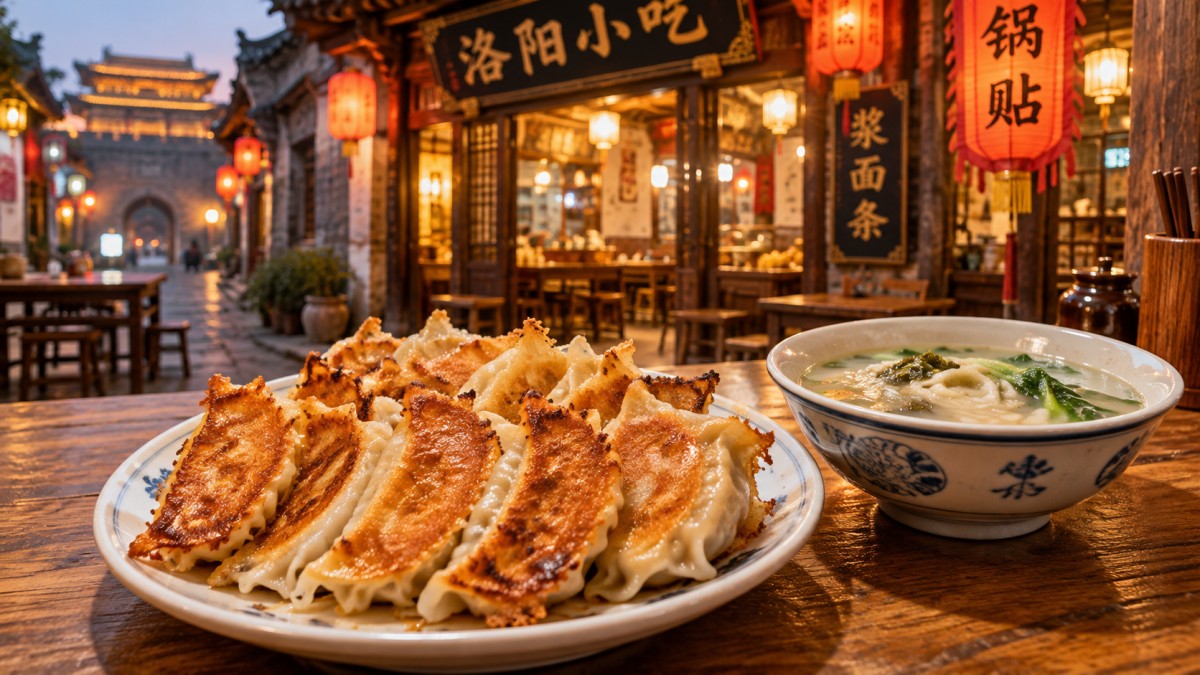
Guotie are pan-fried dumplings with crisp bases and softer upper wrappers. They are not exclusive to Luoyang, but they make a satisfying contrast to the city’s soups and soft noodles. Their quality depends heavily on timing: a freshly cooked batch is usually a better choice than dumplings that have been waiting on a tray.
Look for browned bottoms rather than uniformly pale wrappers. Fillings vary, so do not assume a particular meat or that a vegetable filling is vegetarian. Ask before ordering, especially if you avoid pork, eggs, or other common ingredients. Vinegar and chili can be served separately; try one dumpling plain before deciding how much sauce it needs.
For two people, a small portion makes a useful shared stop. Dumplings are also a sensible option for a companion who is unsure about fermented flavors, although the filling still needs checking.
Jiang miantiao: try a small bowl of the unfamiliar
Jiang miantiao is a particularly worthwhile choice if you want something more distinctive than standard street-food fare. The noodles are cooked in a fermented mung bean liquid, giving the dish a tangy character. This is not the sharpness of vinegar poured over ordinary noodles; fermentation shapes the flavor of the whole bowl.
The texture tends toward soft and comforting rather than springy, with vegetables and toppings varying between kitchens. Expect a humble, filling dish rather than a neatly arranged tasting portion. Its aroma can surprise first-time visitors, and liking other noodle soups does not guarantee that you will enjoy this one.
That is a reason to order small, not to skip it automatically. Share a bowl if the shop permits and taste the broth before mixing in condiments. If you dislike fermented aromas, choose dumplings instead. Travel eating should leave room for curiosity without turning every local specialty into an obligation.
Bufan tang and other dishes worth leaving room for
Another name to look for is bufan tang, a local sour-and-peppery soup associated with small mung bean pancakes. Versions may include ingredients such as vermicelli, wood ear mushrooms, or dried shrimp, so ask what goes into the bowl. It offers a different experience from beef soup: more about tang, pepper, and contrasting textures than a meaty broth.
Despite the similar sound of their English spellings, bufan tang and beef soup are different dishes. A menu photograph or saved dish name can help prevent an ordering mix-up. If you have already tried jiang miantiao, decide whether you want another sour dish or would prefer something crisp and savory for variety.
You may also encounter fried snacks labeled as luoyang hutu or other local specialties, depending on the vendor. Rather than ordering from an unfamiliar transliteration alone, ask about ingredients and preparation. Luoyang’s famous water banquet, meanwhile, is better treated as a separate sit-down meal. Its series of soup-based dishes cannot be meaningfully replaced by one snack purchased while walking.
Where do skewers and sweets fit?
Grilled skewers are part of the evening atmosphere, even when they are not uniquely local. Buy them because you want something smoky and freshly cooked, not because every barbecue stand represents an old Luoyang tradition. Check the displayed price and whether it applies per skewer, portion, or weight before ordering.
Sweet snacks can provide a pleasant finish, but colorful presentation is not evidence of local heritage. If your appetite is limited, prioritize the dishes you are less likely to encounter elsewhere, then choose a small dessert. There is no need to turn the evening into a checklist of everything displayed along the street.
A balanced first visit might mean sharing guotie, trying one local soup or noodle dish, and adding a skewer or sweet only if you still feel hungry. You will notice more about each dish than you would by buying several heavy portions at once.
Order clearly, especially with dietary restrictions
A translation app is useful, but specific questions work better than broad labels. “Does this contain meat broth?” is clearer than “Is this vegetarian?” Likewise, ask about shrimp, sesame, peanuts, eggs, or other relevant allergens individually. A vegetable-looking bowl may still contain animal stock or dried seafood.
- Ask for chili separately if you are unsure about spice; peppery heat may already be present in the broth.
- Confirm portion size and the total price before the vendor starts preparing your order.
- Choose food cooked thoroughly and served hot, while checking that raw and cooked ingredients are handled separately.
- For a severe allergy, carry a clearly translated allergy card. If ingredients or cross-contact cannot be confirmed, choose another place.
Do not assume that removing a visible topping makes a dish suitable. The same ingredient may already be in the stock, filling, or cooking oil. Travelers with strict dietary requirements may find a fixed restaurant with time to discuss preparation more practical than a crowded stall.
Make the food walk fit the rest of your trip
After visiting the Longmen Grottoes, an old-city food walk can be an appealing change of pace. Leave enough flexibility for transport, tired legs, and somewhere to sit. Families and older travelers often benefit more from two comfortable food stops than from a long route through crowded streets.
Henan Le Journey Travel Agency Co., Ltd., based in Luoyang, can incorporate dining arrangements into a wider Henan itinerary alongside transport, guides, and sightseeing. The useful request is specific: say whether you want unfamiliar local flavors, mild food, seated stops, or help discussing dietary needs. Confirm evening availability rather than assuming every celebrated breakfast specialty belongs on a night-market route.
For a wider China trip, keep each destination’s food experience distinct. A separate city excursion such as the Chongqing Highlights One-Day Tour belongs in its own part of the itinerary; it is not a substitute for exploring Luoyang’s soup shops and old-city snacks.
For your first Luoyang night market visit, start with a small portion of guotie and one genuinely local bowl—jiang miantiao or bufan tang if available. Save beef soup for breakfast if the right shop closes early. The aim is not to eat everything in one evening, but to leave knowing which Luoyang flavor you would happily order again.
Your 1:1 travel consultant will respond within 1 business day
How to plan your trip
- The Ice and Snow Industry Surpasses RMB 1 Trillion, with Direct High-Speed Rail Access and Upgraded Nighttime Offerings Driving Spending
- Autumn Breaks in Multiple Regions Boost Family Travel and Tourism
- Liaoning 2026–2027 Winter Culture Carnival Kicks Off
- Shenyang Cultural Tourism Promotion Delegation Visits Guangzhou to Promote Winter Tourism and Attract Investment
- 2026 Hebei Culture and Tourism Promotion Week in Beijing Kicks Off
Monthly travel guide
- October 2026 County-Level Tourism Communications Report Released: Top 100 Index Rebounds
- More Than 100 Cities Introduce Autumn Breaks, Creating a New Hotspot for Family and Educational Travel
- The 2026 China-Vietnam (Honghe) Border Economic, Trade and Tourism Fair Opens in Hekou
- The 2026 Guangxi Cultural Tourism Carnival Held in Hezhou
- Luoyang launches the “Autumn Charm of the Divine Capital” tourism promotion to build anticipation for winter travel
- Typhoon “White Dolphin” Forces Henan Scenic Areas to Close, Putting Summer Ground-Handling Services Under Pressure
- RCEP Implementing Rules for Indonesia Take Effect: Zero Tariffs for Cultural and Tourism Services Alongside Strict Customer Service Requirements
- Saudi Arabia’s New SASO Regulations Take Effect: Taqat Certification Required Before Chinese-Language Cultural Tourism Services Can Access Visit Saudi
- Zhengzhou Launches a Dedicated LCL Shipping Route for Cultural and Tourism Materials, Cutting Freight Costs by 18%
- Luoyang Cold Chain Intensification: Cultural and Creative Exports Delivered in 9 Days
- Expedited Pre-Approval for Group Visas to Three Southeast Asian Countries
- Tightening air freight capacity at Zhengzhou Airport delays the delivery of cultural and tourism materials
Popular destinations
- Is Jingshan Park worth visiting for sunset views over Beijing?
- Mutianyu vs Jinshanling Great Wall: Which Suits a First Visit?
- Is Luoyang, China, worth a stop on your first visit to China?
- How many days do you need in Luoyang to see its major sights?
- What local snacks should you try at a Luoyang night market?
Why choose us

High cost-performance and transparent experience
Offer astonishing low prices without hidden tourism traps, enabling travelers to explore at lower costs while avoiding unnecessary spending loopholes, ensuring transparent consumption.

Personalization and dedicated service
Support 100% free customization, paired with one-on-one expert service, crafting exclusive itineraries based on travelers' specific needs, while providing professional guidance to enhance the personalization and professionalism of the journey.

Premium itinerary planning
Compact yet rich itineraries allow travelers to experience more within limited time; simultaneously, carefully selected hotels in prime locations provide convenient lodging conditions, overall enhancing travel comfort and experience.