Welcome to Our Travel Agency!




Travel Guide
Mutianyu is the better default for a first Great Wall visit if you want straightforward transport, flexible walking, and an easier day with children or older relatives. Jinshanling is the stronger choice if walking the Wall is the main purpose of your day and you are comfortable exchanging a longer journey and more demanding terrain for expansive ridge views and a quieter experience.
The distinction is not “touristy versus authentic.” Both are historic Great Wall sections with managed visitor access, and both involve steps, gradients, and exposure to the weather. The practical question is how much of your day you want to spend reaching the Wall, how far you want to walk once there, and how easily you need to shorten the visit.
The difference that matters most: flexibility versus commitment
Mutianyu, northeast of central Beijing, works well when the Great Wall is one part of a busy itinerary. Its transport infrastructure and established visitor services make it easier to plan a relatively gentle visit, although road traffic and entrance procedures still take time. You can use an uphill lift, walk a selected stretch, and return without committing to a long hike.
Jinshanling, farther from Beijing in Hebei Province, rewards travelers who want the Wall itself to occupy most of the day. Its ridgeline setting creates long views of walls and watchtowers rising and falling across the mountains. A short visit is possible, but the longer transfer makes more sense when you leave enough time to explore rather than rush back after a few photographs.
These driving times are planning estimates, not transfer guarantees. Your hotel location, departure time, holiday traffic, and road conditions can change the day substantially. Transfers within the scenic area, ticket checks, lift queues, and the walk to the Wall come on top of the road journey.
Neither section is flat, even if you take a cable car
The most consequential mistake in a Mutianyu vs Jinshanling Great Wall comparison is treating lift access as a substitute for walking ability. A lift removes part of the approach climb. It does not turn the Wall into a level promenade.
At Mutianyu, restored masonry gives visitors a comparatively consistent walking surface, but stair heights vary and some stretches climb sharply. Choosing a shorter route around the lift arrival area can make the visit manageable for someone who walks comfortably but does not want sustained exertion. Heading toward the steeper outer stretches produces a very different day.
Jinshanling suits people who enjoy walking over changing gradients. The effort comes from repeated ascents and descents rather than one continuous climb. Uneven steps and worn surfaces require attention, particularly when descending. Someone who is comfortable walking several kilometers through a city may still find this considerably harder.
Judge fitness by stair tolerance, balance, and confidence on descents—not distance alone. Knee discomfort can become more limiting on the return journey than breathlessness on the way up. If anyone in your group has significant mobility limitations, neither section should be assumed to offer a step-free Wall experience; confirm the precise access route before booking.
For families, the youngest child’s walking ability matters more than the adults’ enthusiasm. Strollers are not a practical solution for exploring the Wall itself. A child carrier also changes the adult’s balance and workload on steep stairs. Mutianyu offers more room to keep the outing short, but supervision remains essential at steps, thresholds, and crowded access points.
Choose scenery by the experience you want, not by claims of authenticity
Mutianyu provides the classic first-visit view: a substantial stone wall, closely spaced watchtowers, and wooded mountain ridges. Its restored appearance makes the structure easy to appreciate, especially if your priority is to stand on the Wall, understand its scale, and take memorable photographs without a lengthy hike.
Jinshanling’s appeal lies in the way the Wall travels across the landscape. Successive ridges create depth, and changes in elevation reveal different arrangements of towers and mountain silhouettes. Walking farther can produce a stronger sense of the Wall as a defensive line shaped by terrain rather than as a single attraction.
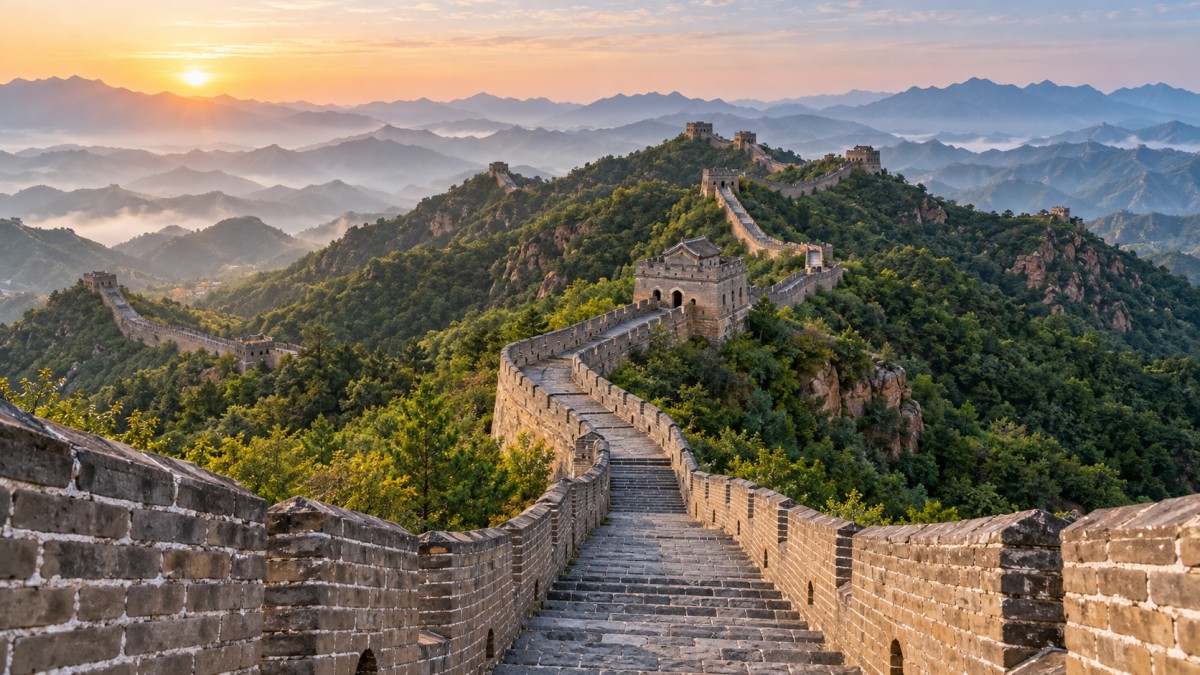
Restoration is not a reliable measure of historical value. An unrestored-looking section is not automatically more meaningful, and a maintained section is not less authentic simply because it accommodates visitors. At either location, understanding watchtower placement, steep slopes, and the relationship between the Wall and the ridgeline can add more to the visit than seeking the roughest masonry.
For photography, Jinshanling is particularly appealing if you want layered landscapes and are willing to walk for different viewpoints. Mutianyu is a strong option for family portraits and recognizable Wall scenes with less logistical effort. Visibility can outweigh the location advantage: haze, low cloud, or rain may obscure distant ridges at either site.
Transport can decide the choice before fitness does
With a private vehicle, the central trade-off is additional road time versus your interest in walking. For Jinshanling, agree on the arrival gate, intended walking route, pickup location, and return time before setting out. A route that ends at a different gate is only convenient if that gate is open and the driver can collect you there.
Mutianyu is generally easier to arrange through organized day trips and visitor-oriented transport services from Beijing. Independent public transport can require transfers and a final local connection. Jinshanling demands more careful checking of departure points, operating dates, return arrangements, and the distance between a transport stop and the scenic-area entrance.
Do not build either day around an old bus timetable or an unconfirmed return service. Check current arrangements with the operator, and distinguish a direct tourist shuttle from a public bus that stops elsewhere in the surrounding area. A cheap outward journey has little value if the return leaves before you finish walking.
For a short Beijing stay, the extra driving to Jinshanling has an opportunity cost: less time resting, eating, or visiting another attraction. For someone who regards the Great Wall as the highlight of the trip, that extra time may be entirely justified. Neither conclusion depends on which section is “better” in isolation.
Allow most of a day for Mutianyu if you want an unhurried visit from central Beijing. Treat Jinshanling as a full-day outing. Combining either with a major, time-sensitive evening commitment leaves less margin for traffic, particularly after a tiring walk.
Lift tickets and route details deserve more attention than headline prices
At Mutianyu, the cable car and the chairlift/toboggan system serve different access points. They should not be treated as interchangeable parts of one return service. Before buying, check which ascent and descent your ticket includes and where each leaves you on the Wall. A route that looks simple on a sales page can require extra walking between lift stations.
The toboggan is an optional activity, not a dependable accessibility solution. Participation conditions, weather, queues, and operating restrictions can affect whether it suits your group. Anyone who does not want to use it should have a clear alternative descent.
At Jinshanling, an operating cable car can reduce the approach effort, but it does not remove the repeated climbs along a longer Wall route. Confirm its current service and last descent rather than assuming it will be available throughout your visit. Leave enough time to return on foot if your planned arrangements require it.
Compare the total day cost: transport, admission, any required internal shuttle, lifts, guide services, and meals. The lowest advertised tour price may exclude items that materially change both cost and convenience. Check actual time at the Wall, shopping stops, pickup coverage, and whether the schedule allows you to walk at your own pace.
When assessing a family program such as Family-friendly travel itinerary 2, the useful questions are whether the proposed Wall route matches the least mobile traveler, which lift arrangements are included, and how the day can be shortened. The itinerary name alone does not establish suitability.
Quieter does not mean empty, and early does not solve everything
Jinshanling generally attracts fewer visitors than Mutianyu, but popular viewpoints can still become busy. Mutianyu’s crowds tend to be more noticeable near lift arrival points and convenient photo locations. Walking farther may create space, although the price is additional exertion and a longer return.
At either section, weekdays outside major Chinese holiday periods offer a better starting point for avoiding crowds. An early departure can help, but only when it matches current opening hours and transport availability. Arriving before facilities operate simply replaces a queue with a wait.
Weather should influence the route, not just clothing. Summer heat makes exposed stairs harder; rain can make stone slippery; winter ice can turn manageable descents into a significant hazard. Strong wind or thunderstorms can affect safe access and lift operations. Carry water, suitable footwear, sun protection, and an appropriate extra layer rather than relying on supplies being available at every tower.
Sunrise and sunset photographs at Jinshanling require specific planning. Standard daytime admission does not automatically provide access at those hours, and finishing a walk after transport or lifts stop creates avoidable problems. Confirm access and return arrangements before choosing the section for a particular lighting window.
Which choice will leave you happier at the end of the day?
Choose Mutianyu if your ideal visit is a memorable few hours on the Wall without making physical endurance the defining feature. It is particularly sensible for mixed-fitness groups, families, short Beijing stays, and travelers who want the freedom to stop after a modest walk. You are not settling for a lesser Great Wall experience by choosing convenience.
Choose Jinshanling if the walk is the attraction rather than the route to a photograph. It is worth the longer transfer when you enjoy sustained outdoor activity, want changing ridge perspectives, and can keep your schedule flexible enough for a full day. Stay on officially open routes; do not assume that onward walks to neighboring sections are permitted or accessible.
If you remain undecided, ask one question: would you prefer more time on the road for a longer walk, or less logistical commitment with an easier exit? For most first visits, Mutianyu makes the day simpler. Jinshanling earns the extra effort when that effort is part of what you came to enjoy.
Your 1:1 travel consultant will respond within 1 business day
How to plan your trip
- The Ice and Snow Industry Surpasses RMB 1 Trillion, with Direct High-Speed Rail Access and Upgraded Nighttime Offerings Driving Spending
- Autumn Breaks in Multiple Regions Boost Family Travel and Tourism
- Liaoning 2026–2027 Winter Culture Carnival Kicks Off
- Shenyang Cultural Tourism Promotion Delegation Visits Guangzhou to Promote Winter Tourism and Attract Investment
- 2026 Hebei Culture and Tourism Promotion Week in Beijing Kicks Off
Monthly travel guide
- October 2026 County-Level Tourism Communications Report Released: Top 100 Index Rebounds
- More Than 100 Cities Introduce Autumn Breaks, Creating a New Hotspot for Family and Educational Travel
- The 2026 China-Vietnam (Honghe) Border Economic, Trade and Tourism Fair Opens in Hekou
- The 2026 Guangxi Cultural Tourism Carnival Held in Hezhou
- Luoyang launches the “Autumn Charm of the Divine Capital” tourism promotion to build anticipation for winter travel
- Typhoon “White Dolphin” Forces Henan Scenic Areas to Close, Putting Summer Ground-Handling Services Under Pressure
- RCEP Implementing Rules for Indonesia Take Effect: Zero Tariffs for Cultural and Tourism Services Alongside Strict Customer Service Requirements
- Saudi Arabia’s New SASO Regulations Take Effect: Taqat Certification Required Before Chinese-Language Cultural Tourism Services Can Access Visit Saudi
- Zhengzhou Launches a Dedicated LCL Shipping Route for Cultural and Tourism Materials, Cutting Freight Costs by 18%
- Luoyang Cold Chain Intensification: Cultural and Creative Exports Delivered in 9 Days
- Expedited Pre-Approval for Group Visas to Three Southeast Asian Countries
- Tightening air freight capacity at Zhengzhou Airport delays the delivery of cultural and tourism materials
Popular destinations
- Is Jingshan Park worth visiting for sunset views over Beijing?
- Mutianyu vs Jinshanling Great Wall: Which Suits a First Visit?
- Is Luoyang, China, worth a stop on your first visit to China?
- How many days do you need in Luoyang to see its major sights?
- What local snacks should you try at a Luoyang night market?
Why choose us

High cost-performance and transparent experience
Offer astonishing low prices without hidden tourism traps, enabling travelers to explore at lower costs while avoiding unnecessary spending loopholes, ensuring transparent consumption.

Personalization and dedicated service
Support 100% free customization, paired with one-on-one expert service, crafting exclusive itineraries based on travelers' specific needs, while providing professional guidance to enhance the personalization and professionalism of the journey.

Premium itinerary planning
Compact yet rich itineraries allow travelers to experience more within limited time; simultaneously, carefully selected hotels in prime locations provide convenient lodging conditions, overall enhancing travel comfort and experience.