Welcome to Our Travel Agency!




Travel Guide
Yes—Jingshan Park is worth visiting for sunset views over Beijing when visibility is good and a stepped uphill walk fits your plans. Its main attraction is the elevated view south across the Forbidden City, where layers of imperial rooftops stretch toward the capital’s central axis. Late sunlight brings out the roof colors and gives the palace complex a depth that is harder to appreciate from street level.
The main qualification is the direction of the view: the Forbidden City lies south of the hill, while the sun sets toward the west, with its position shifting through the year. Expect warm light across the palace and a separate view toward the sunset. A photograph with the sun dropping directly behind the palace rooftops is not the standard composition from here.
Jingshan deserves a place on a clear-evening itinerary, especially after visiting the Forbidden City. During heavy haze, steady rain, or a tightly scheduled evening, its value as a sunset stop falls considerably.
The view that makes the climb worthwhile
Wanchun Pavilion, at the central summit, is the park’s best-known viewpoint. Looking south, the Forbidden City’s scale becomes immediately legible: courtyards, rooflines, and gateways form an ordered sequence beneath you. The elevated perspective explains the layout in a way that walking through individual palace courtyards cannot.
Turn away from the palace and the experience broadens. The surrounding city reveals a mixture of historic roofs, trees, and newer buildings. In clear conditions, the wider horizon adds depth; in hazy conditions, the nearest architectural details carry most of the scene. This distinction matters when deciding whether a less-than-perfect forecast still justifies the visit.
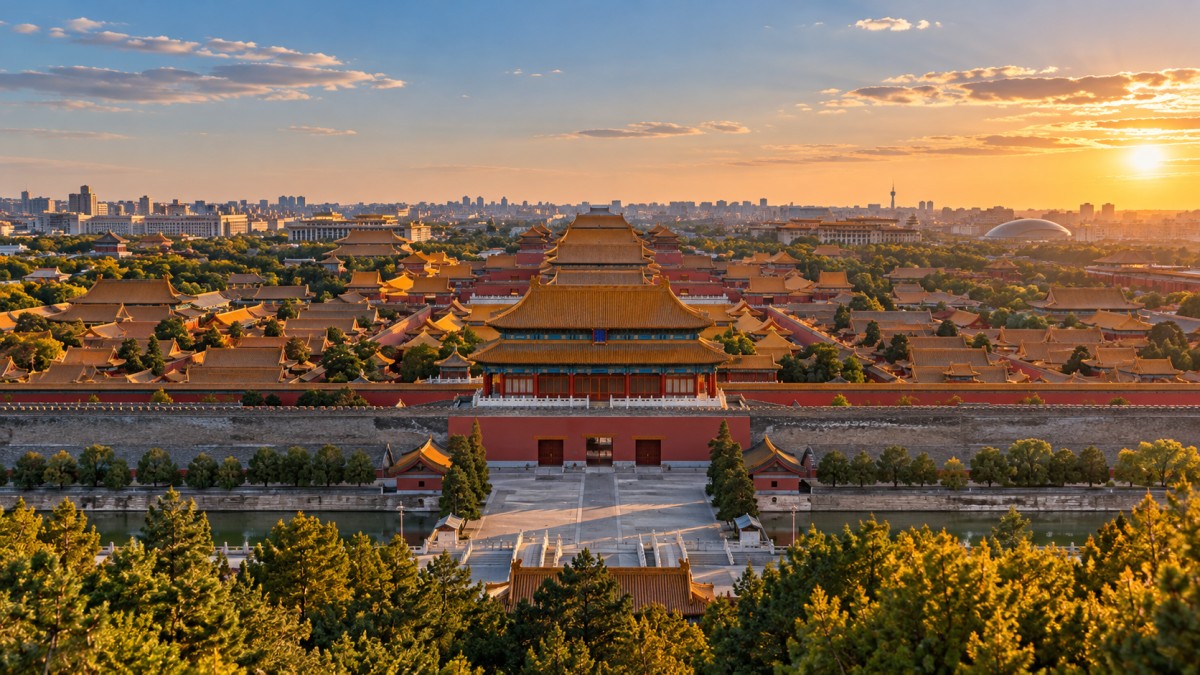
Sunset adds atmosphere, although the strongest palace photographs often happen before the sun reaches the horizon. Low, warm light gives the rooftops texture while there is still enough illumination to distinguish the courtyards. Waiting exclusively for the exact sunset minute can mean missing the most balanced light.
The pavilion is also a popular destination in its own right. Expect people talking, taking photographs, and waiting for a place along the viewing edge. The setting is rewarding, but it should not be planned as a secluded hilltop experience.
Visibility matters more than a promising sunset icon
A weather app showing sunshine does not guarantee a crisp panorama. Cloud cover describes only part of the conditions; haze, airborne dust, and humidity also influence how much detail remains visible across the city. A bright afternoon can still produce a washed-out horizon.
Before committing to the climb, look at distant buildings from street level. Clearly defined outlines are an encouraging sign. If even nearby towers disappear into a pale background, the broad skyline view will probably be disappointing. The Forbidden City is much closer to the hill, so its roof patterns may remain interesting even when the distant panorama lacks definition.
Cloud type changes the experience too. Broken clouds with an open western horizon can produce attractive light and color. A thick, continuous layer is more likely to turn the scene gradually gray. Colorful clouds overhead do not automatically mean the palace below will receive warm illumination.
Rain clearing before evening sometimes improves visibility, but residual cloud can still block the sun. Wind can help clear the air while making the exposed summit uncomfortable. Consider the view and the conditions for standing outside together, particularly in colder months.
Arrive before the light becomes urgent
A practical planning allowance is to reach the park entrance around an hour before the published sunset. Treat this as breathing room rather than a guaranteed requirement: admission queues, walking pace, photographs along the way, and congestion near the pavilion all affect how quickly you reach a useful viewing position.
The climb is relatively short, but it includes steps and uphill paths. Arriving at the gate as the sky begins to turn orange leaves little margin for a slow ascent or a crowded viewing edge. Reaching the summit earlier also gives time to distinguish the south-facing palace view from the western sunset view.
Sunset time changes substantially across the year. Use the date of your actual visit, then compare it with the park’s current opening hours, last admission arrangements, and any notices affecting the hill or pavilion. General opening hours do not establish that every viewing area will remain accessible throughout twilight.
Season also changes the comfort calculation. Summer evenings offer more daylight after daytime sightseeing, but heat, humidity, and showers affect the climb. Winter sunset arrives earlier, so a long afternoon palace visit can leave less flexibility than expected. A warm street-level temperature can also feel quite different once you stop moving on the summit.
If access remains open and conditions are comfortable, linger briefly after sunset. The sky sometimes develops richer color after the sun disappears, although the palace itself becomes harder to photograph as daylight fades. Leave enough energy and attention for the stepped descent.
The climb and the crowds are the real trade-offs
Jingshan is a manageable addition to many walking itineraries, but the combination of stairs, accumulated fatigue, and standing at the top deserves consideration. After several hours inside the Forbidden City, a climb that looked minor on a map can feel much more demanding.
The summit route should not be assumed to offer step-free access. Where stairs or balance are a concern, establish current route conditions before making the hilltop view a central part of the day. Exploring the lower park offers a different experience and does not reproduce the panorama from Wanchun Pavilion.
Crowding affects photography more than the overall ability to appreciate the setting. The most direct palace-facing positions attract sustained attention. A place at the front may open only briefly, and a wide composition can include people or railings. Avoid building the evening around an uninterrupted tripod session.
Weekends and public holidays generally warrant more time for movement and waiting. Even on a quieter date, clear sunset weather draws people toward the summit. Keep bags close, leave stairs and walkways open, and move away from the viewing edge when reviewing photographs so others can see.
Fitting Jingshan into a Forbidden City day
The geographic pairing is convenient: Jingshan lies immediately north of the Forbidden City, across the road from its northern side. When the palace visit finishes at the northern exit, the park is a natural next stop. Follow the designated pedestrian route rather than assuming the closest-looking crossing is the correct approach.
The challenge is pacing. Palace admission arrangements and visiting routes need to be planned separately from the park visit. Leave time between the two for food, water, and a seated break. An exhausted rush uphill is a poor exchange for a few extra minutes of sightseeing earlier in the afternoon.
The pairing also has educational value. Inside the Forbidden City, individual halls and courtyards dominate attention; from Jingshan, their spatial relationship becomes clearer. In a Study Tour Travel Itinerary, the hilltop stop can serve as a short observation exercise in orientation, symmetry, and the relationship between imperial architecture and the surrounding city.
Keep the evening commitment flexible where possible. A dinner reservation immediately after sunset creates pressure to leave just as the light changes, while an early reservation can force the climb into a rushed gap. Allowing some space around the visit makes it easier to respond to weather and crowd conditions.
Getting useful photographs without elaborate equipment
A phone is sufficient for a strong record of the view. Clean the lens before reaching the summit, particularly after a hot afternoon of handling the device. Smudges become conspicuous when bright sky and reflected light enter the frame.
For the palace-facing view, begin with a composition that shows the central axis and enough surrounding roofs to communicate scale. An excessively wide frame often gives much of the image to an unremarkable sky. A tighter view can retain architectural detail when haze makes the distant horizon less attractive.
Bright sunset skies and darker rooftops create an exposure challenge. Tap or meter on the brighter part of the scene and reduce exposure if the sky loses its color. Then inspect the roof detail. Some silhouettes are effective, but a nearly black palace may not convey the view that made the visit worthwhile.
Photograph the south-facing architecture and the western sky as separate subjects when their lighting differs. Trying to force both into one image can produce an awkward angle. Panoramas also become difficult when people move through the foreground or crowd the viewing edge.
Tripod access and equipment restrictions should be established from current park guidance. A handheld approach is easier in a busy space, and resting a camera securely in your hands avoids occupying a large section of the viewing area.
When another evening plan makes more sense
If the goal is a relaxed meal with a skyline backdrop, a suitable rooftop venue offers seating and a different pace, subject to its access and reservation arrangements. If the priority is an easy waterside stroll, the nearby Beihai area offers a different evening setting; its opening arrangements still need to fit the date. Neither choice duplicates Jingshan’s elevated view into the Forbidden City.
Skipping Jingshan is reasonable when visibility has collapsed, stairs are unsuitable, or reaching the summit would require cutting short a more important visit. A clear late-afternoon visit on another day can be more satisfying than a hazy sunset pursued solely for the clock time.
Give the final decision to the actual scene that afternoon: readable rooflines, enough time for an unhurried ascent, and comfortable conditions at the top. When those align, watching evening light settle across the Forbidden City is a compelling use of an hour in Beijing.
Your 1:1 travel consultant will respond within 1 business day
How to plan your trip
- The Ice and Snow Industry Surpasses RMB 1 Trillion, with Direct High-Speed Rail Access and Upgraded Nighttime Offerings Driving Spending
- Autumn Breaks in Multiple Regions Boost Family Travel and Tourism
- Liaoning 2026–2027 Winter Culture Carnival Kicks Off
- Shenyang Cultural Tourism Promotion Delegation Visits Guangzhou to Promote Winter Tourism and Attract Investment
- 2026 Hebei Culture and Tourism Promotion Week in Beijing Kicks Off
Monthly travel guide
- October 2026 County-Level Tourism Communications Report Released: Top 100 Index Rebounds
- More Than 100 Cities Introduce Autumn Breaks, Creating a New Hotspot for Family and Educational Travel
- The 2026 China-Vietnam (Honghe) Border Economic, Trade and Tourism Fair Opens in Hekou
- The 2026 Guangxi Cultural Tourism Carnival Held in Hezhou
- Luoyang launches the “Autumn Charm of the Divine Capital” tourism promotion to build anticipation for winter travel
- Typhoon “White Dolphin” Forces Henan Scenic Areas to Close, Putting Summer Ground-Handling Services Under Pressure
- RCEP Implementing Rules for Indonesia Take Effect: Zero Tariffs for Cultural and Tourism Services Alongside Strict Customer Service Requirements
- Saudi Arabia’s New SASO Regulations Take Effect: Taqat Certification Required Before Chinese-Language Cultural Tourism Services Can Access Visit Saudi
- Zhengzhou Launches a Dedicated LCL Shipping Route for Cultural and Tourism Materials, Cutting Freight Costs by 18%
- Luoyang Cold Chain Intensification: Cultural and Creative Exports Delivered in 9 Days
- Expedited Pre-Approval for Group Visas to Three Southeast Asian Countries
- Tightening air freight capacity at Zhengzhou Airport delays the delivery of cultural and tourism materials
Popular destinations
- Is Jingshan Park worth visiting for sunset views over Beijing?
- Mutianyu vs Jinshanling Great Wall: Which Suits a First Visit?
- Is Luoyang, China, worth a stop on your first visit to China?
- How many days do you need in Luoyang to see its major sights?
- What local snacks should you try at a Luoyang night market?
Why choose us

High cost-performance and transparent experience
Offer astonishing low prices without hidden tourism traps, enabling travelers to explore at lower costs while avoiding unnecessary spending loopholes, ensuring transparent consumption.

Personalization and dedicated service
Support 100% free customization, paired with one-on-one expert service, crafting exclusive itineraries based on travelers' specific needs, while providing professional guidance to enhance the personalization and professionalism of the journey.

Premium itinerary planning
Compact yet rich itineraries allow travelers to experience more within limited time; simultaneously, carefully selected hotels in prime locations provide convenient lodging conditions, overall enhancing travel comfort and experience.