Welcome to Our Travel Agency!




Travel Guide
For a three-hour Summer Palace visit, take a one-way walk from East Palace Gate through the palace courtyards, along the Long Corridor, and past the Marble Boat, then leave through North Ruyi Gate. This route combines imperial architecture and Kunming Lake scenery without a hill climb or a full circuit of the grounds. It works best for first-time visitors who can walk steadily but want time for photographs and short rests.
The main problem with a short visit is not choosing enough sights; it is choosing too many. Adding the Tower of Buddhist Incense, Seventeen-Arch Bridge, and a boat ride can turn a manageable walk into a rushed itinerary. If you are searching for a “summer palace best route” before another Beijing appointment, keep those additions optional and protect your departure time.
The route and its three-hour timetable
East Palace Gate → Hall of Benevolence and Longevity → Hall of Jade Ripples area → Hall of Joyful Longevity → Long Corridor → Marble Boat → North Ruyi Gate. Follow the lower paths beside the lake rather than climbing Longevity Hill. Check the visitor map at entry for temporary closures and the signed route to your exit.
The schedule below is a planning allowance, not a promise of walking speed. It counts three hours from arrival at East Palace Gate to departure through North Ruyi Gate. Travel to the entrance and onward transport after leaving are additional.
That final allowance makes the itinerary practical. Do not treat it as spare sightseeing time at the beginning: congestion and fatigue are easier to judge once you reach the Marble Boat.
Before arrival: make the entrance and exit work together
The Summer Palace is a large site with several gates. Arriving at whichever entrance appears first in a transport search can leave you far from the intended starting point. Use East Palace Gate, also called Donggongmen, as your arrival destination, and distinguish the Summer Palace, or Yiheyuan, from the separate Old Summer Palace, or Yuanmingyuan.
Check current official admission information before travelling. Opening hours, last admission, ticket arrangements, and access to individual attractions can differ by season or operating conditions. Some interior sights require admission beyond the basic park ticket. For this lower-level route, do not buy a combined ticket simply because it covers more places; first decide whether you will actually visit them.
- Keep booking identification accessible. Follow the current instructions for the document used to reserve admission, including passport requirements where applicable.
- Save the gate names in Chinese. East Palace Gate is 东宫门; North Ruyi Gate is 北如意门. These are useful when confirming directions or a pickup.
- Arrange onward transport from the exit. Returning to East Palace Gate defeats the purpose of a one-way route and adds walking.
- Carry water and wear supportive shoes. Stone paving, courtyard thresholds, and lengthy paths matter more here than the absence of a major climb.
A three-hour visit near closing needs extra care. The main grounds and individual attractions may not share the same access hours. Start early enough that the route does not depend on reaching a courtyard just before it closes.
From East Palace Gate to the lake: keep the courtyards selective
Begin with the Hall of Benevolence and Longevity
After entering, make the Hall of Benevolence and Longevity your first substantial stop. This administrative area gives context to the imperial retreat before the route becomes dominated by scenery. Look at the courtyard arrangement and architectural details rather than trying to read every interpretation panel.
Allow roughly 20–25 minutes for this section once admission is complete. Access to hall interiors can be restricted, so plan around the courtyards and whatever viewing arrangements are available. Waiting for an uncertain interior opening is not a good use of a fixed three-hour window.
Continue through the residential area without exploring every branch
Follow signs toward the Hall of Jade Ripples and the Hall of Joyful Longevity. These areas introduce the residential side of the palace and lead naturally toward Kunming Lake. Consult the site map at junctions: a direct-looking path may lead into another courtyard rather than toward the lakeshore.
This is the first place to adjust your pace. If entry took longer than expected, shorten courtyard stops instead of walking faster through crowded passages. Aim to reach the eastern end of the Long Corridor around the first hour, allowing a little flexibility for photographs and orientation.
For visitors more interested in gardens and water than imperial history, this section can be brief. Keep one meaningful courtyard stop, then move on. The route works because it offers a contrast between enclosed palace spaces and the open lake, not because every building receives equal time.
Along the Long Corridor: spend time here, not on extra distance
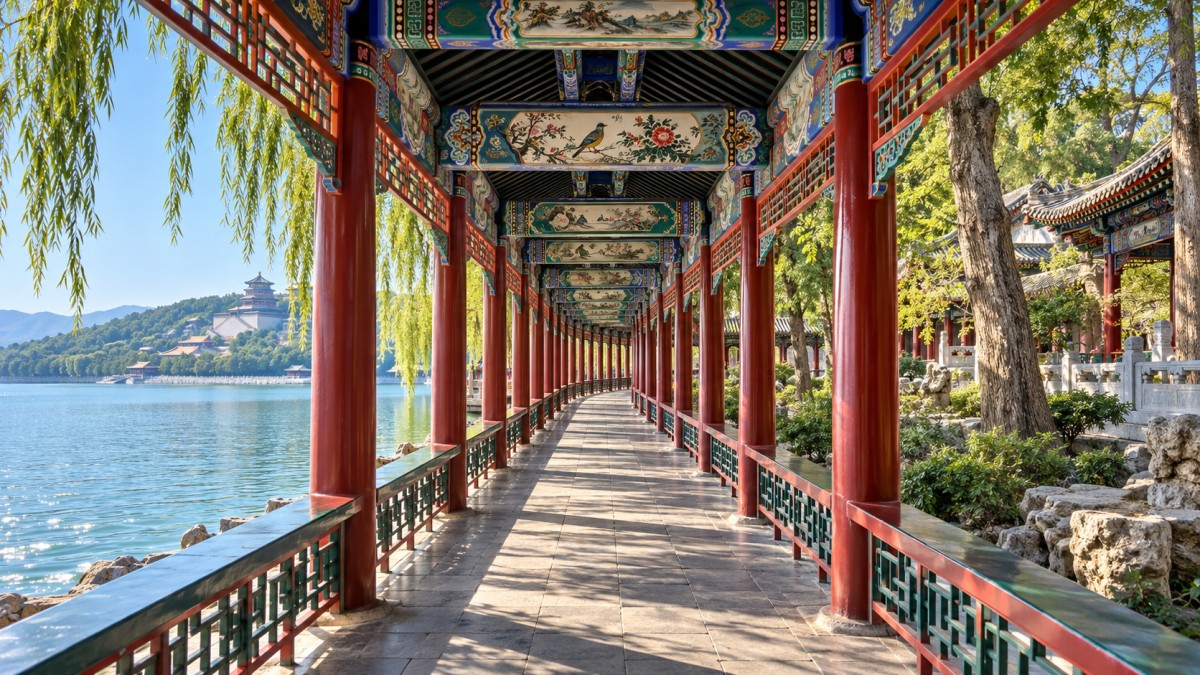
Walk west along the Long Corridor, with Kunming Lake generally on your left and Longevity Hill on your right. Its painted beams and sheltered walkway make this the central section of the itinerary. Alternate between looking at the decoration and pausing at lakeside openings; otherwise, the corridor can become merely a passage to the next landmark.
Allow about 45 minutes, including stops. You do not need to photograph every painted panel. Choose a few details, then take wider views showing how the corridor connects the hillside buildings with the water. Step out of the main walking line before stopping, especially when groups are passing.
Near the central hillside complex, views toward the Hall of Dispelling Clouds and the Tower of Buddhist Incense can make a climb tempting. For the default route, stay on the lower level. The ascent adds stairs, sightseeing time, and potentially separate admission arrangements; it is not a minor detour.
Use the corridor as your decision point: if the group is tired or the paths are busy, continue directly toward the Marble Boat. If everyone is comfortable and you are ahead of schedule, spend the extra minutes on lakeside views rather than adding a distant attraction.
The Marble Boat and the last part of the walk
The Marble Boat is a natural final sightseeing stop on this westward route. Enjoy the exterior and its lakeside setting without assuming that boarding or interior access will be available. The useful view may be from the surrounding shore rather than immediately beside the structure, where visitors can cluster.
Allow approximately 20–25 minutes for photographs and a brief rest. Before settling down, check the time and locate the signed onward path. Your visit is not finished at the Marble Boat: you still need to reach North Ruyi Gate.
Follow the current visitor map and signs toward the gate, asking staff if a path is closed or unclear. Do not simply follow the lakeshore indefinitely. Tell a driver or other group members which exit you are using before anyone separates, and confirm the actual meeting point outside. A pickup at a different gate can erase the time saved by walking one way.
When a different three-hour plan makes more sense
The East Palace Gate–Marble Boat route is a strong first-visit choice, but it assumes you value a balanced introduction more than any single landmark. Change it deliberately when your priorities differ.
Visitors using wheelchairs or travelling with someone who has limited mobility should verify suitable paths, thresholds, and gate access before committing to the route. “Mostly level” does not mean every courtyard or connection is step-free, and a shorter route can be the better visit.
Boats, weather, and the temptation to add one more stop
A boat ride is best treated as an alternative experience, not a guaranteed shortcut. Services depend on operating conditions, and boarding points, destinations, queues, and schedules need checking on the day. A crossing that looks convenient on a map may leave you away from your intended exit.
With a hard departure deadline, use this rule: only board when the destination and likely total time are clear, including waiting and the walk after disembarking. Otherwise, keep the walking plan. Do not build a three-hour schedule around an assumed departure.
Hot weather calls for shorter exposed stops and more drinking breaks. The Long Corridor offers shelter, but the approach paths and exit walk still require effort. Rain can make paving and steps slippery; reduce the route rather than trying to recover time by hurrying. Strong wind also makes a boat-dependent plan less reliable.
The same pacing principle helps when planning the rest of a China trip: choose the experience you want before filling every available hour. If you are also considering a separate, slower-paced destination, the Yunnan Dali Leisure Tour is an option to review, rather than a reason to squeeze more into this Beijing visit.
At the Summer Palace, let your departure deadline decide the final stop. Reach the Marble Boat with time remaining for the exit walk, or shorten the route earlier if delays accumulate. Leave the last part of the visit for getting out comfortably—not for discovering how far away your gate is.
Your 1:1 travel consultant will respond within 1 business day
How to plan your trip
- The Ice and Snow Industry Surpasses RMB 1 Trillion, with Direct High-Speed Rail Access and Upgraded Nighttime Offerings Driving Spending
- Autumn Breaks in Multiple Regions Boost Family Travel and Tourism
- Liaoning 2026–2027 Winter Culture Carnival Kicks Off
- Shenyang Cultural Tourism Promotion Delegation Visits Guangzhou to Promote Winter Tourism and Attract Investment
- 2026 Hebei Culture and Tourism Promotion Week in Beijing Kicks Off
Monthly travel guide
- October 2026 County-Level Tourism Communications Report Released: Top 100 Index Rebounds
- More Than 100 Cities Introduce Autumn Breaks, Creating a New Hotspot for Family and Educational Travel
- The 2026 China-Vietnam (Honghe) Border Economic, Trade and Tourism Fair Opens in Hekou
- The 2026 Guangxi Cultural Tourism Carnival Held in Hezhou
- Luoyang launches the “Autumn Charm of the Divine Capital” tourism promotion to build anticipation for winter travel
- Typhoon “White Dolphin” Forces Henan Scenic Areas to Close, Putting Summer Ground-Handling Services Under Pressure
- RCEP Implementing Rules for Indonesia Take Effect: Zero Tariffs for Cultural and Tourism Services Alongside Strict Customer Service Requirements
- Saudi Arabia’s New SASO Regulations Take Effect: Taqat Certification Required Before Chinese-Language Cultural Tourism Services Can Access Visit Saudi
- Zhengzhou Launches a Dedicated LCL Shipping Route for Cultural and Tourism Materials, Cutting Freight Costs by 18%
- Luoyang Cold Chain Intensification: Cultural and Creative Exports Delivered in 9 Days
- Expedited Pre-Approval for Group Visas to Three Southeast Asian Countries
- Tightening air freight capacity at Zhengzhou Airport delays the delivery of cultural and tourism materials
Popular destinations
- Should you travel from Wuzhen to Shanghai by bus or train?
- What can you do if Forbidden City tickets are sold out?
- Is the Summer Palace North Gate convenient for arriving by subway?
- How to walk from the Summer Palace East Palace Gate to Kunming Lake
- Can you buy Summer Palace admission tickets at the East Gate?
Why choose us

High cost-performance and transparent experience
Offer astonishing low prices without hidden tourism traps, enabling travelers to explore at lower costs while avoiding unnecessary spending loopholes, ensuring transparent consumption.

Personalization and dedicated service
Support 100% free customization, paired with one-on-one expert service, crafting exclusive itineraries based on travelers' specific needs, while providing professional guidance to enhance the personalization and professionalism of the journey.

Premium itinerary planning
Compact yet rich itineraries allow travelers to experience more within limited time; simultaneously, carefully selected hotels in prime locations provide convenient lodging conditions, overall enhancing travel comfort and experience.