Welcome to Our Travel Agency!




Travel Guide
Choose the train if you need a more predictable arrival in Shanghai; choose a direct bus if avoiding transfers matters more and its confirmed drop-off point suits your destination. The important difference is that Wuzhen has no passenger railway station in the scenic town itself. A train journey therefore starts with a road transfer, commonly to Tongxiang Railway Station, while a direct coach can remove that intermediate change.
Neither option is automatically faster from hotel to hotel. A short high-speed rail journey can be offset by reaching the station, waiting to board, and crossing Shanghai after arrival. Conversely, a convenient direct bus can lose its advantage if it encounters traffic or terminates far from your hotel. Compare the complete journey, not just the time printed on one ticket.
The first question is where in Shanghai you need to arrive
“Shanghai” is too broad a destination for a useful transport comparison. Shanghai Hongqiao Railway Station, Shanghai Railway Station, a long-distance coach terminal, and a central hotel are different endpoints. A service that looks convenient on a booking screen may still leave a substantial final transfer.
For a hotel near Hongqiao or an onward train from Shanghai Hongqiao, a train from Tongxiang to that station is a logical choice. You reach the relevant transport hub without depending on a coach’s city arrival point. Check the exact arrival station before paying: Shanghai Hongqiao, Shanghai Railway Station, and Shanghai South Railway Station are not interchangeable.
For accommodation elsewhere in Shanghai, compare the onward journey from each available terminal. A direct bus is attractive when its verified drop-off point offers a straightforward metro or taxi connection. It is less attractive when the destination is listed only as “Shanghai,” without an identifiable terminal or street address.
Hongqiao is also not Pudong. Arriving at Shanghai Hongqiao Railway Station does not put you close to Shanghai Pudong International Airport. If you have a flight, the airport transfer and required check-in time belong in the comparison from the beginning.
What each journey actually involves
For either option, establish whether your Wuzhen hotel is inside a pedestrian scenic area. Your journey may begin with a walk, an internal shuttle, or a hotel luggage transfer before you reach a public road. That first section is easy to overlook when calculating departure time.
When the train is worth the extra transfer
The train’s strongest advantage is not simply speed. It is the ability to separate most of the intercity journey from highway conditions. This matters when you have a timed appointment, an onward rail connection, or limited flexibility after reaching Shanghai.
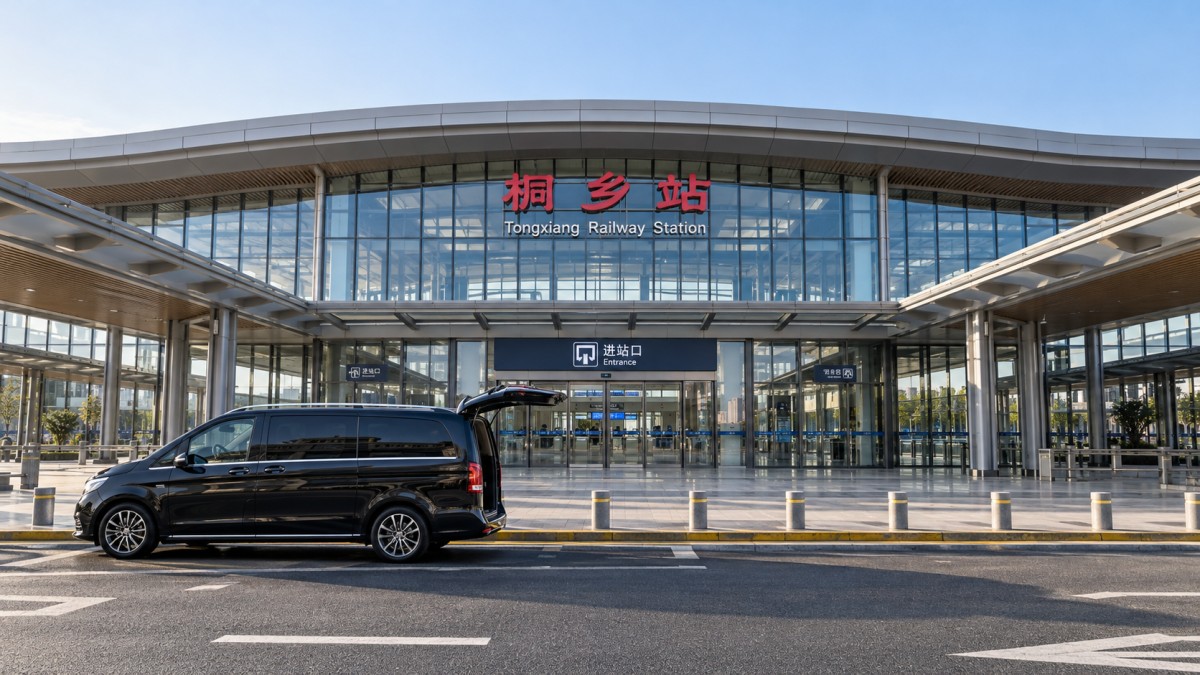
From Wuzhen, Tongxiang Railway Station is a common access point for high-speed services toward Shanghai. Be careful with the name: the station is not in Wuzhen, and reaching it requires a separate journey. Search for the actual railway station rather than a generic destination in Tongxiang city.
As a rough planning guide, allow around an hour for the road transfer, with additional margin for your pickup location and traffic. Some high-speed services between Tongxiang and Shanghai Hongqiao take roughly an hour or less, but the exact duration depends on the train. These are planning estimates, not a timetable; your selected service and transfer arrangements should determine the final schedule.
The time between those two segments matters. You need to enter the station, complete security and identity checks, find the departure area, and board before the gate closes. Arriving at the station at the train’s advertised departure time is too late. For an unfamiliar station, planning to arrive around 45–60 minutes before departure provides a more comfortable margin than relying on a last-minute arrival.
The train becomes less convenient when the first transfer is poorly matched to the departure. A cheap local bus to the station may create a long wait or leave too little recovery time if delayed. A taxi or arranged transfer can simplify that section, but its cost must be included in the rail comparison.
Book through China Railway’s official 12306 service or a reputable booking provider, using the same identity document you will carry. Check the passenger name, document number, departure station, arrival station, and date. International travelers should also follow the booking provider’s instructions for passport verification and station entry rather than assuming every automated gate will work with their document.
When a direct bus is the more sensible choice
A direct coach can be the easier option when you have a flexible arrival time, a suitable departure, and luggage you would rather not move through a railway station. Once your bags are loaded, you avoid the road-to-rail transfer at Tongxiang.
That convenience depends on the service being genuinely direct and currently operating. Do not build a departure plan around an old travel blog or an undated timetable screenshot. Coach routes, departure points, and frequencies can change. Confirm the service for your specific travel date through the operator, an established booking platform, or your accommodation.
Ask for the exact boarding location. Wuzhen Bus Station, a scenic-area parking facility, and a hotel pickup point are not the same place. A ticket described as departing from “Wuzhen” does not necessarily mean you can board beside your accommodation.
Check the Shanghai endpoint just as carefully. A terminal that is convenient for one hotel can be awkward for another. The direct bus only removes an intermediate transfer; it does not necessarily eliminate a final metro journey or taxi ride.
A road journey to Shanghai is best treated as a several-hour commitment rather than a tightly fixed arrival promise. The operator’s published duration is useful for planning, but congestion on the approach to Shanghai can extend it. On holidays or other busy travel dates, avoid scheduling something important immediately after the advertised arrival.
For travelers prone to motion sickness, the longer continuous road segment may outweigh the convenience of fewer transfers. For someone who finds station walking and repeated luggage handling difficult, the opposite may be true. The practical question is which part of the journey creates more difficulty for you.
Compare the full cost—not a coach fare against a train fare
A low rail fare does not represent the full cost of traveling from Wuzhen to Shanghai. Add the journey to Tongxiang station, any booking fee, and the onward trip from the Shanghai arrival station. For the coach, add transport to its departure point and from its final stop to your destination.
The useful comparison is:
- Bus total: Wuzhen pickup transfer + coach tickets + Shanghai onward transfer.
- Train total: transfer to Tongxiang station + rail tickets + Shanghai onward transfer.
Group size can change the result. A solo traveler paying for a taxi to Tongxiang absorbs that transfer cost alone. Two or more people sharing the same vehicle spread the cost, although each still needs a train ticket. If the group and luggage require a larger vehicle, obtain the appropriate transfer quote rather than assuming a standard taxi will be sufficient.
Use prices for your actual date and departure. Without live inventory, a fixed fare comparison risks giving the wrong answer. Seat class, service choice, ticket availability, and booking charges can all affect what you pay.
A small saving is not necessarily worthwhile if it produces a long wait or an inconvenient arrival. Compare the complete itinerary alongside the total price: a slightly higher fare may buy a substantially easier journey.
Luggage, children, and limited mobility can change the answer
With a compact suitcase, the rail transfer is relatively straightforward. With several large bags, a stroller, or a traveler who cannot comfortably walk long distances, each change becomes more significant. The train involves unloading from the first vehicle, passing through security, reaching the platform, boarding, and finding suitable luggage space.
A coach may reduce that handling, but it is not automatically accessible. Steps can be steep, luggage compartments may require assistance, and seating or wheelchair arrangements vary. Confirm boarding assistance and storage before booking if either is essential.
On trains, luggage remains your responsibility, and oversized items must comply with railway rules. On coaches, check the operator’s allowance rather than assuming every suitcase is included or that unusual items will fit. Keep passports, medication, electronics, and other valuables with you rather than in an underfloor compartment.
For families, the best choice may be the journey that aligns with meals, naps, and a realistic departure from the hotel. A theoretically faster train offers little benefit if reaching it requires rushing children and luggage through several transitions. Equally, a long coach ride may be harder than a road transfer followed by a shorter rail segment.
Be more conservative if you have a flight or onward connection
Neither option should be planned to arrive just before a non-refundable connection. The bus faces road uncertainty throughout its route. The train reduces that exposure but still depends on reaching Tongxiang station on time, and disruption remains possible.
For an onward train from Hongqiao, choose an arrival with enough time to complete the required transfer procedure and recover from a modest delay. Do not assume that arriving at the same station guarantees an immediate platform-to-platform connection.
For flights, work backward from the airline’s airport arrival guidance, then add the transfer from your Shanghai terminal and a disruption allowance. Hongqiao Railway Station is within the Hongqiao transport complex, but reaching the correct airport terminal still takes time. Pudong requires a separate cross-city journey.
If missing the connection would seriously disrupt your trip, traveling to Shanghai the previous day may be more valuable than optimizing the bus-versus-train choice.
Make the choice using the services you can actually book
For a relaxed return to a Shanghai hotel, take the direct bus when its departure point is easy to reach, its drop-off is useful, and you are comfortable with road-related delays. Its main benefit is fewer transitions, not guaranteed speed.
For a more time-sensitive journey, favor a suitable train from Tongxiang, provided you arrange the station transfer with adequate margin. Its main benefit is a more predictable intercity segment, not a transfer-free trip.
Before purchasing either option, put the exact Wuzhen pickup point, booked departure, Shanghai arrival terminal, and final destination into one itinerary. Once those locations and times are visible together, the better choice is usually clearer than a headline comparison of “bus versus train.”
Your 1:1 travel consultant will respond within 1 business day
How to plan your trip
- The Ice and Snow Industry Surpasses RMB 1 Trillion, with Direct High-Speed Rail Access and Upgraded Nighttime Offerings Driving Spending
- Autumn Breaks in Multiple Regions Boost Family Travel and Tourism
- Liaoning 2026–2027 Winter Culture Carnival Kicks Off
- Shenyang Cultural Tourism Promotion Delegation Visits Guangzhou to Promote Winter Tourism and Attract Investment
- 2026 Hebei Culture and Tourism Promotion Week in Beijing Kicks Off
Monthly travel guide
- October 2026 County-Level Tourism Communications Report Released: Top 100 Index Rebounds
- More Than 100 Cities Introduce Autumn Breaks, Creating a New Hotspot for Family and Educational Travel
- The 2026 China-Vietnam (Honghe) Border Economic, Trade and Tourism Fair Opens in Hekou
- The 2026 Guangxi Cultural Tourism Carnival Held in Hezhou
- Luoyang launches the “Autumn Charm of the Divine Capital” tourism promotion to build anticipation for winter travel
- Typhoon “White Dolphin” Forces Henan Scenic Areas to Close, Putting Summer Ground-Handling Services Under Pressure
- RCEP Implementing Rules for Indonesia Take Effect: Zero Tariffs for Cultural and Tourism Services Alongside Strict Customer Service Requirements
- Saudi Arabia’s New SASO Regulations Take Effect: Taqat Certification Required Before Chinese-Language Cultural Tourism Services Can Access Visit Saudi
- Zhengzhou Launches a Dedicated LCL Shipping Route for Cultural and Tourism Materials, Cutting Freight Costs by 18%
- Luoyang Cold Chain Intensification: Cultural and Creative Exports Delivered in 9 Days
- Expedited Pre-Approval for Group Visas to Three Southeast Asian Countries
- Tightening air freight capacity at Zhengzhou Airport delays the delivery of cultural and tourism materials
Popular destinations
- Should you travel from Wuzhen to Shanghai by bus or train?
- What can you do if Forbidden City tickets are sold out?
- Is the Summer Palace North Gate convenient for arriving by subway?
- How to walk from the Summer Palace East Palace Gate to Kunming Lake
- Can you buy Summer Palace admission tickets at the East Gate?
Why choose us

High cost-performance and transparent experience
Offer astonishing low prices without hidden tourism traps, enabling travelers to explore at lower costs while avoiding unnecessary spending loopholes, ensuring transparent consumption.

Personalization and dedicated service
Support 100% free customization, paired with one-on-one expert service, crafting exclusive itineraries based on travelers' specific needs, while providing professional guidance to enhance the personalization and professionalism of the journey.

Premium itinerary planning
Compact yet rich itineraries allow travelers to experience more within limited time; simultaneously, carefully selected hotels in prime locations provide convenient lodging conditions, overall enhancing travel comfort and experience.