Welcome to Our Travel Agency!




Travel Guide
Jinshanling Great Wall or Mutianyu for a more challenging hike?
Choosing between Jinshanling Great Wall or Mutianyu for a more challenging hike? Jinshanling generally offers the tougher outing, with repeated climbs, uneven steps, and ridge-following routes that reward the effort with sweeping mountain views. Mutianyu’s restored paths and optional lift access make it more flexible, although its steep stairways can still test your legs. The right choice depends on your fitness, available time, and comfort on irregular terrain—not simply which section looks more dramatic in photographs.
There is one important qualification: compare the routes you will actually walk. A short Jinshanling visit using a cable car can be less demanding than a long Mutianyu hike starting from the valley. Both should be planned within officially open sections, with current access checked before departure.
Why Jinshanling usually feels harder
At Jinshanling, the challenge comes from the rhythm of the terrain. You climb toward a watchtower, descend, and then face another rise. The wall follows mountain ridges rather than a comfortable walking gradient, so a relatively modest distance can involve considerable effort. Looking only at kilometers gives an incomplete picture.
Foot placement also demands attention. Within the accessible visitor area, surface conditions and restoration levels vary. Steps may differ in height, and some stretches require slower, more deliberate movement. For hikers accustomed to smooth trails, that constant adjustment can be as tiring as the climbing itself.
The reward is a stronger sense of moving through the mountain landscape. Watchtowers appear along successive ridgelines, and the changing angles reveal how the wall used the terrain defensively. Jinshanling often suits travelers who want the walk—not just arrival at a viewpoint—to be the main event.
However, “less restored” should never be treated as permission to explore beyond barriers. Closed sections, damaged masonry, and unofficial connecting trails are not appropriate ways to make a hike more adventurous.
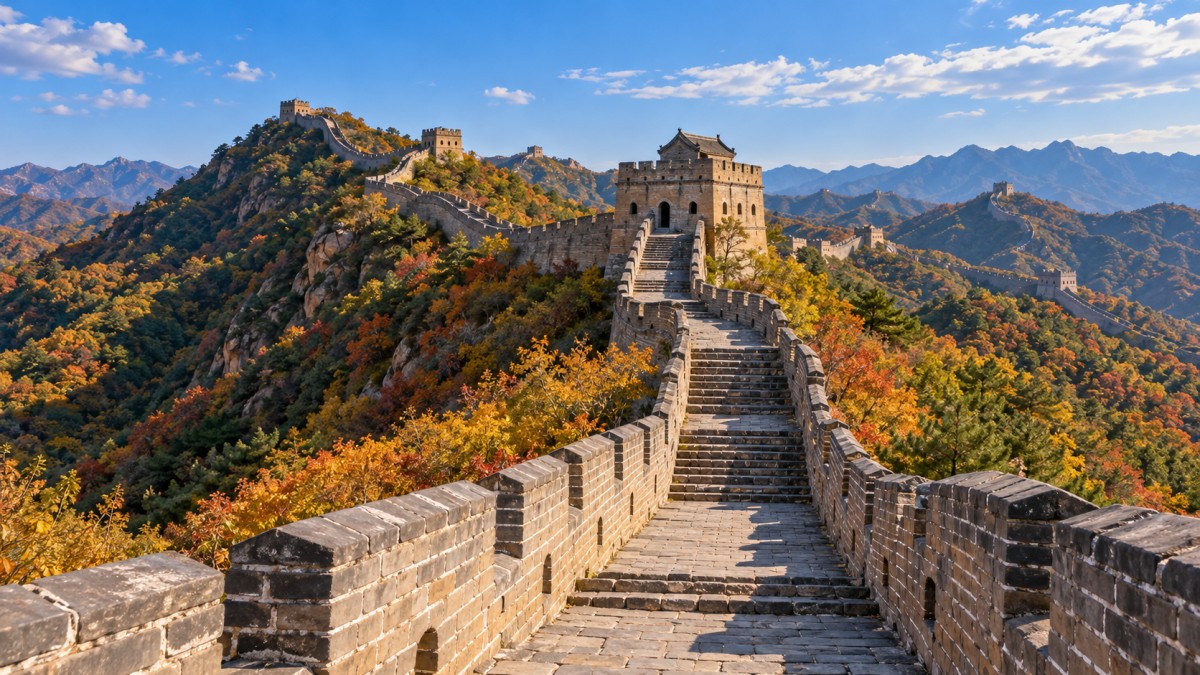
Mutianyu is more manageable, not necessarily easy
Mutianyu gives visitors more control over the amount of climbing. Its restored visitor section, established access infrastructure, and optional cable car or chairlift services make it easier to adjust an outing around different fitness levels. Those advantages matter when one traveler wants a workout while another mainly wants to experience the wall.
Once on the wall, though, steep stairways remain. Walking farther toward the higher portions of the open section can be strenuous, particularly if you also climb up from the entrance area. Restoration improves the walking surface; it does not flatten the mountain.
Mutianyu is therefore a sensible choice for someone who wants a demanding stair workout without committing to the same degree of uneven footing. It can also work better for a mixed-ability group, provided meeting points and return arrangements are clear. Different lift systems serve different access points, so tickets and pickup plans should match the intended route.
The distinction is sustained, varied hiking at Jinshanling versus a more adjustable stair-climbing experience at Mutianyu. Neither description guarantees an easy day.
Compare the whole route before choosing
Tour descriptions such as “Great Wall hiking experience” can hide very different outings. Before booking, ask for the entrance, planned walking direction, turnaround or exit point, and whether uphill access is on foot or by lift. These details tell you more than a broad difficulty label.
Be cautious with older route descriptions advertising a continuous Jinshanling-to-Simatai traverse. Separate scenic areas do not automatically form a currently permitted through-route. Confirm which sections and exits are officially operating for your date, rather than assuming an online hiking map establishes access rights.
Two ways to build a genuinely challenging day
At Jinshanling, choose a route that includes several successive climbs within the open area, rather than simply reaching the nearest photogenic tower. Ask whether the plan is an out-and-back or an approved point-to-point walk. If it uses different entrances, the driver must know the correct collection point; otherwise, an intended shortcut can create an unexpected return climb.
At Mutianyu, walking up instead of taking a lift increases the workload before the wall walk begins. Continue only as far as your energy and the official boundaries allow, keeping enough strength for the descent. Using a lift down can reduce stair loading, but availability, operating hours, and the position of the lift station need checking in advance.
Neither plan needs an ambitious distance target. Ask your organizer to separate actual walking time from transfers, queues, photographs, meals, and rest stops. A full-day excursion is not the same thing as a full day of hiking.
Fitness matters, but descending is often the deciding factor
Being comfortable on a long, flat walk does not necessarily prepare you for repeated steep stairs. A more useful self-check is whether you can climb and descend stairs repeatedly while maintaining balance and a controlled pace. Consider how you feel afterward, not only whether you can reach the top.
Travelers with knee discomfort may find descents harder than ascents. Jinshanling’s variable steps can add another layer of difficulty, while Mutianyu’s lift options may offer a more manageable arrangement. Neither site should be assumed suitable for someone with significant mobility limitations simply because mechanical access is available; stairs and uneven surfaces can remain between access points and viewpoints.
- Choose Jinshanling if you already enjoy hillwalking and remain confident on irregular steps when tired.
- Choose Mutianyu if you want substantial climbing but value the option to reduce part of the ascent or descent.
- For mixed-ability companions, plan around the least confident walker unless separate, clearly coordinated routes are practical.
If you have a medical condition that affects exertion or balance, seek appropriate medical advice before committing to a strenuous route. A guide can help manage pace and logistics, but cannot remove the physical demands.
Weather and timing can change the answer
Dry, mild conditions make either section more manageable. Summer heat increases the strain of exposed climbs, and water should be carried rather than left dependent on finding a vendor. Rain can make stone and brick slippery; ice and snow can turn ordinary stairs into a serious hazard. Exposed ridges are also unsuitable places to remain during thunderstorms.
Spring and autumn are often appealing for walking, but the forecast still matters more than the season’s reputation. Wind can affect comfort and lift operations. Check official notices close to departure and accept that a closure may require a different plan, not a workaround.
Wear footwear with reliable grip, carry layers and sun protection, and leave room in the schedule for a slower descent. For photography, do not assume sunrise or sunset access is included in ordinary admission. Opening hours, permitted access, and return transport must all support the plan.
Fit the hike into the rest of your China journey
Jinshanling makes most sense when you can give the excursion a generous day without rushing toward an evening train or flight. Mutianyu is often easier to fit into a tighter Beijing stay, although it still deserves enough time for traffic, entry procedures, and an unhurried walk.
Think about the following day, too. A demanding wall hike followed immediately by another stair-heavy excursion can leave an otherwise enjoyable cultural itinerary feeling exhausting. Travelers continuing west might review Xi'an Tour Routes while deciding where to place a lighter sightseeing day between more physical activities.
Henan Le Journey Travel Agency Co., Ltd., based in Luoyang, provides customized domestic travel and specializes in inbound journeys within Henan. For a trip combining Beijing with Longmen Grottoes, Shaolin Temple, or other Central Plains destinations, useful planning support means coordinating transport, accommodation, guides, reservations, and realistic activity levels—not packing every available hour with sightseeing.
When requesting a tailored itinerary, share your recent hiking experience, any concerns about descending, and whether lift access is a preference or a necessity. Ask for the walking plan and weather alternative alongside the price.
For the more challenging overall hiking experience, favor Jinshanling. Choose Mutianyu when you want steep climbing with more ways to adjust the day. Before confirming either, establish the open route, expected stair demands, return arrangements, and conditions that would trigger a change of plan.
Your 1:1 travel consultant will respond within 1 business day
How to plan your trip
- The Ice and Snow Industry Surpasses RMB 1 Trillion, with Direct High-Speed Rail Access and Upgraded Nighttime Offerings Driving Spending
- Autumn Breaks in Multiple Regions Boost Family Travel and Tourism
- Liaoning 2026–2027 Winter Culture Carnival Kicks Off
- Shenyang Cultural Tourism Promotion Delegation Visits Guangzhou to Promote Winter Tourism and Attract Investment
- 2026 Hebei Culture and Tourism Promotion Week in Beijing Kicks Off
Monthly travel guide
- October 2026 County-Level Tourism Communications Report Released: Top 100 Index Rebounds
- More Than 100 Cities Introduce Autumn Breaks, Creating a New Hotspot for Family and Educational Travel
- The 2026 China-Vietnam (Honghe) Border Economic, Trade and Tourism Fair Opens in Hekou
- The 2026 Guangxi Cultural Tourism Carnival Held in Hezhou
- Luoyang launches the “Autumn Charm of the Divine Capital” tourism promotion to build anticipation for winter travel
- Typhoon “White Dolphin” Forces Henan Scenic Areas to Close, Putting Summer Ground-Handling Services Under Pressure
- RCEP Implementing Rules for Indonesia Take Effect: Zero Tariffs for Cultural and Tourism Services Alongside Strict Customer Service Requirements
- Saudi Arabia’s New SASO Regulations Take Effect: Taqat Certification Required Before Chinese-Language Cultural Tourism Services Can Access Visit Saudi
- Zhengzhou Launches a Dedicated LCL Shipping Route for Cultural and Tourism Materials, Cutting Freight Costs by 18%
- Luoyang Cold Chain Intensification: Cultural and Creative Exports Delivered in 9 Days
- Expedited Pre-Approval for Group Visas to Three Southeast Asian Countries
- Tightening air freight capacity at Zhengzhou Airport delays the delivery of cultural and tourism materials
Popular destinations
- Should you travel from Wuzhen to Shanghai by bus or train?
- What can you do if Forbidden City tickets are sold out?
- Is the Summer Palace North Gate convenient for arriving by subway?
- How to walk from the Summer Palace East Palace Gate to Kunming Lake
- Can you buy Summer Palace admission tickets at the East Gate?
Why choose us

High cost-performance and transparent experience
Offer astonishing low prices without hidden tourism traps, enabling travelers to explore at lower costs while avoiding unnecessary spending loopholes, ensuring transparent consumption.

Personalization and dedicated service
Support 100% free customization, paired with one-on-one expert service, crafting exclusive itineraries based on travelers' specific needs, while providing professional guidance to enhance the personalization and professionalism of the journey.

Premium itinerary planning
Compact yet rich itineraries allow travelers to experience more within limited time; simultaneously, carefully selected hotels in prime locations provide convenient lodging conditions, overall enhancing travel comfort and experience.