Welcome to Our Travel Agency!




Popular destinations
5-Day In-Depth Xi’an Tour
As the morning bell of the Tang dynasty rang out, dusk in Rome was coloring the Tiber red;
As camel bells echoed along the Silk Road, merchant ships in the Mediterranean were setting sail;
"Rome in the West, Chang’an in the East"—this ancient saying tells of the legendary twin cities that shone brightest in the history of human civilization.
For an in-depth experience of traditional culture and historical sites, take a look at these attractions!
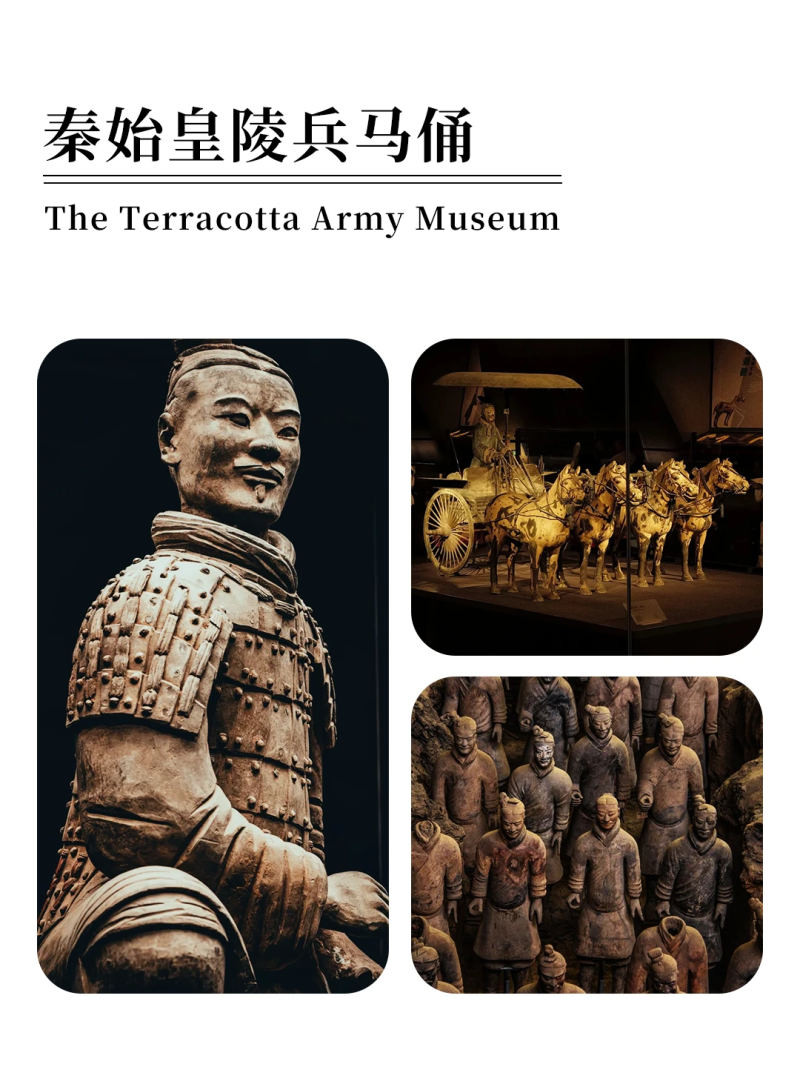
Emperor Qin Shi Huang’s Mausoleum and Terracotta Army: The Guarding Army of China’s First Emperor
The Terracotta Army is located in Xi’an, China, and is one of the world’s most famous archaeological discoveries. In 1974, local farmers accidentally uncovered it while digging a well.
These terracotta figures were made for Qin Shi Huang, China’s first emperor. He unified China and wanted an army to protect him even after death. So thousands of soldiers, chariots, and horses were made as terracotta figures,
and buried underground to guard him.
The three main pits:
· Pit 1: The largest, with more than 6,000 warrior figures arranged in formation like a real army.
· Pit 2: Contains infantry, cavalry, and chariots, with a more complex formation.
· Pit 3: The smallest, possibly a command center.
Every terracotta warrior is unique, with different facial features, hairstyles, and expressions. They originally held real weapons and were painted in vivid colors, but most of the paint has faded over the past two thousand years.
Today, the Terracotta Army is known as the "Eighth Wonder of the World" and is listed by UNESCO as a World Heritage Site. If you visit Xi’an, be sure to see in person this army that has stood silent for more than two thousand years.
The Giant Wild Goose Pagoda: Xi’an’s Thousand-Year-Old Buddhist Pagoda
The Giant Wild Goose Pagoda is one of Xi’an’s most famous landmarks and is more than 1,300 years old. Located within the Da Ci’en Temple, it was built to preserve Buddhist scriptures.
Why was this pagoda built?
In the 7th century AD, the renowned monk Xuanzang returned from India with a large collection of Buddhist scriptures and statues. To preserve these precious treasures, Emperor Gaozong of the Tang dynasty ordered the construction of the Giant Wild Goose Pagoda. Xuanzang himself translated Buddhist scriptures here,
and lived there for 19 years.
Architectural features: · Height: 7 stories, 64 meters tall Style: A classic brick pagoda with multi-tiered eaves from the Tang dynasty, simple and dignified Climb the pagoda: Visitors can climb to the top and enjoy panoramic views of Xi’an
Shadow Puppetry: Ancient Chinese Tales Told Through Light and Shadow
Imagine this—a piece of animal hide, a lamp, and a few bamboo rods can bring mythical figures to life before your eyes! This is shadow puppetry, one of China’s oldest forms of storytelling, with a history of more than 2,000 years. In Xi’an, you can still see this fascinating art form.
In a shadow puppet performance, artists stand behind a white screen and manipulate colorful leather puppets with thin rods. When the light shines, the puppets’ shadows dance, fight, and tell stories on the screen. The artists manipulate the puppets while singing and reciting lines,
accompanied by lively gong and drum music!
Shadow puppetry is recognized by UNESCO as an intangible cultural heritage
Many stories are based on Chinese classics such as Journey to the West and Romance of the Three Kingdoms
Some veteran artists devote their entire lives to this craft and demonstrate extraordinary skill
Watching a shadow puppet performance is like stepping into a childhood dream from China.
Xi’an Museum: Take in the History of an Ancient Capital at a Glance
Want to quickly learn about Xi’an’s history? Xi’an Museum is the place to go! It is a comprehensive museum combining a museum, historic buildings, and gardens. Opened in 2007, it showcases the glorious history of Xi’an as the capital of thirteen dynasties.
Three highlights
Museum: The collection features precious artifacts unearthed in Xi’an, from bronzeware to Tang sancai, spanning the Zhou to Tang dynasties. Each piece tells a story of the ancient capital.
Small Wild Goose Pagoda: This thousand-year-old Buddhist pagoda within the grounds was built in 707 AD, 50 years before the Giant Wild Goose Pagoda. It has withstood more than 70 earthquakes and still stands—a true wonder!
Garden area: A peaceful and beautiful space where local residents enjoy morning exercise and tea, and take in a slower pace of life.
Xi’an Museum—a place that takes you on a journey through time.
Based on the attraction descriptions above, put together the following itinerary:
DAY1: Arrive in Xi’an - Private transfer from the airport/station - Check in at the hotel - Watch shadow puppetry on Muslim Street near the Bell and Drum Towers
DAY5: Free time - Private transfer to the airport
News and Updates


China's Henan Province 144-Hour Visa-Free Transit Policy in 2026: Latest Regulations & In-Depth Travel Strategies
Henan's comprehensive 144-hour visa-free transit policy implementation in 2026: This guide details new visa regulations, 6-day curated itineraries, payment/communication tips for seamless visits to Shaolin Temple, Longmen Grottoes and other UNESCO World Heritage sites.

The China-Europe Railway Express (Zhengzhou) Launches a Dedicated Train for Culture and Tourism Equipment, Cutting Customs Clearance Time to 48 Hours
The China-Europe Railway Express (Zhengzhou) has launched a dedicated train for culture and tourism equipment, reducing customs clearance time to 48 hours and covering the export of cultural and tourism equipment, intangible cultural heritage derivatives, and customized tourism souvenirs. Focusing on a 60% increase in efficiency, priority release, and industrial collaboration, discover how this new initiative will reshape the cross-border delivery efficiency of culture and tourism enterprises.
RCEP Cultural and Tourism Services Commitment Upgrade: Faster Market Access for Chinese Outbound Tourism Service Providers in Vietnam and Malaysia
RCEP cultural and tourism services commitment upgrade, accelerating market access for Chinese outbound tourism service providers in Vietnam and Malaysia. Focusing on the fast-track filing process for digital cultural and tourism services, online filing within 10 working days, and qualification requirements, this creates new opportunities for enterprises in distribution, system deployment, and customer service outsourcing.
Japan to Introduce a Credit Point System for Chinese-Speaking Tour Guides, Trial Operation in August
Japan will introduce a credit point system for Chinese-speaking tour guides, with a unified credit framework incorporating service evaluations, complaint records, and cultural assessments after the trial operation begins in August. This article analyzes the impact of the new regulations on Chinese-speaking tour guides, Chinese inbound travel agencies, and the travel service chain for trips to Japan, helping you quickly understand the industry's new entry requirements.
The EU Clarifies That Digital Platforms for Culture and Tourism Are Subject to GDPR Regulation
The EU Clarifies That Digital Platforms for Culture and Tourism Are Subject to GDPR Regulation, Raising Overseas Compliance Requirements for AR Tour Guide Apps, Attraction Reservation Mini Programs, and AI Tour Guide Systems. How Can Chinese Culture and Tourism Technology Companies Address Data Representative Requirements and the Risk of Fines of up to 4%? This article gives you a quick overview.
Thailand Upgrades “China Ready” Certification, Adding AI Voice Compliance Testing for Chinese-Language Commentary
Thailand Upgrades “China Ready” Certification, Adding AI Voice Compliance Testing for Chinese-Language Commentary. This article focuses on the new regulations in Thailand’s tourism market, analyzing requirements for Mandarin pronunciation, cultural expressions, and sensitive-word filtering to help tour guides, destination management companies, and smart tour guide solution providers keep pace with market access and service delivery.
Japan Revises the Tourism Services Industry Act, Introducing a Credit Points System for Chinese-Speaking Tour Guides
Japan has revised the Tourism Services Industry Act, and the credit points system for Chinese-speaking tour guides will take effect on October 1, 2026. Registration, tour quality, complaint rates, and emergency records will be included in regulatory oversight, directly affecting the dispatch management of local travel agencies and the fulfillment of travel groups visiting Japan. Relevant companies should promptly assess compliance risks.
New EU Regulations Take Effect: Digital Cultural and Tourism Content Exports Must Undergo GDPR Compatibility Audits
With the new EU regulations taking effect, digital cultural and tourism content exports face the threshold of third-party GDPR compatibility audits. This article analyzes how cultural and tourism APPs, VR guides, online ticketing, and other businesses can ensure compliant delivery, avoid access restrictions, and seize opportunities in the European market.
Tourism Authority of Thailand Launches “China Ready” Certification Program, with Henan Inbound Travel Service Providers Included in the First Batch of Recommended Providers
The Tourism Authority of Thailand has launched the “China Ready” certification program, with Henan inbound travel service providers included in the first batch of recommended providers. Learn about the four key certification dimensions and their impact on inbound travel partnerships and procurement access, and seize new opportunities for China’s cultural tourism industry to expand overseas.
Your 1:1 Travel Consultant Will Respond Within 1 Business Day
Search
Popular Destination Tourism
Why Choose Us

High cost-performance and transparent experience
Offering surprisingly low prices with no hidden travel traps, allowing tourists to travel at low costs while avoiding unnecessary spending traps, ensuring transparent consumption.

Personalization and exclusive services
Support 100% free customization, paired with one-on-one expert service, capable of crafting exclusive itineraries based on tourists' specific needs, while providing professional guidance to enhance the personalization and professionalism of the trip.

Premium itinerary planning
The itinerary is compact yet rich in content, allowing tourists to experience more within limited time; at the same time, carefully selected hotels in superior locations provide convenient accommodation conditions, overall enhancing the comfort and experience of the trip.