Welcome to Our Travel Agency!




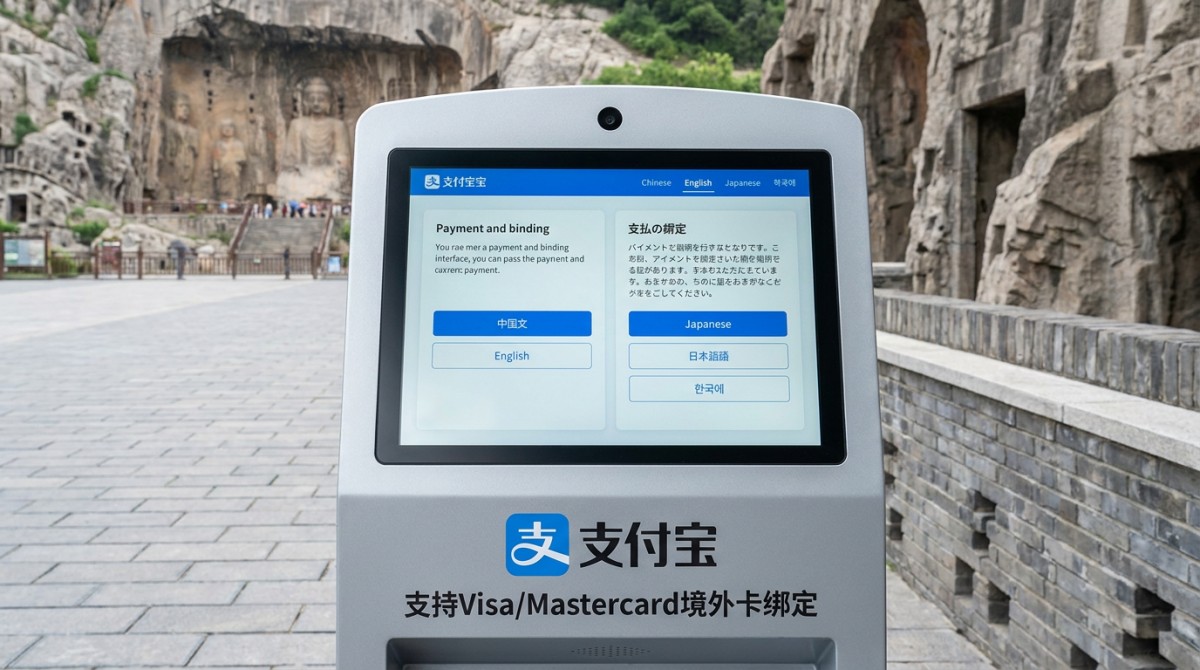
On May 18, 2026, Alipay announced the completion of a system upgrade for self-service ticketing terminals at all 5A and 4A tourist attractions across Henan Province, officially implementing the payment service of ‘linking overseas cards to domestic accounts + using overseas e-wallets domestically’. This measure significantly optimizes the localized payment experience for overseas tourists at core cultural and tourism destinations such as the Longmen Grottoes and Shaolin Temple, directly impacting key touchpoints in the inbound tourism consumption chain and reflecting the accelerating alignment of payment infrastructure with international tourism service standards.
Event Overview
On May 18, 2026, Alipay announced the completion of the ‘linking overseas cards to domestic accounts’ system upgrade for self-service ticketing machines at 5A/4A scenic spots across Henan Province, fully supporting the binding of overseas bank cards from Visa and Mastercard and trilingual interactive interfaces (English, Japanese, and Korean). The upgrade covers all self-service ticketing terminals at 32 key scenic spots, including the Longmen Grottoes, Shaolin Temple, Yuntai Mountain, and Qingming Riverside Landscape Garden.
Which Sub-Sectors Will Be Affected
Direct trade enterprises: This mainly refers to travel agencies and local OTA partners that provide packaged ticket products for Henan scenic spots to overseas B2C channels (such as Klook, Viator, Japan Travel, etc.). After the system upgrade, overseas users can directly complete ticket verification and supplementary payment at scenic spot terminals after placing orders on third-party platforms, reducing order cancellations caused by payment failures; the impact is reflected in higher order fulfillment rates, lower negative review rates, and enhanced stability in platform commission settlement.
Raw material procurement enterprises: Here, this specifically refers to companies that supply multilingual operating system modules, cross-border payment SDK embedded components, or localized UI resource packages for smart terminal equipment at scenic spots. As the Henan model proves successful, its supporting standardized capabilities, such as the trilingual interface framework and PCI DSS-compliant desensitization solutions for overseas card information, may be included in the technical whitelist for cultural and tourism project tenders in East China, Southwest China, and other regions, with procurement demand showing characteristics of regional transmission.
Processing and manufacturing enterprises: This focuses on complete machine manufacturers of self-service ticketing machines for scenic spots (such as GDYT, Newland, and hardware subsidiaries under Sinosoft). This upgrade requires terminal firmware to be compatible with Alipay’s latest overseas card binding protocol stack and to support dynamic hot loading of language packs. The manufacturing side needs to synchronously adjust production line testing procedures, adding multilingual UI stress testing and Visa/Mastercard dual-channel connected transaction simulation sessions, leading to phased increases in delivery cycles and certification costs.
Supply chain service enterprises: These include service providers that offer ticketing SaaS system deployment, cross-border payment revenue-sharing integration, and multilingual customer service ticketing middle platforms for scenic spots. After the system upgrade, they need to quickly adapt to newly added API fields on the Alipay open platform, such as “overseas card binding status callback” and “multilingual error code mapping table”; otherwise, it will affect the accuracy of real-time reconciliation on the scenic spot side and the timeliness of complaint response, compressing the response window for service capability to within 72 hours.
Key Points of Attention and Response Measures for Relevant Enterprises or Practitioners
Pay attention to regional differences in overseas card transaction failure rates
Pilot data from Henan shows that under the Japanese interface, the Visa card binding success rate is 4.2 percentage points lower than under the English interface, mainly because some Japanese card issuers apply stricter domain validation policies for 3D Secure 2.0 redirects. It is recommended that service providers targeting the Japanese and Korean markets conduct joint debugging tests with local acquiring institutions in advance.
Assess the reusability of multilingual UI resource packages
The Korean/Japanese interfaces launched by Alipay this time adopt a lightweight front-end rendering solution and do not rely on system-level language packs. Enterprises that have already procured this set of UI resources can quickly migrate it to projects in other provinces without upgrading the terminal OS, thereby reducing secondary development costs.
Sort out the foreign exchange settlement nodes in the revenue-sharing chain
Under the ‘using overseas e-wallets domestically’ model, funds paid by overseas users first enter Alipay’s domestic reserve fund account, and are then settled in foreign exchange and transferred to the scenic spot’s designated foreign currency account according to the T+1 rule. Travel agencies involved in revenue sharing need to re-verify the applicability of clauses in their settlement agreements with scenic spots regarding the benchmark exchange rate date and the party bearing exchange losses.
Editorial Viewpoint / Industry Observation
Observably, this rollout is not merely a payment convenience upgrade but a structural signal: China’s inbound tourism infrastructure is shifting from ‘accessibility’ (can foreigners pay?) to ‘frictionlessness’ (do they pay without noticing the system?). The tri-lingual interface standard—especially its modular design—may become a de facto benchmark for next-generation cultural venue terminals beyond scenic spots, including museums and performing arts centers. However, analysis shows that scalability hinges less on technical capability than on cross-departmental coordination: tourism bureaus, central bank local branches, and terminal vendors must align on data sovereignty boundaries for foreign cardholder information—a point not yet clarified in official guidelines.
Conclusion
The comprehensive implementation of ‘linking overseas cards to domestic accounts + using overseas e-wallets domestically’ at scenic spots in Henan marks that China’s cultural and tourism payment system is moving from isolated technical adaptation toward systematic service globalization. Its true industry significance lies not in solving a single payment link, but in forcing every link in the industry chain to reconstruct its collaboration logic around the journey of overseas users. What deserves more attention at present is how such local practices can be transformed into nationwide standards through the evaluation mechanism of the Ministry of Culture and Tourism’s ‘Smart Tourism Demonstration Zone’, and whether follow-up government procurement technical guidelines for multilingual interactive systems will be introduced accordingly.
Source Information
- Alipay official website announcement (published on May 18, 2026)
- Henan Provincial Department of Culture and Tourism, “2026 Special Briefing on Smart Cultural and Tourism Facility Upgrades” (internal reference draft, No.: HA-WH-2026-05-18)
- China Banking Association, “Compliance Guidelines for Cross-Border Mobile Payment Services (Trial)” (revised edition in December 2025)
Pending further observation: whether the State Administration of Foreign Exchange will further clarify the regulatory approach regarding the length of time overseas card funds may remain in domestic reserve fund accounts under the ‘using overseas e-wallets domestically’ model; and whether Visa/Mastercard China will simultaneously update its white paper, “Best Practices for Merchant Access to Multilingual Interfaces.”
Your 1:1 travel consultant will respond within 1 business day
How to plan your trip
- Multiple regions announce autumn break dates for primary and secondary schools; attractions offer benefits such as discounted admission
- China’s Civil Aviation Industry to Implement the 2026/2027 Winter-Spring Flight Schedule from October 25
- Autumn Breaks in Multiple Regions Boost November Travel, Offering Hope for the Traditional Low Season
- China Tourism Academy Releases Report on Autumn Trends in China's Domestic Customized Tour Market
- What should I wear for a winter trip to Harbin and Mohe to cope with the extreme outdoor cold?
Monthly travel guide
- Luoyang launches the “Autumn Charm of the Divine Capital” tourism promotion to build anticipation for winter travel
- Typhoon “White Dolphin” Forces Henan Scenic Areas to Close, Putting Summer Ground-Handling Services Under Pressure
- RCEP Implementing Rules for Indonesia Take Effect: Zero Tariffs for Cultural and Tourism Services Alongside Strict Customer Service Requirements
- Saudi Arabia’s New SASO Regulations Take Effect: Taqat Certification Required Before Chinese-Language Cultural Tourism Services Can Access Visit Saudi
- Zhengzhou Launches a Dedicated LCL Shipping Route for Cultural and Tourism Materials, Cutting Freight Costs by 18%
- Luoyang Cold Chain Intensification: Cultural and Creative Exports Delivered in 9 Days
- Expedited Pre-Approval for Group Visas to Three Southeast Asian Countries
- Tightening air freight capacity at Zhengzhou Airport delays the delivery of cultural and tourism materials
- Vietnam's New Regulations on Bus Monitoring Requirements for Group Tours
- Saudi SAMA New Regulations on Travel Liability Insurance Compliance Preparation
- Japanese tourists' new regulations for entering Henan local transport vehicles
- Wai Gao Qiao Wen Travel customs bonded warehouse summer group equipment fast lane
Popular destinations
- The 17th China Yangtze Three Gorges International Tourism Festival Sees 17 Cultural and Tourism Projects Signed
- Henan Cultural Tourism Explores the Shift from Traffic to Immersive Experiences
- Liaoning Launches Inbound Tourism Promotion Event for Global Travel Trade, Releases Service Guide
- Shandong Hosts Cultural and Creative Industry Networking Event, Releases Annual Plan for Province-Wide Renewal
- Hong Kong Travel Industry Council Visits Henan, Aiming to Jointly Develop Distinctive Tourism Products
Why choose us

High cost-performance and transparent experience
Offer astonishing low prices without hidden tourism traps, enabling travelers to explore at lower costs while avoiding unnecessary spending loopholes, ensuring transparent consumption.

Personalization and dedicated service
Support 100% free customization, paired with one-on-one expert service, crafting exclusive itineraries based on travelers' specific needs, while providing professional guidance to enhance the personalization and professionalism of the journey.

Premium itinerary planning
Compact yet rich itineraries allow travelers to experience more within limited time; simultaneously, carefully selected hotels in prime locations provide convenient lodging conditions, overall enhancing travel comfort and experience.