Welcome to Our Travel Agency!




Travel Guide
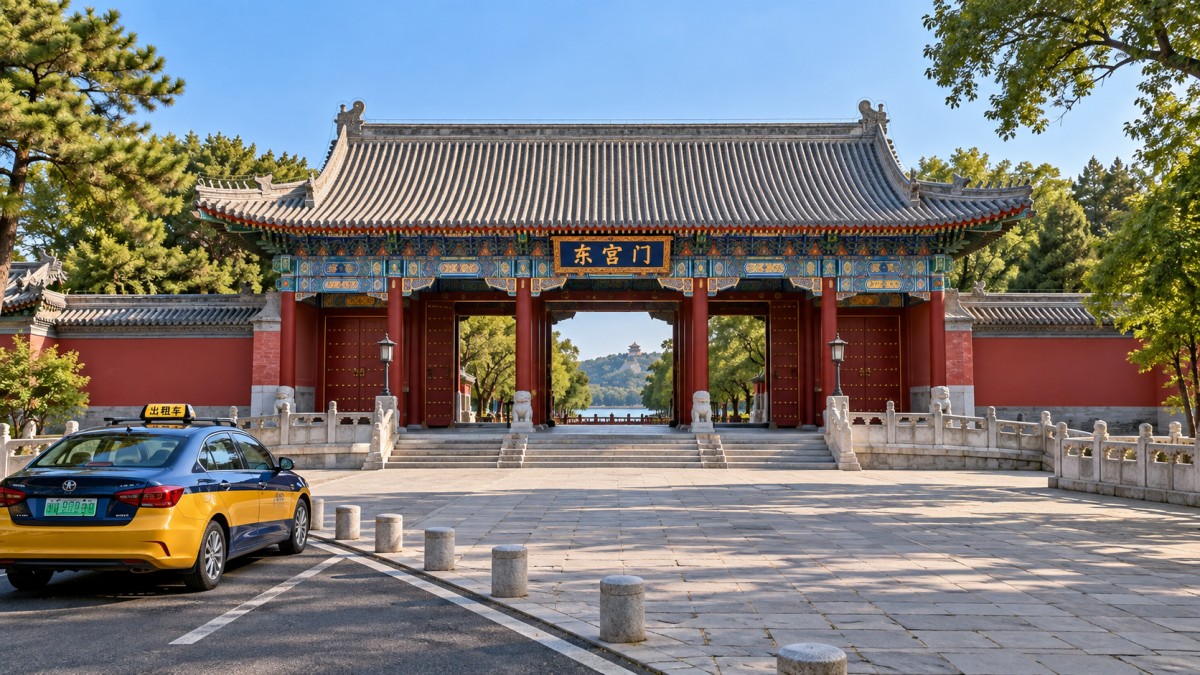
Ask your taxi driver for the Summer Palace East Palace Gate, Donggongmen (颐和园东宫门), and get out at the nearest place where stopping is permitted on the approach to that entrance. Do not give only “Summer Palace” as your destination: the grounds have several entrances, and arriving at another gate can disrupt your planned walking route or meeting arrangements.
The correct destination is the East Gate, but that does not guarantee a drop-off directly outside its entrance. Traffic controls, pedestrian areas, and roadside stopping restrictions determine how close a vehicle can get. A short final walk may be necessary; the important distinction is between walking from a nearby legal stopping point and being delivered to an entirely different gate.
The destination to show your driver
Save this destination in your phone before leaving your hotel:
颐和园东宫门 — Summer Palace East Palace Gate
“Donggongmen” means East Palace Gate. English maps and travel instructions may shorten the name to “East Gate,” so the Chinese characters are useful when confirming that your driver and your map refer to the same entrance.
You can show the driver this request:
请送我到颐和园东宫门,在允许停车、靠近入口的地方下车。
Please take me to the Summer Palace East Palace Gate and drop me off near the entrance where stopping is allowed.
This wording identifies the entrance without asking the driver to stop somewhere prohibited. Avoid insisting on “right at the gate,” particularly when approaching a crowded entrance area.
Also check that the destination is 颐和园, the Summer Palace, rather than 圆明园, the Old Summer Palace. They are separate attractions. Similar English names can cause confusion when a destination is typed quickly or selected from a list of search results.
Choose an entrance pin, not the whole attraction
Searching for summer palace beijing east gate can help locate the intended entrance, but inspect the result before booking a ride. A general attraction pin may represent the grounds rather than a usable vehicle arrival point. Likewise, a nearby business with “Summer Palace” in its name is not a substitute for an entrance pin.
- Search for 颐和园东宫门. Check that the result identifies the East Palace Gate rather than just the Summer Palace.
- Look at the map around the pin. Confirm that it marks an entrance approach, not a location inside the gardens or elsewhere around the perimeter.
- Check the ride destination separately. In a ride-booking service, the vehicle destination may be an access point near your selected place rather than the exact pin.
- Show the Chinese name before departure. This is especially useful when your phone displays an English translation that the driver does not recognize.
Save a screenshot with both the gate name and surrounding streets visible. A tightly cropped label is less useful if you later need to establish which direction to walk. Keep your ticket confirmation and any guide’s meeting instructions accessible too, rather than relying on a single map screen.
A subway station, bus stop, or parking area can help you orient yourself, but it should not replace the gate name in your taxi request. Nearby transport facilities serve a wider area, and their names do not necessarily identify the most convenient pedestrian approach to your entrance.
What a correct drop-off looks like
A successful arrival does not require the taxi to stop beside the entrance sign. It requires a permitted stopping place from which you can continue safely toward Donggongmen. The precise stopping location may change with traffic management, so a fixed roadside instruction found in an older travel account may no longer be suitable.
As the car approaches, check the destination on your map and ask the driver to indicate the walking direction. Do this before unloading, while it is still easy to clarify the route.
Do not judge the drop-off only by whether you can see the gate from the car. A legal stopping point may be separated from the entrance by a pedestrian approach. Conversely, seeing palace walls or tourist crowds does not establish that you are at the East Gate.
Different gate names are not interchangeable
The Summer Palace has multiple entrances, and they lead into different parts of the grounds. The East Palace Gate is associated with the palace and court area; other entrances may suit other routes. That makes the gate choice a practical itinerary decision, not merely a translation detail.
In particular, North Palace Gate (北宫门) and New Palace Gate (新建宫门) are not alternative names for East Palace Gate. A driver may reasonably suggest another entrance because of road conditions, but accepting that suggestion changes where your visit begins.
Before agreeing to a switch, consider whether you have a guide waiting at Donggongmen, a planned route starting around the palace buildings, or companions arriving separately. A different entrance might work for an independent visit, yet create unnecessary coordination problems for a group.
When someone else has arranged your visit, send the proposed gate name to them rather than asking only, “Is another entrance okay?” Naming the alternative makes the decision clear. Do not assume tickets allow entry at every gate or at every time; check the instructions attached to your actual booking.
When a short walk is not a minor detail
For travelers with limited mobility, a stroller, or heavy bags, “near the gate” needs more explanation. A driver’s nearest permitted stopping point may still involve walking, crossing a road, or moving through a busy entrance approach. Road access and pedestrian accessibility are separate questions.
Tell the driver about mobility needs before the journey begins, not only when the car reaches the attraction. Ask for the closest permitted drop-off with a suitable pedestrian approach. This communicates the requirement without implying that the vehicle can enter restricted space.
- Wheelchair users: confirm current accessible entrance arrangements and the approach route with the attraction or your trip organizer. A nearby vehicle stop does not establish that the entire route is step-free.
- Families with children: keep the group together while one adult checks the direction. Avoid unloading everyone into a busy roadside area before understanding where to go.
- Travelers with luggage: settle storage arrangements in advance. Do not rely on finding suitable storage beside the entrance.
There is no single walking-time promise that suits every arrival. The stopping point, crowd conditions, walking speed, and route all matter. For a timed meeting, allow a buffer between the estimated taxi arrival and the time you need to be at the gate.
From leaving the taxi to finding your meeting point
Before the driver leaves, check the seats and luggage area, then move away from the roadway. Establish your direction from the gate name on signs or your map rather than following the largest group of visitors.
Once you reach the entrance area, distinguish between ticket services, security checks, and the admission line. Do not join a queue solely because it is long. Follow the instructions for your booking and keep the identification required for that booking ready, without handing it to unofficial intermediaries.
A guide’s meeting point may be outside the entrance rather than beyond admission. Confirm this before scanning your ticket: entering first can make it harder to meet someone who is waiting outside. “At East Gate” is not always precise enough in a crowded area, so request a recognizable landmark or a shared location pin.
For a larger itinerary, record this detail alongside each transfer: attraction name, entrance name, and whether the meeting is before or after admission. When reviewing another trip option, such as the Chengdu Route, use the same planning question—does each transfer end at a named entrance or meeting point? The route name alone does not answer that operational detail.
If the taxi arrives at the wrong entrance
First establish exactly where you are. Read the entrance sign or inspect your location on the map. “Summer Palace” is not enough information to decide whether to walk, take another ride, or change the visit plan.
If the car has not yet left and the destination differs from what you requested, show 颐和园东宫门 again and discuss continuing to the correct approach. Road restrictions may still prevent a close drop-off, but the driver should understand which entrance you intended.
After the taxi has departed, compare the available pedestrian route with a vehicle transfer before setting off. Do not assume that walking along the perimeter is short or straightforward, and do not enter the grounds merely to use them as a shortcut without checking admission arrangements.
Contact a waiting guide or travel companion promptly with your actual gate name. If nobody is waiting and your ticket permits entry there, starting from the entrance you have reached may be reasonable. The deciding factors are your booking conditions, walking capacity, and intended route—not a need to return to East Gate simply because it was the original plan.
For your departure, arrange a separate pickup location once you know where your visit will end. You may leave through a different gate, and the arrival drop-off may not permit a driver to wait. Send the driver your actual exit name and agree on a legal meeting point before walking toward the road.
Your 1:1 travel consultant will respond within 1 business day
How to plan your trip
- The Ice and Snow Industry Surpasses RMB 1 Trillion, with Direct High-Speed Rail Access and Upgraded Nighttime Offerings Driving Spending
- Autumn Breaks in Multiple Regions Boost Family Travel and Tourism
- Liaoning 2026–2027 Winter Culture Carnival Kicks Off
- Shenyang Cultural Tourism Promotion Delegation Visits Guangzhou to Promote Winter Tourism and Attract Investment
- 2026 Hebei Culture and Tourism Promotion Week in Beijing Kicks Off
Monthly travel guide
- October 2026 County-Level Tourism Communications Report Released: Top 100 Index Rebounds
- More Than 100 Cities Introduce Autumn Breaks, Creating a New Hotspot for Family and Educational Travel
- The 2026 China-Vietnam (Honghe) Border Economic, Trade and Tourism Fair Opens in Hekou
- The 2026 Guangxi Cultural Tourism Carnival Held in Hezhou
- Luoyang launches the “Autumn Charm of the Divine Capital” tourism promotion to build anticipation for winter travel
- Typhoon “White Dolphin” Forces Henan Scenic Areas to Close, Putting Summer Ground-Handling Services Under Pressure
- RCEP Implementing Rules for Indonesia Take Effect: Zero Tariffs for Cultural and Tourism Services Alongside Strict Customer Service Requirements
- Saudi Arabia’s New SASO Regulations Take Effect: Taqat Certification Required Before Chinese-Language Cultural Tourism Services Can Access Visit Saudi
- Zhengzhou Launches a Dedicated LCL Shipping Route for Cultural and Tourism Materials, Cutting Freight Costs by 18%
- Luoyang Cold Chain Intensification: Cultural and Creative Exports Delivered in 9 Days
- Expedited Pre-Approval for Group Visas to Three Southeast Asian Countries
- Tightening air freight capacity at Zhengzhou Airport delays the delivery of cultural and tourism materials
Popular destinations
- Should you travel from Wuzhen to Shanghai by bus or train?
- What can you do if Forbidden City tickets are sold out?
- Is the Summer Palace North Gate convenient for arriving by subway?
- How to walk from the Summer Palace East Palace Gate to Kunming Lake
- Can you buy Summer Palace admission tickets at the East Gate?
Why choose us

High cost-performance and transparent experience
Offer astonishing low prices without hidden tourism traps, enabling travelers to explore at lower costs while avoiding unnecessary spending loopholes, ensuring transparent consumption.

Personalization and dedicated service
Support 100% free customization, paired with one-on-one expert service, crafting exclusive itineraries based on travelers' specific needs, while providing professional guidance to enhance the personalization and professionalism of the journey.

Premium itinerary planning
Compact yet rich itineraries allow travelers to experience more within limited time; simultaneously, carefully selected hotels in prime locations provide convenient lodging conditions, overall enhancing travel comfort and experience.