Welcome to Our Travel Agency!




Travel Guide
You can enjoy a Luoyang water banquet as a couple without ordering a full ceremonial feast. The practical choice is a genuinely small two-person set or a few individually ordered dishes, with portion sizes confirmed before you commit. A traditional full banquet is commonly described as 24 dishes—a format built for a shared table, not a requirement for experiencing the cuisine.
The key question is not simply whether a restaurant serves water banquet dishes, but whether it can serve them in quantities that make sense for two. Start with one signature broth-based dish, add contrasting textures and flavors, and leave room to order more. That gives you a better introduction than a crowded table of similar soups.
Understand what you are ordering before choosing a set
Luoyang’s water banquet, or Luoyang shui xi, takes its name from its many soup- and broth-based dishes and the flowing succession of courses. It is not a seafood banquet, and “water” does not mean that everything is light or vegetarian. Meat, eggs, rich stock, starch-thickened sauces, sour notes, and peppery seasoning can all feature.
The traditional 24-dish arrangement is generally described as eight cold dishes and sixteen hot dishes. For a couple, that number matters mainly as a warning against assuming that the full banquet is the normal dinner order. Smaller selections can introduce the cuisine without reproducing the entire ceremonial sequence.
Menus may use “water banquet” to describe different offerings: a full banquet, a reduced set, or a selection of individual specialties. A restaurant advertising the cuisine does not necessarily offer every format. Ask to see the actual dishes and serving sizes rather than choosing from the package name alone.
Check the ordering format before you sit down
Before accepting a table or paying for a package, establish whether you can order individual dishes. This matters especially when browsing tourist-oriented listings, where a prominent banquet photograph may show a group meal rather than the portion included in the advertised offer.
A useful opening request is: “There are two of us. We would like to try the signature water banquet dishes, but we do not want a full banquet. Do you have small portions or a two-person set?”
If staff recommend a set, clarify these points:
- What exactly is included? Ask for the dish names, not just the number of courses.
- Are the portions reduced? A package labeled “for two” may still contain substantial shared bowls.
- Can you make substitutions? This is important if the set repeats one flavor or includes ingredients either person cannot eat.
- What is the total payable amount? Confirm whether rice, tea, drinks, tableware, private-room charges, or other listed extras are included.
A two-person set is convenient when its contents are clear and portions are genuinely scaled down. Ordering individual dishes is more useful when you want control over ingredients, appetite, or spending. If only a large fixed banquet is available, choosing a different restaurant is more sensible than buying excess food simply to access one famous specialty.
Build the meal around one signature dish
For two moderate appetites, a sensible starting order is one signature soup-based dish, one contrasting savory dish, and one vegetable or small cold dish. Add a modest staple if wanted. This is a starting point rather than a fixed formula: large bowls may make even that order generous, while tasting portions may allow another selection.
Ask the server which signature dish is available in the smallest portion. That question is more useful than asking for every famous item, because the kitchen’s serving format determines how much variety you can comfortably try.
Peony swallow dish: choose it for presentation and local identity
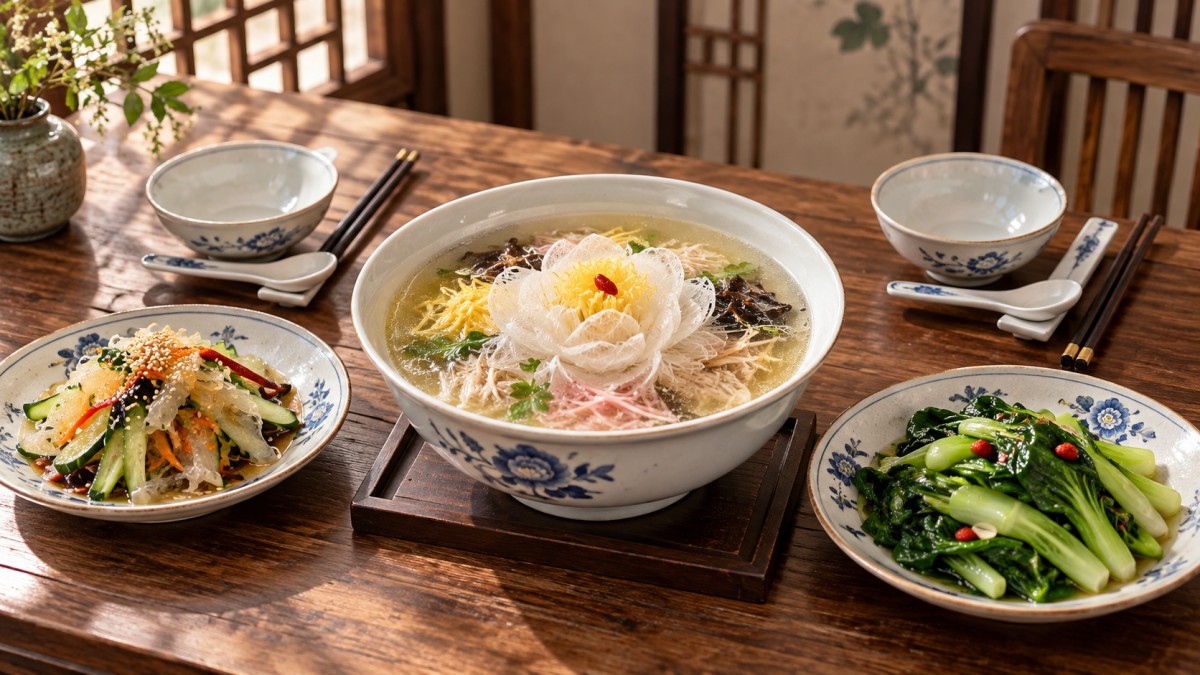
Mudan yancai, often translated as “peony swallow dish,” is one of the best-known Luoyang water banquet specialties. Its defining feature is finely shredded radish prepared to evoke the texture associated with bird’s nest, presented with decorative garnishes in broth. The name should not be taken to mean that it necessarily contains edible bird’s nest.
Recipes and garnishes differ, so ask about the actual ingredients. Radish at the center does not make the finished dish vegetarian: stock and toppings may contain animal ingredients. For a couple seeking one recognizable centerpiece, it is a strong candidate, provided the serving size suits the rest of the order.
Small-bowl soup: ask what “small” means
Lian tang rou pian, a sliced-meat soup dish, and Luoyang xiaowantang, often rendered as Luoyang small-bowl soup, are names you may encounter. English translations are inconsistent, and “small bowl” should not be treated as a reliable portion measurement.
Ask whether the menu item is an individual serving or a shared bowl, and which meat or other ingredients it contains. Sourness and peppery seasoning are also worth checking. If you already have a substantial broth-based centerpiece, a second soup makes sense only if it offers a flavor you particularly want to try.
Add contrast rather than another similar bowl
A crisp vegetable, a refreshing cold dish, or a less liquid meat preparation can make the meal more satisfying than several variations on thickened soup. If the water banquet selection offers little contrast, ask whether you can add a vegetable dish from the restaurant’s regular menu.
There is no need to insist that every plate belong to the formal banquet sequence. For two diners, the more useful goal is a manageable meal that reveals something distinctive about Luoyang cooking.
Use portion size—not dish count—to prevent overordering
Counting dishes alone is unreliable. Three large shared bowls can be more food than several small plates. Broth also occupies table space and fills you up, particularly when dishes contain meat, starch, noodles, or thickened sauces.
Ask staff to point out the bowl size, show a serving photograph, or compare it with another dish already being served. If possible, specify “one small shared portion” rather than simply “one portion.” Small serving bowls placed on the table are not evidence that the kitchen portion itself is small.
A practical order for a couple might look like this:
Tell the server that you may add another dish later. Also ask whether any specialty must be ordered at the beginning because of preparation time. That preserves flexibility without assuming that every item can be produced immediately.
Explain dietary needs more precisely than “not spicy”
In a water banquet, heat may come from pepper as well as chili. A dish can contain little chili yet still taste sharply peppery, while vinegar contributes a separate sour intensity. If you prefer mild food, ask for less chili, less pepper, and less vinegar as separate requests.
Not every adjustment will be possible. A kitchen may use prepared stock or a pre-seasoned soup base, so removing a garnish does not necessarily change the underlying flavor. Ask whether the seasoning can actually be adjusted before ordering.
Vegetarian diners should check stock, cooking fat, and toppings, not just the named main ingredient. A radish or vegetable dish may use meat broth. Likewise, someone avoiding pork needs to ask about broth and lard as well as visible meat.
For allergies, name the specific allergen and ask about both ingredients and preparation. Decorative toppings and soup bases can be harder to identify from a photograph than a plain grilled or steamed dish. Removing a visible topping is not an adequate solution if the allergen has already contacted the food.
If staff cannot confidently establish what is in a dish or whether cross-contact can be avoided, do not rely on a translated menu name as reassurance. Choose an alternative whose preparation can be confirmed, or another dining arrangement if necessary.
Judge the price by the meal you will actually eat
A larger set can appear better value because it includes more dishes, but unused portions do not improve a couple’s dinner. Compare the final cost of the dishes you want with the price of the set—not simply the cost per advertised course.
Before approving the order, ask staff to show the total. Check whether a displayed price applies per person, per set, or per table, and whether pictured dishes are included or optional upgrades. If using an online voucher, read its redemption conditions, serving size, reservation requirements, and any restrictions on dates or substitutions.
There is no dependable citywide price that covers every water banquet experience. Venue, portion size, ingredients, and service format all affect the bill. A clear current menu and an itemized order are more useful than an old travel review quoting a single meal price.
Keep the service pace comfortable for two
A banquet-style meal can involve successive dishes rather than everything arriving together. Ask how your smaller order will be served, especially if you have an evening performance, train, or other timed booking afterward.
If several hot bowls arrive quickly, request slower service where possible. A table covered in soup bowls is awkward for two people, and dishes may cool before you reach them. Use serving utensils to transfer food into your own bowls; you do not need to finish every drop of broth to appreciate the dish.
If you have a firm departure time, state it before ordering and ask whether the chosen dishes can be served comfortably within it. Reducing the order is preferable to rushing through a large set.
A clear request you can show the server
“There are two of us, and we would like a small introduction to Luoyang water banquet dishes rather than a full banquet. Please recommend one signature soup dish, one dish with a different texture, and a vegetable dish. Can these be served in small portions? Please confirm the ingredients, whether the seasoning can be adjusted, and the total price before placing the order. We may add more food later.”
Use a translation app to show that request in the restaurant’s working language, adding any dietary restrictions separately. Ask the server to point to each agreed dish on the menu so that names, portions, and prices remain clear.
The right order for a couple is not the one that reproduces the longest banquet. It is the one that lets both people enjoy a distinctive signature dish, enough contrast to keep the meal interesting, and a quantity they can finish comfortably.
Your 1:1 travel consultant will respond within 1 business day
How to plan your trip
- The Ice and Snow Industry Surpasses RMB 1 Trillion, with Direct High-Speed Rail Access and Upgraded Nighttime Offerings Driving Spending
- Autumn Breaks in Multiple Regions Boost Family Travel and Tourism
- Liaoning 2026–2027 Winter Culture Carnival Kicks Off
- Shenyang Cultural Tourism Promotion Delegation Visits Guangzhou to Promote Winter Tourism and Attract Investment
- 2026 Hebei Culture and Tourism Promotion Week in Beijing Kicks Off
Monthly travel guide
- October 2026 County-Level Tourism Communications Report Released: Top 100 Index Rebounds
- More Than 100 Cities Introduce Autumn Breaks, Creating a New Hotspot for Family and Educational Travel
- The 2026 China-Vietnam (Honghe) Border Economic, Trade and Tourism Fair Opens in Hekou
- The 2026 Guangxi Cultural Tourism Carnival Held in Hezhou
- Luoyang launches the “Autumn Charm of the Divine Capital” tourism promotion to build anticipation for winter travel
- Typhoon “White Dolphin” Forces Henan Scenic Areas to Close, Putting Summer Ground-Handling Services Under Pressure
- RCEP Implementing Rules for Indonesia Take Effect: Zero Tariffs for Cultural and Tourism Services Alongside Strict Customer Service Requirements
- Saudi Arabia’s New SASO Regulations Take Effect: Taqat Certification Required Before Chinese-Language Cultural Tourism Services Can Access Visit Saudi
- Zhengzhou Launches a Dedicated LCL Shipping Route for Cultural and Tourism Materials, Cutting Freight Costs by 18%
- Luoyang Cold Chain Intensification: Cultural and Creative Exports Delivered in 9 Days
- Expedited Pre-Approval for Group Visas to Three Southeast Asian Countries
- Tightening air freight capacity at Zhengzhou Airport delays the delivery of cultural and tourism materials
Popular destinations
- Should you travel from Wuzhen to Shanghai by bus or train?
- What can you do if Forbidden City tickets are sold out?
- Is the Summer Palace North Gate convenient for arriving by subway?
- How to walk from the Summer Palace East Palace Gate to Kunming Lake
- Can you buy Summer Palace admission tickets at the East Gate?
Why choose us

High cost-performance and transparent experience
Offer astonishing low prices without hidden tourism traps, enabling travelers to explore at lower costs while avoiding unnecessary spending loopholes, ensuring transparent consumption.

Personalization and dedicated service
Support 100% free customization, paired with one-on-one expert service, crafting exclusive itineraries based on travelers' specific needs, while providing professional guidance to enhance the personalization and professionalism of the journey.

Premium itinerary planning
Compact yet rich itineraries allow travelers to experience more within limited time; simultaneously, carefully selected hotels in prime locations provide convenient lodging conditions, overall enhancing travel comfort and experience.