Welcome to Our Travel Agency!




On May 19, 2026, the Henan Provincial Department of Culture and Tourism officially released the "2026 Summer Inbound Study Tour Service Guidelines", establishing for the first time mandatory provisions to regulate local reception services for study tours targeting overseas youth groups. This policy directly addresses current pain points in the inbound study tour market, such as weak compliance, inconsistent service standards, and insufficient cross-border coordination and response, marking that China’s inbound cultural and tourism services are rapidly shifting from a ‘reception capacity-oriented’ model to an ‘institutionalized compliance supply-oriented’ model, with structural impacts across every link of the study travel industry chain.
Event Overview
On May 19, 2026, the Henan Provincial Department of Culture and Tourism issued the "2026 Summer Inbound Study Tour Service Guidelines", clearly requiring all local reception travel agencies in Luoyang and across the province that undertake overseas study tour groups to strictly implement 12 mandatory service provisions, including: bilingual teaching plan filing, 100% overseas travel insurance coverage, a cross-border emergency contact mechanism (including a 7×12-hour multilingual response channel), deployment of a multilingual safety alert system, qualification verification for overseas group leaders, pre-assessment reports on risk points along study tour routes, credit background check records for overseas partners, mandatory bilingual signage for transfer vehicles, filing of foreign-related safety agreements for accommodation venues, bilingual disclosure of halal/allergen information for catering suppliers, digital archiving standards for study tour outcomes, and a dynamic access linkage mechanism with the whitelist of the ‘Hello! China’ APP. Effective immediately, the guidelines have been embedded into the whitelist review system of the Ministry of Culture and Tourism’s ‘Hello! China’ international promotion platform, becoming the statutory compliance threshold for overseas schools and educational institutions procuring study tour services within China.
Which Segments of the Industry Will Be Affected
Direct Trade Enterprises
This mainly refers to outbound travel agencies and study tour brand operators that package and sell study tour products to overseas educational institutions and international schools. The core impact on them lies in the ‘rise in compliant delivery costs’ and the ‘lengthening of the procurement decision chain’: provisions such as bilingual teaching plan filing, full insurance coverage, and emergency contact mechanisms significantly increase the complexity of product design and contract performance verification; meanwhile, binding to the ‘Hello! China’ APP whitelist means that overseas buyers will prioritize service providers that have passed provincial compliance certification, and companies that have not completed localization adaptation will effectively lose bidding eligibility. The impact is reflected in a longer order conversion cycle and a higher proportion of compliance service premium in customized quotations, reaching 18%–25% (according to preliminary pilot estimates by the Luoyang Municipal Bureau of Culture and Tourism).
Raw Material Procurement Enterprises
Here, ‘raw materials’ specifically refer to irreplaceable localized resource elements in study tour services, such as guide talent with bilingual interpretation qualifications, study tour bases and venues meeting international safety standards, multilingual guide equipment, and translation service suppliers. After the policy is implemented, the supply of such resources will face structural shortages: there are fewer than 120 people in Luoyang holding valid bilingual study tour interpretation certificates, while the estimated demand for receiving overseas groups during the summer exceeds 400 batches; the multilingual safety alert system must connect to the ISO 7010 international safety symbol standard, forcing local signage production companies to upgrade their certification systems. The impact is reflected in a shift of procurement bargaining power toward scarce resource providers, with average short-term service procurement unit prices rising by 12%–16%.
Processing and Manufacturing Enterprises
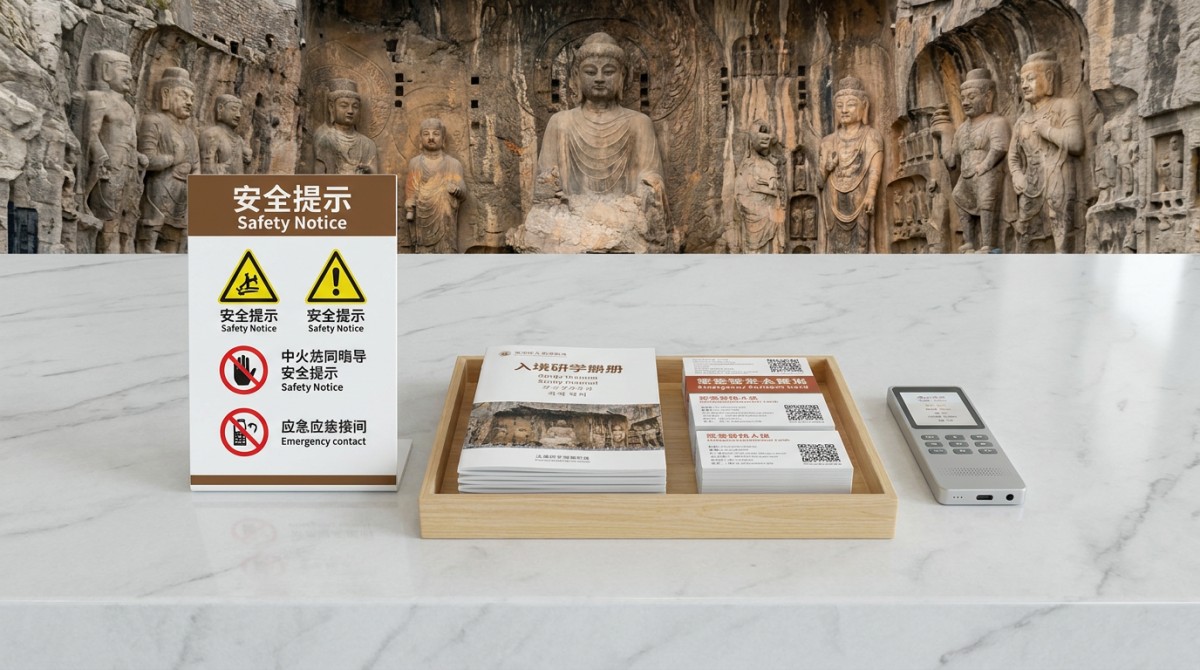
This mainly points to manufacturers of physical products such as study tour teaching aids, safety equipment, and portable multilingual guide hardware. Provisions in the guidelines such as the ‘multilingual safety alert system’ and ‘digital archiving of bilingual teaching plans’ are essentially driving demand for standardized teaching aids and intelligent hardware upgrades. For example, study tour manuals, safety notice cards, and emergency contact cards are required to be simultaneously produced in Chinese, English, Japanese, and Korean versions and support QR code traceability; some provisions implicitly include mandatory compatibility requirements for devices such as RFID positioning wristbands and offline voice guide terminals. The impact is reflected in the compression of product iteration cycles to within 3 months, and products must also obtain filing numbers from cultural and tourism authorities before entering the procurement catalog of local reception agencies.
Supply Chain Service Enterprises
These include cross-border insurance brokers, multilingual legal compliance consulting firms, third-party quality certification providers for study tour services, and technical service providers for ‘Hello! China’ APP integration. Such companies are seeing definite incremental demand: the guidelines clearly require ‘full overseas insurance coverage’, driving a surge in demand for customized cross-border travel liability insurance products; provisions such as ‘bilingual teaching plan filing’ and ‘emergency contact mechanisms’ are giving rise to specialized compliance audit services; and the APP whitelist embedding mechanism makes technical service providers capable of interfacing with cultural and tourism government systems indispensable partners for local reception agencies. The impact is reflected in service contract cycles shifting from one-off project-based arrangements to annual framework agreements, and leading service providers have already begun planning localized service stations in Luoyang.
Key Points for Relevant Enterprises or Practitioners to Watch and Response Measures
Immediately Launch Standardized Upgrading of Bilingual Teaching Plans and Emergency Response Plans
All local reception agencies intending to apply for the ‘Hello! China’ whitelist must complete the preparation of bilingual teaching plans for at least 3 themed study tour courses (such as Sui-Tang culture, Longmen Grottoes, and Luoyi Ancient City) before June 30, 2026, and simultaneously prepare Chinese-English bilingual versions of the "Cross-Border Emergency Incident Response Flowchart" and contact tree diagram, then submit them to the designated platform of the Luoyang Municipal Bureau of Culture and Tourism for filing.
Prioritize Connection to the Provincial Cross-Border Emergency Contact Hub System
The guidelines clearly require that the emergency contact channels of local reception agencies must achieve direct data connection with the emergency command center of Henan Province’s culture and tourism authority. Enterprises should complete system integration testing before July 15 to ensure real-time transmission of fields such as group location, member nationality composition, and health abnormality alerts, so as to avoid temporary suspension of whitelist eligibility due to interface delays.
Carry Out Compliance Adaptation Assessment for Overseas Insurance Products
Current outbound travel insurance generally does not cover new types of risks in overseas study tour scenarios, such as accidents during teaching practice and liability for mediation of cross-cultural conflicts. Enterprises must work with licensed cross-border insurance brokerage institutions to complete policy clause comparisons before the end of June, focusing on confirming whether the three types of coverage—‘liability of third-party overseas teaching venues’, ‘multilingual medical transfer’, and ‘public relations expenses for culturally sensitive incidents’—are included within the underwriting scope.
Establish a Dynamic Update Mechanism for Multilingual Safety Alert Content
The guidelines require that the safety alert system must be updated quarterly and must be reviewed and approved by the language service expert panel of the Luoyang Municipal Bureau of Culture and Tourism. Enterprises need to form an internal multilingual content team (including at least native speakers of English, Japanese, and Korean), and submit update plans before the 10th day of the first month of each quarter to avoid triggering whitelist re-examination due to outdated content.
Editorial Viewpoint / Industry Observation
显然,这份指南不仅仅是一份操作清单,更是一项监管信号,推动中国入境研学旅游市场从‘基于能力的竞争’转向‘以合规为锚点的差异化竞争’。分析表明,这12项强制要求共同提高了低成本、低合规运营者的准入门槛,同时为经过认证的服务整合商创造了溢价空间。更关键的是,嵌入‘你好!中国’APP的机制将省级政策转化为国家级采购把关工具——这在区域旅游监管中是一种罕见的结构性升级。从行业视角来看,这更应被理解为省级层面首次尝试将入境教育旅游制度化为一个邻近外交属性的服务领域,在这一领域中,服务质量将直接影响国家软实力形象。
Conclusion
The implementation of this policy in Luoyang appears on the surface to focus on summer service standards, but in reality it establishes inbound study tours as a strategic support point in the intersecting field of ‘culture and tourism + education + diplomacy’. Its significance lies not only in improving the reception standards of a single city, but also in providing a replicable ‘compliance framework template’ for the standardization of inbound study tour services nationwide. Rational observation suggests that subsequent policy expansion will no longer mainly rely on ‘encouraging guidelines’, but will instead depend on the closed loop of ‘whitelist—procurement side—capital flow’ to form rigid transmission, and the industry as a whole is steadily entering a new stage of ‘no compliance, no transaction’.
Information Source Notes
Official sources: announcement on the official website of the Henan Provincial Department of Culture and Tourism (released on May 19, 2026, full text of the "2026 Summer Inbound Study Tour Service Guidelines"); technical integration instructions for the ‘Hello! China’ national culture and tourism promotion platform (updated version on May 20, 2026). Pending continued observation: the Luoyang Municipal Bureau of Culture and Tourism will publish the first batch of whitelisted enterprises in mid-June; the Ministry of Culture and Tourism plans to launch project research on the "National Standard for Inbound Study Tour Services" in the third quarter.
Your 1:1 travel consultant will respond within 1 business day
How to plan your trip
- Multiple regions announce autumn break dates for primary and secondary schools; attractions offer benefits such as discounted admission
- China’s Civil Aviation Industry to Implement the 2026/2027 Winter-Spring Flight Schedule from October 25
- Autumn Breaks in Multiple Regions Boost November Travel, Offering Hope for the Traditional Low Season
- China Tourism Academy Releases Report on Autumn Trends in China's Domestic Customized Tour Market
- What should I wear for a winter trip to Harbin and Mohe to cope with the extreme outdoor cold?
Monthly travel guide
- Luoyang launches the “Autumn Charm of the Divine Capital” tourism promotion to build anticipation for winter travel
- Typhoon “White Dolphin” Forces Henan Scenic Areas to Close, Putting Summer Ground-Handling Services Under Pressure
- RCEP Implementing Rules for Indonesia Take Effect: Zero Tariffs for Cultural and Tourism Services Alongside Strict Customer Service Requirements
- Saudi Arabia’s New SASO Regulations Take Effect: Taqat Certification Required Before Chinese-Language Cultural Tourism Services Can Access Visit Saudi
- Zhengzhou Launches a Dedicated LCL Shipping Route for Cultural and Tourism Materials, Cutting Freight Costs by 18%
- Luoyang Cold Chain Intensification: Cultural and Creative Exports Delivered in 9 Days
- Expedited Pre-Approval for Group Visas to Three Southeast Asian Countries
- Tightening air freight capacity at Zhengzhou Airport delays the delivery of cultural and tourism materials
- Vietnam's New Regulations on Bus Monitoring Requirements for Group Tours
- Saudi SAMA New Regulations on Travel Liability Insurance Compliance Preparation
- Japanese tourists' new regulations for entering Henan local transport vehicles
- Wai Gao Qiao Wen Travel customs bonded warehouse summer group equipment fast lane
Popular destinations
- The Complete 2026 Guide to Inbound Tourism in Henan, China: 144-Hour Visa-Free Transit, the Latest Policies, and In-Depth Travel Tips
- The Guizhou Provincial Government Approves the Guizhou Province 15th Five-Year Plan for Culture and Tourism
- Liaoning Issues 15th Five-Year Plan for Cultural and Tourism Integration, Setting 2030 Targets
- The Ministry of Culture and Tourism Announces the Second Batch of Technology Innovation Centers, with 11 Centers Entering Formal Operation
- Heilongjiang Repeals Travel Agency Rewards for Bringing Tourists into the Province and Clarifies Application Arrangements
Why choose us

High cost-performance and transparent experience
Offer astonishing low prices without hidden tourism traps, enabling travelers to explore at lower costs while avoiding unnecessary spending loopholes, ensuring transparent consumption.

Personalization and dedicated service
Support 100% free customization, paired with one-on-one expert service, crafting exclusive itineraries based on travelers' specific needs, while providing professional guidance to enhance the personalization and professionalism of the journey.

Premium itinerary planning
Compact yet rich itineraries allow travelers to experience more within limited time; simultaneously, carefully selected hotels in prime locations provide convenient lodging conditions, overall enhancing travel comfort and experience.