Welcome to Our Travel Agency!




Travel Guide
Mutianyu is generally the more practical winter choice when easier access from Beijing and a shorter, adjustable walk matter most. Jinshanling becomes more appealing when open ridge views and a longer outing justify the additional journey and physical effort. That preference changes quickly after snowfall, freezing rain, or strong wind: the better option is whichever has confirmed road access, an open walking route, and a manageable return.
Choosing between Jinshanling or Mutianyu Great Wall in winter therefore starts with two separate questions: how easily can you reach the wall, and what will the descent involve? A scenic area being open does not establish that every staircase, gate, or mechanical transport service is operating. Neither section offers consistently ice-free footing.
The differences that affect the day
These are planning differences, not a ranking of daily safety. A dry, calm day at Jinshanling can offer better walking conditions than a day with shaded ice at Mutianyu. Choose the section first on logistics, then confirm whether the actual surface conditions support the intended walk.
Access means reaching the walking route, not just the entrance
Mutianyu usually fits more comfortably into a Beijing day trip because the road journey is shorter. Even so, arrival at the visitor area is only one stage. Ticketing, any operating internal shuttle, the approach to a boarding point, and the transfer onto the wall all consume time. A vehicle drop-off described simply as “Mutianyu” does not explain how much walking remains.
The cable car and chairlift serve different access points. Their boarding locations and return arrangements are not interchangeable, and tickets should be understood before setting off along the wall. Wind, maintenance, or other operating restrictions can affect availability. A toboggan descent should never be the only planned way down in winter, since its operation depends on suitable conditions.
At Jinshanling, the longer journey makes an unclear arrival plan more costly. Confirm the actual entrance, the walking approach from the drop-off, and whether any advertised cable car service will operate on the travel date. An itinerary based on mechanical access becomes substantially harder if the substitute is a long climb on foot.
Public transport adds another layer of uncertainty. A bus reaching a nearby town or highway stop does not necessarily provide a convenient final connection to the entrance, particularly in winter. Seasonal sightseeing services also require confirmation. For either section, establish the last practical return connection before treating public transport as a workable day-trip plan.
A booked vehicle offers more control over departure and collection, but the pickup location needs to be explicit. Confirm whether the driver will wait, where collection is permitted, and how a route change will be communicated. At Jinshanling especially, an intended exit at another gate should not be assumed accessible merely because it appears on a map.
Restored stone still becomes slippery
Mutianyu’s restored appearance can create an overly reassuring impression. Regular-looking masonry does not guarantee uniform step heights, dependable traction, or a gentle descent. Steep stair flights remain physically demanding, and polished or worn surfaces become difficult when covered by ice. Reaching the wall by cable car reduces the initial climb; it does not remove the stairs encountered afterward.
Jinshanling’s walking routes involve repeated changes in elevation. The effort accumulates because a descent often leads directly into another climb. Some stretches have uneven surfaces and substantial exposure to wind. Route difficulty therefore depends on the chosen section and turnaround point, rather than the total distance alone.
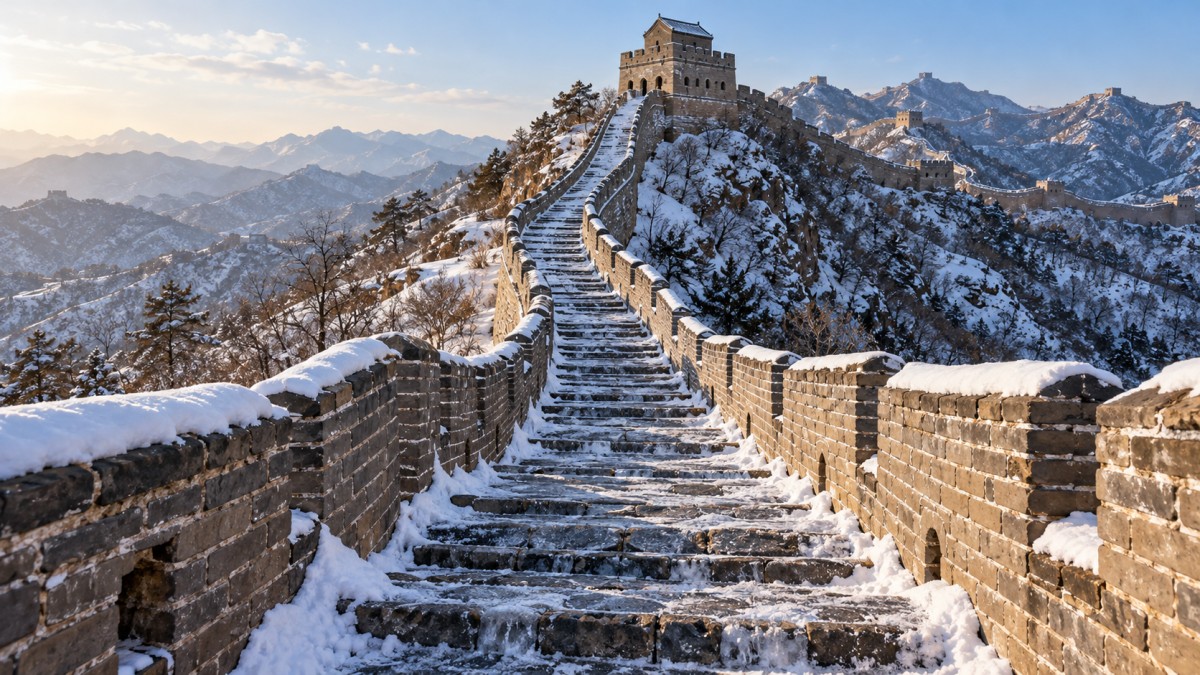
Snow cover and ice present different problems. Fresh snow conceals step edges, depressions, and existing frozen patches. A thin film of ice can be harder to notice, especially where stone looks merely damp. After daytime melting, water can refreeze as temperatures fall. Sunny stretches and shaded tower passages can consequently have very different footing within the same short walk.
The descent should determine the turnaround point. Climbing a staircase can feel manageable because the next foothold is close and body weight stays uphill. Descending the same flight demands controlled lowering and reliable grip. Before climbing a steep stretch, consider whether returning down it would remain comfortable if the surface became colder or more crowded.
Wall openings, parapets, and any available handrails also vary along the route. Do not build a walking plan around continuous hand support. A route that requires gripping the masonry throughout is already a poor match for the conditions or the walker’s balance.
Build the route around a dependable exit
At Mutianyu, a compact out-and-back walk from the operating access point is often the most flexible winter arrangement. Begin with a nearby section, assess the actual steps, and extend only while returning remains straightforward. A distant tower adds little value if reaching it uses the energy or daylight needed for a controlled descent.
The uphill ride and downhill ride deserve separate confirmation. Establish the final boarding time, the route back to that station, and what happens if the service stops. Walking down is not automatically a reasonable backup: it may involve considerably more exertion and its own slippery surfaces. If the backup exceeds the group’s abilities, the original route needs shortening or postponing.
Jinshanling rewards more deliberate route selection. An out-and-back plan makes the return path familiar, but every outward descent becomes a climb on the way back. A walk between separate gates avoids retracing some ground only when both gates, the connecting wall section, and vehicle collection are confirmed. A continuous line on a map is not evidence of an open visitor route.
Avoid treating a longer walk toward another Great Wall section as a casual extension. Access restrictions and closed connections can interrupt routes that appear in older trip descriptions. Stay within the sections currently open to visitors and follow local closures, even when footprints continue beyond a barrier.
Set a turnaround time before starting. It should leave room for slow movement, short warming breaks, the descent, and the transfer back to transport. Winter photography often consumes more time than expected because gloves come off, batteries cool, and suitable light encourages repeated stops.
Conditions that change the choice
Dry stone, light wind, and confirmed transport: both sections remain plausible. Mutianyu favors a shorter outing with convenient access; Jinshanling favors a longer ridge walk when fitness and daylight allow it. This is the situation in which scenery and preferred walking distance can reasonably lead the decision.
Recent snow followed by freezing temperatures: route condition becomes more important than the section’s reputation. Ask specifically about ice on visitor stairways and access paths. A general statement that the attraction is open leaves too much unresolved. Where those surfaces cannot be confirmed, postpone the wall walk or choose a different activity.
Strong wind: exposure and transport reliability both deteriorate. A forecast for central Beijing does not describe conditions on an elevated ridge. Jinshanling’s longer walking possibilities lose much of their appeal when extended stops become uncomfortable, while Mutianyu’s access advantage shrinks if mechanical transport is suspended.
Limited stair tolerance or uncertain balance: Mutianyu’s infrastructure gives it a logistical advantage, but neither destination guarantees an easy walk. Mechanical access still leaves uneven ground and stairs. The useful question is whether the confirmed route contains a short, acceptable walking section with a reliable return.
A quieter wall also has tradeoffs. Fewer visitors improve the atmosphere and reduce congestion at narrow steps, but nearby assistance and open facilities can be less immediate. Do not assume that every kiosk, refreshment point, or sheltered space shown in photographs operates through winter.
Equipment helps only within suitable conditions
Footwear should fit securely and have soles intended for traction on outdoor surfaces. Warm fashion boots with shallow tread can perform poorly on snow-covered stone. Thick socks must leave enough room to move the toes; a cramped boot can become uncomfortable during long, cold stops.
Removable traction devices require judgment. They can improve grip on some icy surfaces, but their behavior changes on exposed stone, steep steps, and mixed patches. Use them only where permitted and appropriate to the surface, following their instructions. Their presence does not make a closed or heavily iced route suitable.
Gloves need to preserve enough dexterity for tickets, zips, and secure hand contact. A wind-resistant outer layer matters on exposed ridges, while adjustable insulation helps prevent overheating during climbs and chilling during stops. Carry water, a small snack, and a charged phone close to the body. Keep enough battery capacity for contacting the driver after photography.
Make the booking specific enough to adjust
Before committing, obtain answers about the intended gate, operating access services, open walking section, and return arrangement. Ask when that information was last confirmed. Conditions reported before a snowfall or overnight freeze are a weak basis for the following morning’s route.
A useful booking also explains what changes if access is interrupted: a later departure, a shorter visit, a different activity, or cancellation under the agreed terms. Comparing only the headline excursion price hides differences in waiting time, transfers, included rides, and the flexibility to turn back early.
Longer China itineraries need the same separation between a tour’s theme and its physical demands. A food-focused title such as Go Wild for Spicy Flavors--Mount Emei Leshan Chengdu City Small Private Group Tour still leaves questions about walking, elevation, and seasonal access to resolve from the detailed itinerary. For a winter Great Wall day, the section name likewise needs to be translated into an actual route.
On departure morning, use the latest road, weather, and site information to confirm that route. If the only workable plan requires rushing down unfamiliar icy steps to catch the final ride, the day needs changing before the journey begins.
Your 1:1 travel consultant will respond within 1 business day
How to plan your trip
- The Ice and Snow Industry Surpasses RMB 1 Trillion, with Direct High-Speed Rail Access and Upgraded Nighttime Offerings Driving Spending
- Autumn Breaks in Multiple Regions Boost Family Travel and Tourism
- Liaoning 2026–2027 Winter Culture Carnival Kicks Off
- Shenyang Cultural Tourism Promotion Delegation Visits Guangzhou to Promote Winter Tourism and Attract Investment
- 2026 Hebei Culture and Tourism Promotion Week in Beijing Kicks Off
Monthly travel guide
- October 2026 County-Level Tourism Communications Report Released: Top 100 Index Rebounds
- More Than 100 Cities Introduce Autumn Breaks, Creating a New Hotspot for Family and Educational Travel
- The 2026 China-Vietnam (Honghe) Border Economic, Trade and Tourism Fair Opens in Hekou
- The 2026 Guangxi Cultural Tourism Carnival Held in Hezhou
- Luoyang launches the “Autumn Charm of the Divine Capital” tourism promotion to build anticipation for winter travel
- Typhoon “White Dolphin” Forces Henan Scenic Areas to Close, Putting Summer Ground-Handling Services Under Pressure
- RCEP Implementing Rules for Indonesia Take Effect: Zero Tariffs for Cultural and Tourism Services Alongside Strict Customer Service Requirements
- Saudi Arabia’s New SASO Regulations Take Effect: Taqat Certification Required Before Chinese-Language Cultural Tourism Services Can Access Visit Saudi
- Zhengzhou Launches a Dedicated LCL Shipping Route for Cultural and Tourism Materials, Cutting Freight Costs by 18%
- Luoyang Cold Chain Intensification: Cultural and Creative Exports Delivered in 9 Days
- Expedited Pre-Approval for Group Visas to Three Southeast Asian Countries
- Tightening air freight capacity at Zhengzhou Airport delays the delivery of cultural and tourism materials
Popular destinations
- The Ice and Snow Industry Surpasses RMB 1 Trillion, with Direct High-Speed Rail Access and Upgraded Nighttime Offerings Driving Spending
- Liaoning 2026–2027 Winter Culture Carnival Kicks Off
- Shenyang Cultural Tourism Promotion Delegation Visits Guangzhou to Promote Winter Tourism and Attract Investment
- 2026 Hebei Culture and Tourism Promotion Week in Beijing Kicks Off
- Sanya’s Winter Tourism Market Heats Up: More Frequent Flights and Booming Duty-Free Shopping
Why choose us

High cost-performance and transparent experience
Offer astonishing low prices without hidden tourism traps, enabling travelers to explore at lower costs while avoiding unnecessary spending loopholes, ensuring transparent consumption.

Personalization and dedicated service
Support 100% free customization, paired with one-on-one expert service, crafting exclusive itineraries based on travelers' specific needs, while providing professional guidance to enhance the personalization and professionalism of the journey.

Premium itinerary planning
Compact yet rich itineraries allow travelers to experience more within limited time; simultaneously, carefully selected hotels in prime locations provide convenient lodging conditions, overall enhancing travel comfort and experience.