Welcome to Our Travel Agency!




Travel Guide
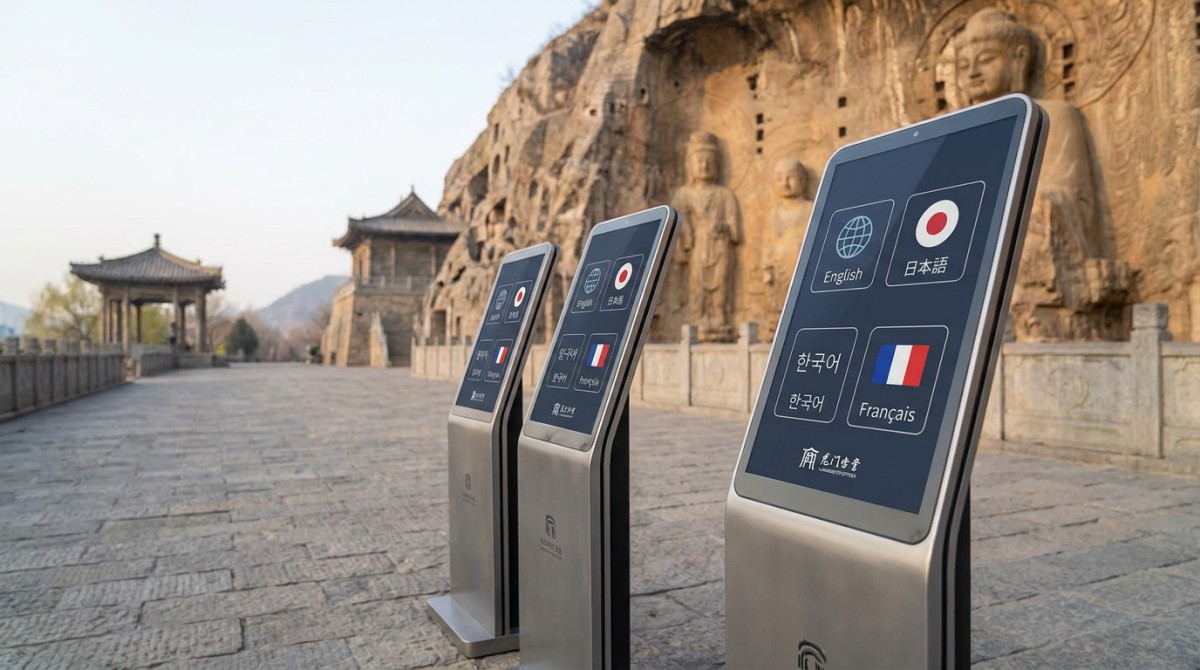
On May 17, 2026, key scenic areas in Luoyang, Henan, including the Longmen Grottoes, White Horse Temple, and Laojun Mountain, officially launched a multilingual AI voice guide system and a unified real-time reservation middle platform. This move marks a new stage of intelligent and internationalized infrastructure for ground handling services in Central and Western China, substantially improving the response efficiency, service standardization, and cross-border coordination capabilities of the inbound tourism industry chain.
Event Overview
Henan Lelv Travel Agency disclosed that starting from May 2026, cooperative scenic areas such as Luoyang Longmen Grottoes, White Horse Temple, and Laojun Mountain have fully adopted an AI voice guide system supporting English, Japanese, Korean, and French, and connected it to a unified real-time reservation middle platform. The system provides standardized API interfaces to overseas travel agencies, supporting batch inventory status (Note: here it refers to remaining reservation timeslots for scenic areas) inquiries, multilingual electronic voucher verification, and alert push functions for sudden visitor flow surges.
Which Sub-Sectors Will Be Affected
Direct trade enterprises: mainly referring to tour operators, outbound travel wholesalers, and localized operation entities of international OTAs targeting overseas markets. The primary reason they are affected is that the service delivery chain is moving forward—ground handling response cycles previously dependent on manual coordination (averaging more than 48 hours) are being compressed to minute-level API calls. The impact is reflected in greater certainty in order fulfillment, a lower rate of refund and change disputes, and reduced complexity in designing multi-destination connecting itinerary products; however, this simultaneously requires their technical integration capabilities (such as API integration and voucher parsing logic) to adapt quickly.
Raw material procurement enterprises: here specifically referring to enterprises that provide hardware carriers for smart scenic area construction, such as multilingual audio terminal equipment manufacturers, low-power Bluetooth beacon suppliers, and multimodal content production service providers. The main reason they are affected lies in changes to demand structure—from single hardware procurement to combined procurement of “hardware + language content packages + cloud platform subscriptions.” The impact is reflected in shorter order cycles, a rising share of customized content development, and new requirements for localized language service capabilities (such as compliance review of Japanese guide scripts).
Processing and manufacturing enterprises: mainly covering smart guide hardware assembly plants and OEM factories for scenic area gate machines/ticket verification terminals. The main reason they are affected is the accelerated iteration of technical standards—the new middle platform requires devices to be compatible with unified verification protocols (such as ISO/IEC 14443 Type A/B dynamic key exchange), forcing production lines to upgrade firmware flashing and security certification modules. The impact is reflected in a higher proportion of small-batch, multi-version production, increased pressure for simultaneous CE/FCC/CCC triple certification, and stronger reliance on embedded system engineers’ cross-standard debugging capabilities.
Supply chain service enterprises: including technical service providers that offer cloud resource scheduling, multilingual AI model fine-tuning, and real-time visitor flow prediction algorithm deployment for cultural tourism enterprises. The main reason they are affected is the deepening granularity of scenarios—SaaS tools originally serving macro traffic monitoring now need to sink down to concurrency processing at the single ticket checkpoint level (such as 300+ electronic voucher verifications per second). The impact is reflected in surging demand for edge computing node deployment, offline disaster recovery capability of multilingual NLU models under weak network environments becoming a key indicator, and the increasing importance of compliant authorization procedures for data interfaces with government systems such as public security and transportation.
Key Focus Points and Response Measures for Relevant Enterprises or Practitioners
Prioritize Completion of API Technical Sandbox Access Verification
Overseas tour operators and domestic wholesalers should complete testing in the sandbox environment of the Luoyang reservation middle platform before the third quarter of 2026, focusing on verifying the end-to-end latency of the full chain of generation-transmission-verification for electronic vouchers in four languages (target ≤1.2 seconds) and the idempotent retry mechanism after abnormal interruptions, so as to avoid large-scale verification failures during the peak season.
Launch a Secondary Compliance Review of Multilingual Content
Guide content producers should work together with local cultural and tourism authorities and, in accordance with the revised version of the “Specification for Tour Guide Interpretation Services in Tourist Attractions” (LB/T 077-2019), conduct a secondary compliance review of historical descriptions, religious terminology, and geographical names in Japanese/Korean/French voice scripts, with particular attention to the translation accuracy of sensitive information such as the dating of Longmen Grottoes statues and the founding period of White Horse Temple.
Reconstruct the Warning Response Thresholds in Ground Handling Response SOPs
Ground handling agencies need to include the “yellow alert” pushed by the middle platform (instantaneous visitor flow reaching 75% of carrying capacity) as a mandatory response trigger condition, while synchronously adjusting the preset time windows for actions such as vehicle dispatching, narrator scheduling, and diversion channel activation, shifting from the traditional “post-event handling” to “threshold-driven proactive intervention.”
Assess the Feasibility of Edge Computing Node Deployment
Technical service providers should conduct on-site surveys of the existing network topology in each scenic area and, in weak-signal zones such as the West Hill cave clusters of Longmen Grottoes and the Golden Summit viewing platform of Laojun Mountain, evaluate the cost-benefit ratio of deploying hybrid 4G/5G networking and LoRaWAN edge gateways, ensuring that AI guide voice streams maintain end-to-end latency of ≤200ms at more than 95% of points.
Editorial Viewpoint / Industry Observation
Observably, this rollout is not merely a technical upgrade but a structural signal: the de facto standardization of inbound tourism service interfaces is accelerating in Tier-2 cities. Analysis shows that Luoyang’s API-first approach lowers the barrier for mid-sized overseas agencies to enter Central China markets—yet simultaneously raises the operational literacy bar for domestic ground handlers. From an industry perspective, the real inflection point lies not in multilingual support per se, but in the shift from ‘capacity booking’ to ‘experience orchestration’ as the core KPI. What matters now is not just whether a slot is available, but whether the entire guest journey—from visa-linked arrival prediction to post-visit sentiment analysis—is algorithmically coordinated.
Conclusion
The essence of this system upgrade in Luoyang is to push ground handling services from “labor-intensive response” toward “algorithm-driven coordination.” Its industry significance lies not in a single-point technological breakthrough, but in providing a reusable digital infrastructure model for cultural tourism destinations in Central and Western China. What is currently more worthy of attention is: can this model achieve cost-controllable large-scale replication in Northwest and Southwest regions where visitor flow fluctuations are even more seasonal? It is more appropriate to understand it as a regional infrastructure strengthening effort, rather than the starting point of a nationwide leap in service standards.
Information Source Notes
The information comes from the “Notice on the Launch of the Luoyang Smart Ground Handling System” issued by Henan Lelv Travel Agency to its overseas partner agencies on May 15, 2026; for technical interface documentation, please refer to the “Cultural Tourism Digital Platform” section on the official website of the Luoyang Municipal Bureau of Culture, Radio, Television and Tourism (URL: http://wlly.ly.gov.cn/digital-platform); the policy basis is Article 3.2.4, “Promote pilot interconnection of smart scenic areas in Central and Western China,” in the “14th Five-Year Plan for Cultural and Tourism Development.” Items pending continuous observation: actual reservation fulfillment rate of overseas tour groups during the summer vacation of 2026, completion rate of users of four-language guided tours (Completion Rate), and week-on-week fluctuation coefficient of API call volume.
Your 1:1 travel consultant will respond within 1 business day
How to plan your trip
- Hebei Launches Five “Trendy Hebei” Premium Tourism Routes for Inbound Travelers, Moving Toward Standardized Offerings
- The 12th Qionghai Tanmen Coastal Foraging Festival Opens on August 16
- Guangxi’s Digital Silk Road Accelerates: Orah Mandarin Juice Secures an Italian Order, Drawing Attention to Export Standards for Souvenirs
- New Inquiry Triggered by Coastal Cultural Tourism Space Standards
- Zhuanghe’s agro-cultural tourism model draws ASEAN attention, highlighting the compliance requirements for the internationalization of camping and intangible cultural heritage handicrafts
Monthly travel guide
- Typhoon “White Dolphin” Forces Henan Scenic Areas to Close, Putting Summer Ground-Handling Services Under Pressure
- RCEP Implementing Rules for Indonesia Take Effect: Zero Tariffs for Cultural and Tourism Services Alongside Strict Customer Service Requirements
- Saudi Arabia’s New SASO Regulations Take Effect: Taqat Certification Required Before Chinese-Language Cultural Tourism Services Can Access Visit Saudi
- Zhengzhou Launches a Dedicated LCL Shipping Route for Cultural and Tourism Materials, Cutting Freight Costs by 18%
- Luoyang Cold Chain Intensification: Cultural and Creative Exports Delivered in 9 Days
- Expedited Pre-Approval for Group Visas to Three Southeast Asian Countries
- Tightening air freight capacity at Zhengzhou Airport delays the delivery of cultural and tourism materials
- Vietnam's New Regulations on Bus Monitoring Requirements for Group Tours
- Saudi SAMA New Regulations on Travel Liability Insurance Compliance Preparation
- Japanese tourists' new regulations for entering Henan local transport vehicles
- Wai Gao Qiao Wen Travel customs bonded warehouse summer group equipment fast lane
- JTB Warning: Risks in Henan’s September Red Leaf Family Tour Purchases
Popular destinations
- China's Henan Province 144-Hour Visa-Free Transit Policy in 2026: Latest Regulations & In-Depth Travel Strategies
- The China-Europe Railway Express (Zhengzhou) Launches a Dedicated Train for Culture and Tourism Equipment, Cutting Customs Clearance Time to 48 Hours
- RCEP Cultural and Tourism Services Commitment Upgrade: Faster Market Access for Chinese Outbound Tourism Service Providers in Vietnam and Malaysia
- Japan to Introduce a Credit Point System for Chinese-Speaking Tour Guides, Trial Operation in August
- The EU Clarifies That Digital Platforms for Culture and Tourism Are Subject to GDPR Regulation
Why choose us

High cost-performance and transparent experience
Offer astonishing low prices without hidden tourism traps, enabling travelers to explore at lower costs while avoiding unnecessary spending loopholes, ensuring transparent consumption.

Personalization and dedicated service
Support 100% free customization, paired with one-on-one expert service, crafting exclusive itineraries based on travelers' specific needs, while providing professional guidance to enhance the personalization and professionalism of the journey.

Premium itinerary planning
Compact yet rich itineraries allow travelers to experience more within limited time; simultaneously, carefully selected hotels in prime locations provide convenient lodging conditions, overall enhancing travel comfort and experience.