Welcome to Our Travel Agency!




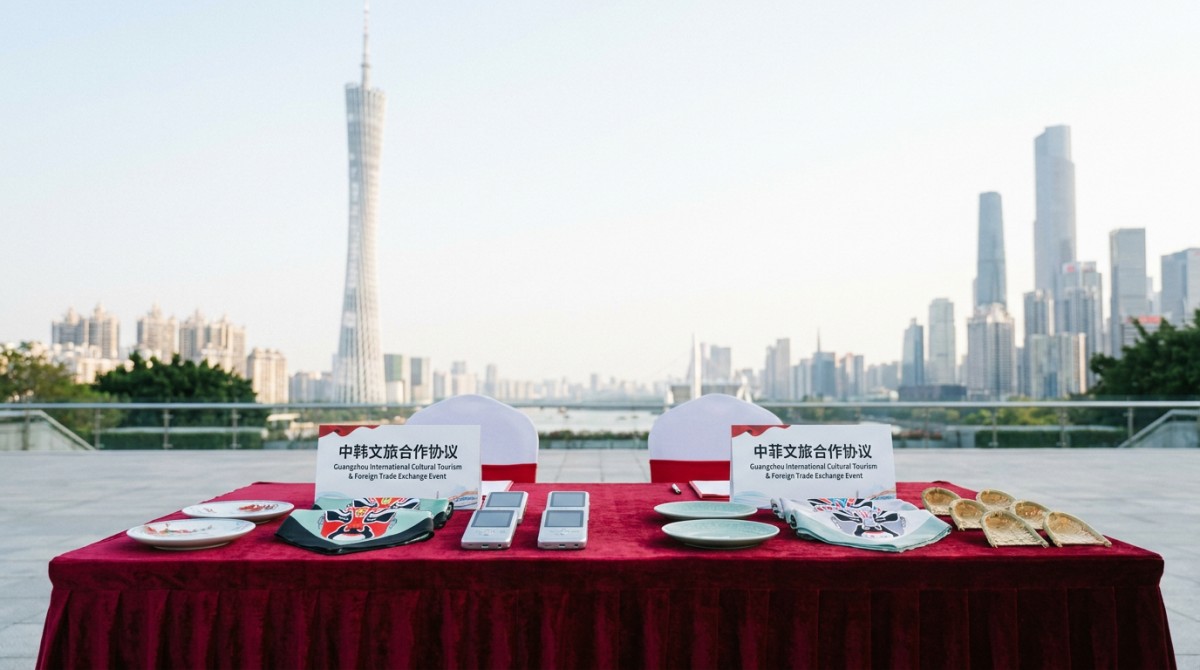
On 20 May 2026,the Guangzhou Municipal Culture, Radio, Television and Tourism Bureau hosted an international cultural tourism foreign trade cooperation and exchange event,where the China National Base for International Cultural Trade (Guangzhou) signed strategic cooperation agreements on cultural tourism trade with the Korea Creative Content Agency and Philippine Asia World Travel Agency. The event marks an acceleration in the institutionalized promotion of Lingnan culture going global,and will have a substantive impact on segments such as cultural tourism content production,cross-border tourism operations,industrialization of intangible cultural heritage,and digital cultural tourism exports.
Event Overview
On 20 May 2026,the Guangzhou Municipal Culture, Radio, Television and Tourism Bureau hosted an international cultural tourism foreign trade cooperation and exchange event. The China National Base for International Cultural Trade (Guangzhou) signed strategic cooperation agreements respectively with the Korea Creative Content Agency and Philippine Asia World Travel Agency,with a clear focus on two-way exchanges in the China-Korea cultural industry and joint promotion of China-Philippines inbound and outbound tourism. During the same period,7 cultural tourism foreign trade enterprises and intangible cultural heritage institutions joined the base’s export sales platform,using its overseas channels to promote the batch overseas expansion of premium Lingnan cultural products and digital cultural tourism products.
Which Segmented Industries Will Be Affected
Direct Trade Enterprises
The signatories are a national-level cultural trade platform and overseas official/semi-official cultural tourism institutions,which means that the export processes for cultural tourism products in the China-Korea and China-Philippines directions are expected to receive mechanism support such as customs clearance facilitation,mutual recognition of standards,and joint marketing. The impact is mainly reflected in:export category lists may shift toward high-value-added digital cultural tourism products such as intangible cultural heritage handicrafts,immersive performing arts IP,and AR guide systems;order acquisition channels will move from single-point matchmaking to platform-based batch access.
Cross-Border Tourism Operators
The China-Philippines agreement clearly points to “inbound and outbound tourism promotion”,indicating that the recovery of bilateral tourism has entered a policy coordination stage. The impact is mainly reflected in:rising demand for destination reception services targeting the Philippine market,development of multilingual interpretation systems,and flight-hotel-scenic area linked product design;at the same time,attention should be paid to the implementation pace of supporting measures on the Philippine side such as visa facilitation for Chinese tourists,payment adaptation,and safety notices.
Intangible Cultural Heritage Inheritance and Industrialization Institutions
The entry of 7 intangible cultural heritage institutions into the export sales platform reflects that intangible cultural heritage resources are shifting from display-oriented protection to trade objects that are tradable,replicable,and adaptable to localization. The impact is mainly reflected in:intangible cultural heritage derivatives need to meet compliance requirements in target markets (such as Korea K-CE certification and Philippine BPS standards);traditional crafts need to cooperate with foreign trade adaptation capabilities such as digital modeling,multilingual content packaging,and small-batch flexible supply.
Digital Cultural Tourism Technology Service Providers
The phrase “batch overseas expansion of digital cultural tourism products” in the agreement points to solutions such as VR exhibitions,cloud performing arts SaaS,and multilingual smart guide services. The impact is mainly reflected in:technical delivery needs to embed overseas localized interfaces (such as Korea Naver Pay payment and Philippine GCash integration);service models need to shift from project-based models to subscription-based or revenue-sharing models,so as to match the procurement habits of overseas cultural tourism institutions.
What Key Points Relevant Enterprises or Practitioners Should Focus On,and How to Respond at Present
Monitor Subsequent Official Statements or Policy Changes
The current agreement is a framework signing,and implementation details have not yet been released. Enterprises should continuously track supporting operational guidelines,pilot catalogs,or funding application notices subsequently issued by the Guangzhou Municipal Culture, Radio, Television and Tourism Bureau,the Department of Trade in Services of the Ministry of Commerce,and the competent authorities of China-Korea and China-Philippines,so as to avoid misreading the framework agreement as an immediately effective policy.
Focus on Changes in Key Categories,Key Markets,or Key Business Links
For the China-Korea direction,it is advisable to first sort out Lingnan cultural symbols with IP potential (such as Cantonese opera facial makeup,Guangcai porcelain patterns,and lion dance motion libraries),and adapt them to Korea’s K-Culture content re-creation ecosystem;for the China-Philippines direction,it is advisable to strengthen Chinese-Tagalog bilingual content production capabilities,and test the cultural tourism short video dissemination models of mainstream Philippine social media platforms (TikTok PH,Facebook PH).
Distinguish Policy Signals from Actual Business Implementation
The signing itself is an institutional signal,and does not equal automatic order growth. Enterprises need to check whether their products have been filed in the Catalogue of Key National Cultural Export Enterprises and Key Projects or the Guangdong Provincial Cultural Export Support List;those not yet filed should simultaneously begin qualification preparation,rather than passively relying only on platform channels to acquire customers.
Prepare Supply Chain,Localization,and Communication Contingency Plans in Advance
For intangible cultural heritage physical goods or digital products planned for export,it is recommended to start compliance consultation for target markets in advance (such as the Korea KC certification cycle of about 8–12 weeks);at the same time,establish a Korean/Tagalog customer service response mechanism to avoid delayed after-sales responses affecting platform repurchase rates;maintain regular business communication with the Guangzhou base to obtain a closed loop of feedback from overseas channels.
Editorial Viewpoint / Industry Observation
Observably, this event is less a near-term commercial trigger and more a structural signal: it confirms the institutionalization of Guangzhou’s role as a node for cross-border cultural trade in South China. The involvement of Korea’s official cultural agency (KOCCA) and a major Philippine travel operator signals growing acceptance of standardized cultural trade protocols—not just ad hoc exchanges. However, the actual volume impact remains contingent on implementation speed, especially in tourism visa facilitation and digital product certification pathways. Industry attention should focus less on the signing ceremony itself and more on how quickly these MOUs translate into updated export classification codes, customs guidance, or pilot project calls from the Guangzhou base.
Conclusion:this signing is a concrete implementation of institutionalized cooperation in cultural tourism foreign trade,and its core significance lies in promoting the transformation of Lingnan cultural resources from “displayable” to “tradable,measurable,and exportable in compliance”. At present,it is more suitable to understand it as a phased milestone in the upgrading of regional cultural trade infrastructure,rather than an explosive market opportunity. The industry should rationally assess its capability gaps in content adaptation,standard alignment,and channel coordination,and participate in the subsequent implementation process at a pragmatic pace.
Information Source Statement:
Main sources:public event announcements by the Guangzhou Municipal Culture, Radio, Television and Tourism Bureau,and information released on the official website of the China National Base for International Cultural Trade (Guangzhou).
Areas requiring continuous observation:specific implementation details of the China-Korea and China-Philippines agreements,overseas expansion performance data of the first batch of resident enterprises,and the actual conversion rate of the Guangzhou base’s overseas channels,which require follow-up tracking and verification.
Your 1:1 travel consultant will respond within 1 business day
How to plan your trip
- Hebei Launches Five “Trendy Hebei” Premium Tourism Routes for Inbound Travelers, Moving Toward Standardized Offerings
- The 12th Qionghai Tanmen Coastal Foraging Festival Opens on August 16
- Guangxi’s Digital Silk Road Accelerates: Orah Mandarin Juice Secures an Italian Order, Drawing Attention to Export Standards for Souvenirs
- New Inquiry Triggered by Coastal Cultural Tourism Space Standards
- Zhuanghe’s agro-cultural tourism model draws ASEAN attention, highlighting the compliance requirements for the internationalization of camping and intangible cultural heritage handicrafts
Monthly travel guide
- Typhoon “White Dolphin” Forces Henan Scenic Areas to Close, Putting Summer Ground-Handling Services Under Pressure
- RCEP Implementing Rules for Indonesia Take Effect: Zero Tariffs for Cultural and Tourism Services Alongside Strict Customer Service Requirements
- Saudi Arabia’s New SASO Regulations Take Effect: Taqat Certification Required Before Chinese-Language Cultural Tourism Services Can Access Visit Saudi
- Zhengzhou Launches a Dedicated LCL Shipping Route for Cultural and Tourism Materials, Cutting Freight Costs by 18%
- Luoyang Cold Chain Intensification: Cultural and Creative Exports Delivered in 9 Days
- Expedited Pre-Approval for Group Visas to Three Southeast Asian Countries
- Tightening air freight capacity at Zhengzhou Airport delays the delivery of cultural and tourism materials
- Vietnam's New Regulations on Bus Monitoring Requirements for Group Tours
- Saudi SAMA New Regulations on Travel Liability Insurance Compliance Preparation
- Japanese tourists' new regulations for entering Henan local transport vehicles
- Wai Gao Qiao Wen Travel customs bonded warehouse summer group equipment fast lane
- JTB Warning: Risks in Henan’s September Red Leaf Family Tour Purchases
Popular destinations
- China's Henan Province 144-Hour Visa-Free Transit Policy in 2026: Latest Regulations & In-Depth Travel Strategies
- The China-Europe Railway Express (Zhengzhou) Launches a Dedicated Train for Culture and Tourism Equipment, Cutting Customs Clearance Time to 48 Hours
- RCEP Cultural and Tourism Services Commitment Upgrade: Faster Market Access for Chinese Outbound Tourism Service Providers in Vietnam and Malaysia
- Japan to Introduce a Credit Point System for Chinese-Speaking Tour Guides, Trial Operation in August
- The EU Clarifies That Digital Platforms for Culture and Tourism Are Subject to GDPR Regulation
Why choose us

High cost-performance and transparent experience
Offer astonishing low prices without hidden tourism traps, enabling travelers to explore at lower costs while avoiding unnecessary spending loopholes, ensuring transparent consumption.

Personalization and dedicated service
Support 100% free customization, paired with one-on-one expert service, crafting exclusive itineraries based on travelers' specific needs, while providing professional guidance to enhance the personalization and professionalism of the journey.

Premium itinerary planning
Compact yet rich itineraries allow travelers to experience more within limited time; simultaneously, carefully selected hotels in prime locations provide convenient lodging conditions, overall enhancing travel comfort and experience.