Welcome to Our Travel Agency!




Travel Guide
The initiative to promote Beijing’s inbound tourism through AI-generated multilingual video content was announced on May 31, 2026, at the Beijing Inbound Tourism Development Conference. Although the exact event date of public rollout was not specified, the collaboration with major overseas online travel agencies (OTAs) — including Booking, TripAdvisor, Expedia, and Klook — marks a regulatory-adjacent shift in how Chinese cultural and tourism offerings are positioned, certified, and algorithmically surfaced in international digital marketplaces.
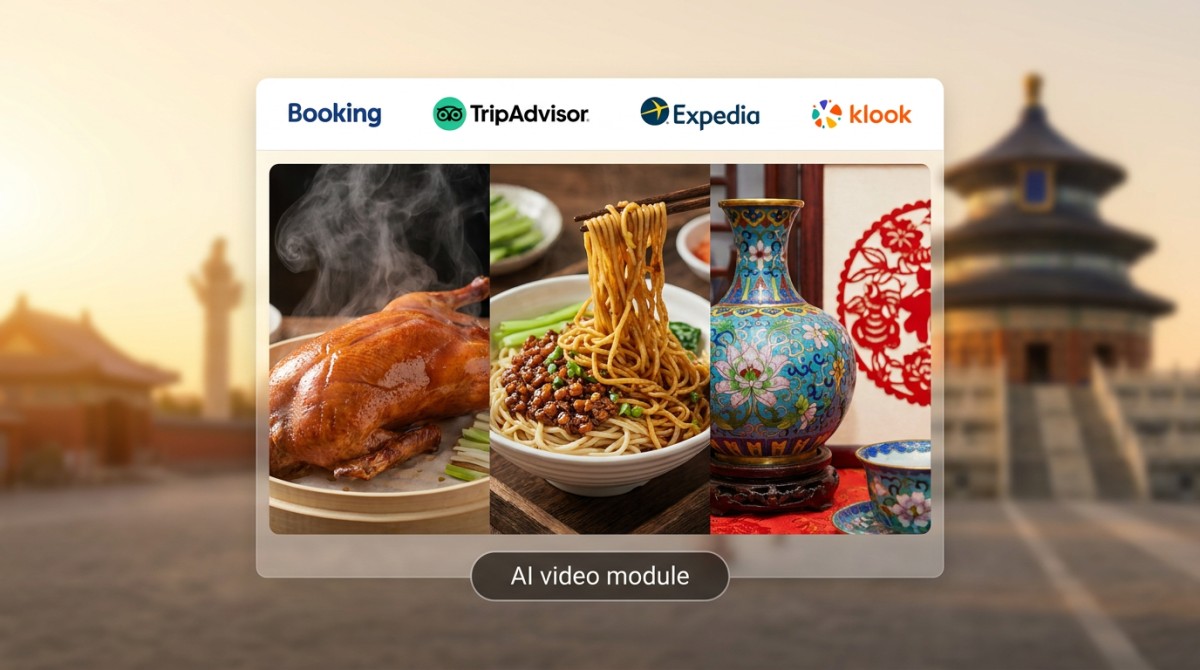
Launch of Multilingual 'Must-Eat' and 'Must-Buy' Lists via AI Video
On May 31, 2026, the Beijing Inbound Tourism Development Conference partnered with Booking, TripAdvisor, Expedia, and Klook to debut AI-generated short videos featuring Beijing’s ‘Must-Eat List’ and ‘Must-Buy List’. The lists were built using real consumer transaction data combined with AI-powered semantic analysis. They support instant retrieval in English, Japanese, Korean, French, and Spanish, and have been integrated directly into the search and recommendation engines of participating OTAs.
Impacts Across Tourism Supply Chain Roles
Direct Tourism Service Providers
These businesses — including restaurants, boutique retailers, and cultural experience operators — now face heightened visibility requirements. Since the AI-curated lists are algorithmically triggered by OTA search behavior, providers must ensure their offerings align with verified consumption patterns and multilingual metadata standards. Listing eligibility may increasingly depend on compliance with data transparency and digital tagging protocols defined by platform-level integration rules.
Destination Marketing & Content Agencies
Agencies responsible for promoting Beijing’s tourism assets must adapt to AI-driven content curation logic. Traditional campaign narratives are being supplemented — and in some cases superseded — by structured, data-validated, and linguistically localized video assets. This shifts emphasis from creative storytelling alone toward technical alignment with OTA recommendation APIs and multilingual semantic taxonomies.
Tourism Technology Integrators
Firms developing or managing PMS, CRM, or digital concierge systems for hotels and attractions need to assess compatibility with the new AI-video feed infrastructure. Integration may require updates to content ingestion pipelines, translation memory management, and real-time data synchronization with third-party OTA analytics layers.
Local Regulatory & Certification Support Services
Entities assisting businesses with tourism-related licensing, food safety certification, or cross-border e-commerce compliance must now account for multilingual digital exposure as part of risk assessment. For example, inclusion in a high-visibility ‘Must-Buy’ list may trigger enhanced scrutiny of labeling accuracy, product origin documentation, and service standard disclosures — particularly in non-English language interfaces.
Key Operational Considerations for Tourism Businesses
Alignment with OTA Recommendation Algorithms
Businesses should review how their digital profiles — including name spelling, category tags, operating hours, and review sentiment — map to the AI models powering the ‘Must-Eat’ and ‘Must-Buy’ rankings. Inconsistent or incomplete metadata may reduce algorithmic eligibility, regardless of actual service quality.
Multilingual Content Validation
Since AI-generated videos rely on semantic analysis across five languages, providers must verify that translated descriptions of dishes, products, or experiences retain accurate cultural and functional meaning — especially where idiomatic expressions or regional terminology apply. Misalignment could affect both user trust and platform-side classification accuracy.
Data Transparency & Source Verification Protocols
The use of real consumption data as a ranking input implies increasing expectations for verifiable, auditable transaction records. Tourism operators may soon be asked to demonstrate data provenance — for instance, proof of sales volume, customer nationality distribution, or review authenticity — to qualify for inclusion in future AI-curated lists.
Industry Observation: From Promotion to Algorithmic Compliance
Analysis shows this initiative reflects an emerging paradigm: inbound tourism promotion is evolving from standalone marketing campaigns into a regulated, platform-governed layer of digital trade infrastructure. What deserves closer attention is how OTA-level integration — once considered a commercial channel decision — is now functioning as a de facto compliance gateway. Observably, adherence to multilingual data structuring, semantic tagging, and real-time performance metrics is becoming a prerequisite for market access in key overseas digital environments. It is more appropriate to understand this as a soft regulatory convergence, where commercial platforms codify operational expectations that mirror formal certification criteria.
Strategic Significance for Cultural Tourism Ecosystems
This development signals a structural shift — not merely a promotional upgrade. By embedding AI-curated, multilingual lists directly into global OTA search ecosystems, Beijing establishes a scalable, self-updating mechanism for demand shaping and market qualification. The long-term implication is reduced reliance on manual outreach and increased dependence on interoperable digital readiness. Rational observation suggests that success will hinge less on scale or budget, and more on precision in data governance, linguistic fidelity, and platform-specific technical alignment.
Source Attribution & Ongoing Monitoring
This article was generated based solely on the provided title, event date (May 31, 2026), and summary description. Specific official source links were not provided in the input and should be verified continuously. Stakeholders are advised to monitor forthcoming guidance from the Beijing Municipal Bureau of Culture and Tourism, OTA platform policy updates (especially regarding AI-content integration requirements), and industry feedback on multilingual recommendation performance metrics.
Your 1:1 travel consultant will respond within 1 business day
How to plan your trip
- Hebei Launches Five “Trendy Hebei” Premium Tourism Routes for Inbound Travelers, Moving Toward Standardized Offerings
- The 12th Qionghai Tanmen Coastal Foraging Festival Opens on August 16
- Guangxi’s Digital Silk Road Accelerates: Orah Mandarin Juice Secures an Italian Order, Drawing Attention to Export Standards for Souvenirs
- New Inquiry Triggered by Coastal Cultural Tourism Space Standards
- Zhuanghe’s agro-cultural tourism model draws ASEAN attention, highlighting the compliance requirements for the internationalization of camping and intangible cultural heritage handicrafts
Monthly travel guide
- Typhoon “White Dolphin” Forces Henan Scenic Areas to Close, Putting Summer Ground-Handling Services Under Pressure
- RCEP Implementing Rules for Indonesia Take Effect: Zero Tariffs for Cultural and Tourism Services Alongside Strict Customer Service Requirements
- Saudi Arabia’s New SASO Regulations Take Effect: Taqat Certification Required Before Chinese-Language Cultural Tourism Services Can Access Visit Saudi
- Zhengzhou Launches a Dedicated LCL Shipping Route for Cultural and Tourism Materials, Cutting Freight Costs by 18%
- Luoyang Cold Chain Intensification: Cultural and Creative Exports Delivered in 9 Days
- Expedited Pre-Approval for Group Visas to Three Southeast Asian Countries
- Tightening air freight capacity at Zhengzhou Airport delays the delivery of cultural and tourism materials
- Vietnam's New Regulations on Bus Monitoring Requirements for Group Tours
- Saudi SAMA New Regulations on Travel Liability Insurance Compliance Preparation
- Japanese tourists' new regulations for entering Henan local transport vehicles
- Wai Gao Qiao Wen Travel customs bonded warehouse summer group equipment fast lane
- JTB Warning: Risks in Henan’s September Red Leaf Family Tour Purchases
Popular destinations
- China's Henan Province 144-Hour Visa-Free Transit Policy in 2026: Latest Regulations & In-Depth Travel Strategies
- The China-Europe Railway Express (Zhengzhou) Launches a Dedicated Train for Culture and Tourism Equipment, Cutting Customs Clearance Time to 48 Hours
- RCEP Cultural and Tourism Services Commitment Upgrade: Faster Market Access for Chinese Outbound Tourism Service Providers in Vietnam and Malaysia
- Japan to Introduce a Credit Point System for Chinese-Speaking Tour Guides, Trial Operation in August
- The EU Clarifies That Digital Platforms for Culture and Tourism Are Subject to GDPR Regulation
Why choose us

High cost-performance and transparent experience
Offer astonishing low prices without hidden tourism traps, enabling travelers to explore at lower costs while avoiding unnecessary spending loopholes, ensuring transparent consumption.

Personalization and dedicated service
Support 100% free customization, paired with one-on-one expert service, crafting exclusive itineraries based on travelers' specific needs, while providing professional guidance to enhance the personalization and professionalism of the journey.

Premium itinerary planning
Compact yet rich itineraries allow travelers to experience more within limited time; simultaneously, carefully selected hotels in prime locations provide convenient lodging conditions, overall enhancing travel comfort and experience.